Good graduated driver licensing laws reduced fatalities for 15 to 17-year-old drivers by 19% overall, and by 41% for 16-year-olds, according to the Insurance Institute for Highway Safety (IIHS study on graduated driver licensing outcomes). That number changes the conversation.
For many families, graduated driver licensing sounds like a list of frustrating limits. Teens hear �not yet.� Parents hear �one more thing to monitor.� But the point of graduated driver licensing is not to delay freedom for the sake of delay. It is to build freedom in layers, when skill, judgment, and experience can support it.
As a driving educator, I often tell families that the safest teen driver is not the one who rushes to the road test. It is the one who learns in the right order, with a parent who supervises well and a system that introduces risk gradually. Florida�s graduated driver licensing process works best when everyone understands the purpose behind each phase.
Why Graduated Driver Licensing is a Teen's Best Co-Pilot
A teen�s first year of driving is not just about learning how to steer, brake, and park. It is about learning how to make decisions while under pressure, while tired, while running late, and while friends are talking in the car.
That is why graduated driver licensing matters. It treats driving as a progression, not a single event. A passing score on a test does not instantly create mature judgment. The system gives teens time to build habits before they face the highest-risk situations alone.
Why the rules help instead of punish
Parents sometimes worry that restrictions will make a teen feel singled out. Teens sometimes assume the rules mean adults do not trust them. In reality, graduated driver licensing is built around a simple idea: new drivers need time in lower-risk conditions before they handle harder ones independently.
The strongest GDL programs use steps such as supervised practice, limits on late-night driving, and limits on teen passengers. Those are not random rules. They reduce exposure to the situations that challenge new drivers most.
A shared job, not a solo test
Florida�s system works best when three people do their parts:
- The teen driver: practices consistently, asks questions, and treats each drive as training
- The parent or supervising adult: coaches calmly, sets standards, and models safe driving
- The driver educator: teaches the why behind scanning, spacing, speed control, and decision-making
Key takeaway: Graduated driver licensing works best when families treat it as a coaching process, not a countdown to unrestricted driving.
Why Florida families should care
Florida�s graduated driver licensing structure gives families a roadmap. It creates a starting point for practice, a middle phase with limits, and a later phase with more independence. When parents and teens understand that structure early, the process feels less confusing and far more manageable.
The Three Core Stages of Earning Driving Freedom
Learning to drive is a lot like learning to swim. You do not start in deep water alone. You begin with support, then you practice in a safer space, and only later do you move into full independence.

Learner permit stage
This is the hands-on stage. Think of it as being in the water with an instructor close by.
A teen learns the fundamentals with supervision from a fully licensed adult. That matters because basic vehicle control is only one part of driving. A new driver also has to notice hazards early, judge speed and space, and recover from mistakes without panic.
In this stage, the supervising adult helps turn commentary into habits. A parent might say, �Check the crosswalk before turning right,� or �Ease off the gas because traffic is compressing ahead.� Over time, the teen starts doing those things without being reminded.
Intermediate license stage
This is the shallow-end stage. The teen has more freedom, but not full freedom.
The driver can handle some trips without constant supervision, yet important restrictions remain in place. That middle phase is one of the smartest parts of graduated driver licensing because it prevents a sudden jump from heavily supervised practice to unrestricted driving in every condition.
The safety logic is strong. The most restrictive GDL programs, with at least a 6-month learner stage, nighttime restrictions beginning no later than 10 p.m., and limits of no more than one teen passenger, showed a 38% reduction in fatal crashes and a 40% reduction in injury crashes among 16-year-old drivers (NHTSA overview of graduated licensing countermeasures).
Full license stage
This is the deep-end stage. The driver has earned broader privileges because experience has started to catch up with confidence.
By this point, the teen should have practiced in many conditions, developed routines, and learned that safe driving is not about luck. It is about habits. Mirror checks, speed choices, following distance, and patience become normal rather than forced.
Why the progression matters
Each stage adds challenge without removing structure too quickly. That is the heart of graduated driver licensing.
If your family is still sorting out the timing for eligibility, this guide on what age you can get your license can help clarify the age-based path.
Tip for parents: Do not treat the learner stage as a waiting period. Treat it as the most valuable training year your teen will ever have behind the wheel.
Navigating Florida's Specific GDL Requirements
Florida�s graduated driver licensing rules are easiest to understand when you look at them as a timeline. The teen starts with a learner�s license, then moves to a restricted license, then later gains unrestricted driving privileges.

Learner's license in Florida
Florida allows a teen to begin at age 15. This stage is where families build the foundation.
According to the Florida PTA summary of Florida�s GDL framework, learner�s permit holders must complete Traffic Law and Substance Abuse Education, drive during daytime only for the first three months, then may drive until 10 p.m. with required front-seat supervision by a licensed adult age 21+ (Florida PTA overview of Florida GDL requirements).
What tends to confuse families is the purpose of the daytime-first rule. It is not because night driving is �advanced� in a technical sense. It is because darkness reduces visibility, changes depth perception, and leaves less room for a new driver to recognize problems early.
Restricted license at age 16
This is the next step, but it is not automatic.
To move forward, Florida requires a minimum one-year learner's permit holding period plus 50 hours of supervised driving, including at least 10 hours at night, with no traffic convictions, as described in the same Florida PTA summary linked above. For 16-year-olds, driving is restricted between 6 a.m. and 11 p.m.
That one-year holding period often frustrates eager teens. I encourage families to reframe it. A year creates space for seasonal practice, school traffic, rain, night driving with supervision, parking lots, neighborhood streets, and larger roads. A teen who only practices in one narrow set of conditions is not fully prepared.
Restricted license at age 17
The system expands privileges as the teen gets older and gains more experience.
By this point, families should think less about �Can my teen drive alone?� and more about �Has my teen shown steady decision-making?� The law creates the framework, but the family still has to judge readiness for more complex trips such as heavy traffic, unfamiliar routes, or emotionally charged drives after a stressful day.
For teens still preparing for the permit step, this overview of the Florida learner's permit process is a useful starting point.
Florida graduated driver licensing stages at a glance
| Requirement | Learner's License (Age 15+) | Intermediate License (Age 16) | Intermediate License (Age 17) |
|---|---|---|---|
| Minimum age | 15 | 16 | 17 |
| Education requirement | Traffic Law and Substance Abuse Education required | Prior learner stage applies | Prior learner stage applies |
| Supervised driving requirement | Practice under required supervision | One-year learner period completed plus 50 supervised hours, including 10 at night | Same progression standard before advancement |
| Early driving time rule | Daytime only for first three months | Restricted between 6 a.m. and 11 p.m. | Expanded privileges compared with age 16 |
| Supervision | Front-seat licensed adult age 21+ | More independent driving within restrictions | More independent driving within restrictions |
| Traffic record expectation | Must stay eligible to progress | No traffic convictions for advancement | Continued safe record supports progression |
What parents should pay attention to
The legal checklist matters, but daily habits matter more. Watch for these signs during the learner year:
- Scanning problems: your teen looks only straight ahead and misses side hazards
- Late braking: your teen reacts instead of planning
- Speed inconsistency: your teen slows too much when nervous, then speeds up abruptly
- Peer pressure risk: your teen drives differently when talking about friends, plans, or social events
Parent coaching note: Keep your corrections short and specific. �Check the left mirror before moving over� works better than a long lecture while the car is moving.
A Step-by-Step GDL Checklist for Parents and Teens
The graduated driver licensing process feels easier when families break it into checkpoints. Instead of thinking about the whole path at once, handle the next right step.

Before the permit
Start with preparation, not pressure. A teen who rushes into the permit stage often memorizes rules without understanding how those rules work in real traffic.
A simple pre-permit checklist helps:
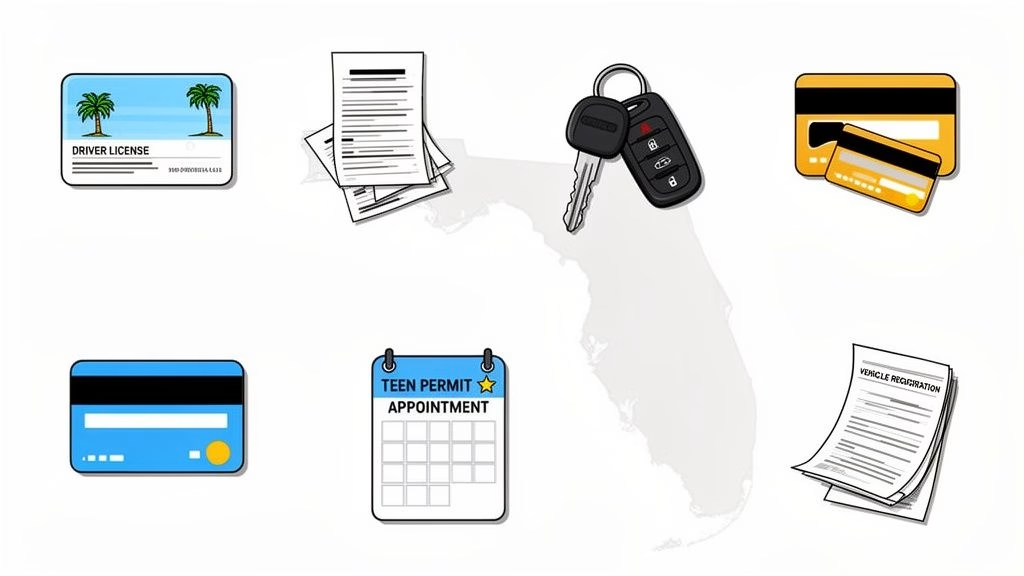
- Gather documents early so the family is not scrambling before the visit.
- Complete the required education step and confirm it is accepted for Florida requirements.
- Study road rules in small sessions instead of one long cramming session.
- Talk about expectations at home before any driving begins.
Parents should also agree on practical rules before handing over the keys for practice. Decide who will supervise, what cars the teen may use, and what kind of attitude counts as �ready to drive today.�
If your family is comparing education options beyond the teen permit path, this overview of a 5-hour pre-licensing course may help clarify how different driver education programs fit different situations.
During the learner year
Most of the significant growth occurs in this period. The hours matter, but the quality of those hours matters more.
Use a varied practice plan instead of repeating the same easy route. Rotate through:
- Quiet neighborhoods for basic control and turn positioning
- Busier local roads for lane management and traffic flow
- Parking lots and parking structures for low-speed precision
- Rainy or low-light conditions with supervision once basic skills are stable
Many parents accidentally become either too silent or too intense. Neither works well. A calm running commentary is usually best. Point out one or two important things at a time, then let the teen process and respond.
Practical tip: Keep a driving log after every session, not days later. Short notes like �left turns,� �parking,� or �night visibility� make the record more accurate and help you spot gaps in practice.
Preparing for the road test
Road test preparation should be broader than �Can my teen pass?� Ask better questions.
Can your teen:
- manage a mistake without freezing?
- check mirrors without being reminded?
- merge with confidence but not aggression?
- follow directions while still scanning traffic?
That kind of readiness matters more than perfect parking on one day.
A short visual refresher can help families talk through the process together:
After the restricted license begins
Do not stop coaching once the teen starts driving more independently. In many families, this is when the most useful conversations begin.
Try a weekly debrief. Keep it brief and nonjudgmental:
- What felt easy this week?
- What felt stressful?
- Did any other driver pressure you into a bad decision?
- Is there any trip you are not ready to do alone yet?
Those talks help teens build self-awareness. That is one of the most important driving skills they can develop.
The Life-Saving Impact of Graduated Licensing Rules
Graduated driver licensing saves lives because it gives skill time to catch up with freedom.
That matters for teens and parents alike. A new driver can memorize signs, signals, and right-of-way rules, then still struggle with timing, scanning, distraction, and pressure. GDL rules slow the process on purpose, the same way a good coach does not send an athlete into the hardest drill on day one.
Why age and inexperience matter together
According to the CDC summary included in the verified data, drivers ages 16 to 19 are three times more likely to crash fatally per mile driven than older drivers. That statistic is not a character judgment. It reflects how demanding driving really is for someone whose habits are still under construction.
Parents often see one part of the picture. Their teen may look confident after a few good drives. Teens often feel the other part. They can handle familiar roads, then feel overloaded in a new situation. GDL helps both sides respect that gap between early confidence and steady judgment.
Why nighttime limits save lives
Night driving removes some of a beginner's margin for error. Hazards appear later. Glare makes details harder to read. Fatigue can dull attention, even in motivated teens who want to do well.
As mentioned earlier, states with strong GDL laws saw meaningful reductions in teen driver fatalities. Curfews help because they limit exposure during one of the hardest driving conditions, before a teen has built enough experience to spot trouble early and respond calmly.
Why passenger limits make sense
Friends do not have to be reckless to raise the risk. They just add noise to the task.
A teen who is carrying peers is often handling conversation, music, social pressure, and the desire to seem relaxed, all while judging speed, lane position, and gaps in traffic. For an experienced adult, that load may be manageable. For a new driver, it can crowd out the mental space needed for mirror checks, braking decisions, and noticing the car that is about to pull out.

Why supervised practice changes the outcome
Supervised practice works like training wheels for judgment. The teen is still steering, deciding, and learning, but an experienced adult helps catch small mistakes before they become dangerous habits.
That is why the parent-teen partnership matters so much. A calm parent can point out what an experienced driver notices automatically, such as a stale green light, a hidden driveway, or a turn taken too fast. Over time, those reminders turn into the teen's own inner voice. Formal instruction helps families do this better, too. A quality online drivers ed course for teenagers gives parents and teens a shared language for risk, space management, and decision-making.
Key takeaway: Graduated driver licensing rules protect teens while they build real judgment, and they work best when parents and teens treat the process as a team effort, not a countdown to unrestricted driving.
How BDISchool Prepares You for GDL Success
Florida families often need more than a legal checklist. They need instruction that turns the rules into habits. That is where structured driver education can make the graduated driver licensing journey smoother.
Starting with the required first step
For many teens, the path begins with the education required before getting a learner�s permit. A good course does more than help a student check a box. It introduces the language of safe driving early, including risk awareness, substance-impaired driving prevention, and the responsibilities that come with driving privileges.
Families looking for a teen-focused online option can review online drivers ed for teenagers to see how formal instruction supports the first stage of the process.
Helping parents coach more effectively
Parents are usually the main supervising drivers during the learner stage. That is a major responsibility, and many parents feel unprepared for it.
Driver education helps by giving families a shared framework. Instead of saying �be careful,� a parent can coach more precisely:
- check your mirrors before slowing
- look through the turn
- leave more following distance
- recognize the stale green light ahead
That shared vocabulary lowers tension in the car. It also makes practice sessions more productive.
Supporting safer habits after licensing
The GDL journey does not end when a teen begins driving with more independence. The habits formed during training still matter.
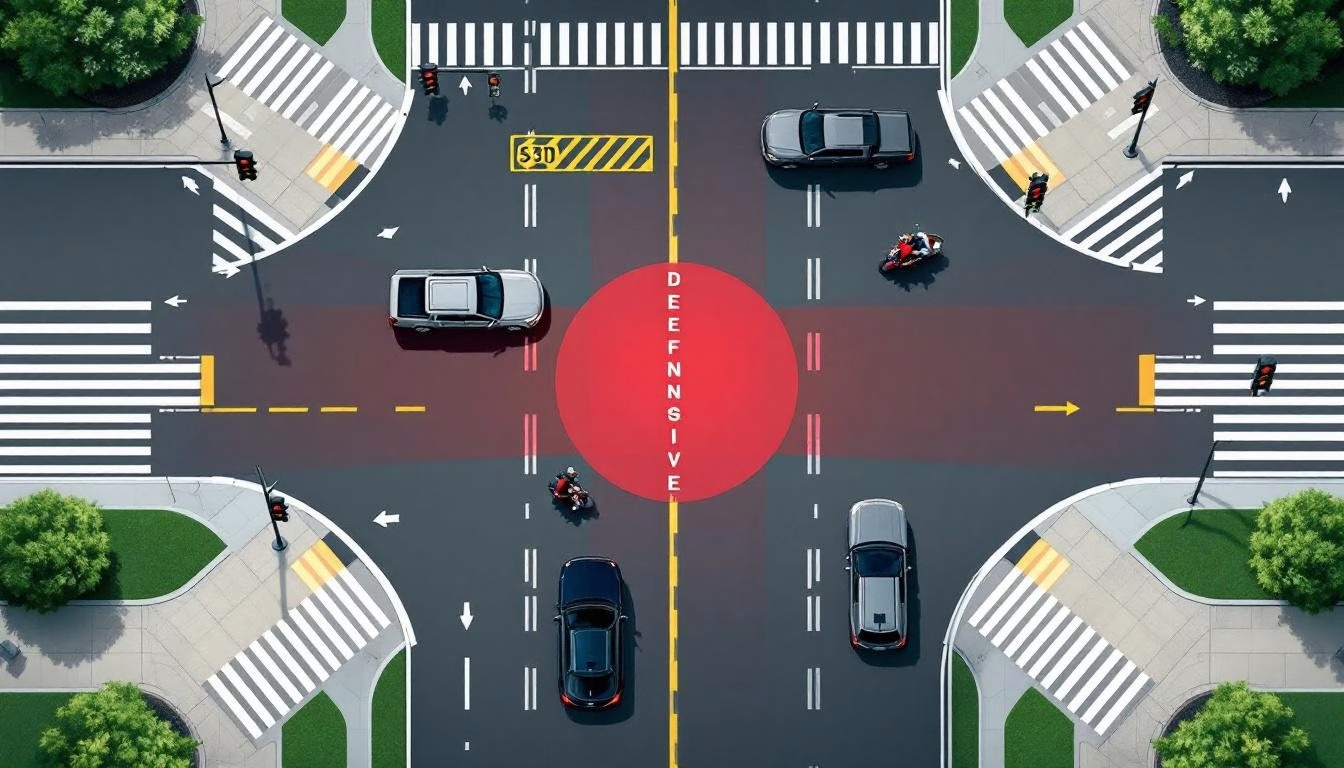
Defensive driving instruction reinforces the core ideas behind graduated driver licensing:
- anticipate hazards early
- manage space around the vehicle
- reduce distractions
- choose caution over social pressure
If a teen has a setback such as a moving violation, Florida traffic school options can also help families protect progress and refocus on safer habits. That can be especially important during the restricted-license years, when a clean record matters for moving forward.
Answers to Common Florida GDL Questions
What happens if a teen violates a GDL restriction in Florida
Families should take any restriction seriously. A violation can create legal trouble, licensing delays, and a loss of trust at home.
The exact consequence depends on the situation and how it is handled, so parents should confirm details with Florida�s licensing authorities or qualified legal guidance when needed. From an educator�s perspective, the bigger issue is what the violation reveals. If a teen breaks a curfew rule or drives beyond their limits, that usually signals a judgment problem that needs attention before more freedom is given.
Can supervised driving in another state count toward Florida practice
Possibly, but families should verify how Florida wants that practice documented. The safest approach is to keep careful records, note dates and conditions, and confirm state-specific acceptance before assuming those hours will count.
When families move, travel for long periods, or share supervision across households, documentation becomes even more important.
Will my teen's license affect our car insurance
In most cases, adding a teen driver changes the insurance picture. Exactly how much depends on the insurer, the vehicle, the household, and the driving record.
Parents should talk with their insurance carrier before the teen starts driving independently. Ask what documentation they need, whether training completion matters, and how they handle good driving records over time.
Does a teen need to retake the knowledge exam if a learner's permit expires
That depends on the permit status and current Florida licensing rules at the time the family returns to the process. Expiration issues are one reason I urge families not to let long gaps develop during the learner stage.
If a permit is close to expiring, check the current state guidance promptly instead of guessing. Small delays can create avoidable repeat steps.
How can parents keep practice sessions from turning into arguments
Use shorter drives. Pick one skill to coach at a time. Give feedback after the maneuver when possible, not during every second of it.
Many teens respond better when the parent sets a calm routine. Begin with the route, the focus skill, and the expectation that mistakes are part of learning. End by naming one thing the teen improved. That does not lower standards. It makes improvement easier to repeat.
When is a teen really ready for more independence
Readiness is more than meeting the minimum requirement. Look for consistency.
A ready driver usually does the small things without reminders. They scan early, leave space, slow down before problems develop, and handle other drivers� mistakes without reacting emotionally. If those habits are still shaky, more supervised practice is time well spent.
If your family is starting the graduated driver licensing journey or needs a flexible Florida-approved course, BDISchool offers online driver education and traffic school programs designed to help new and experienced drivers build safer habits with clear instruction and convenient access.