Getting a notice about red light cameras in Florida can definitely ruin your day, but here’s a crucial piece of information right up front: the initial ticket is a $158 fine with no points on your license. The real trouble starts if you ignore it. That’s when it escalates into a formal traffic citation, bringing higher fees and points along with it.
What Every Florida Driver Needs to Know
So, you’ve got that dreaded envelope in your hands. What now? Don’t panic. This guide is your roadmap to understanding exactly how these automated systems work, the laws behind them, and what you can do about it. Think of this as your game plan for handling a red light camera ticket and making the smartest choice for your wallet and your driving record.
We�ll break down everything from the flash of the camera to the steps you can take to keep your record clean. The goal here is to pull back the curtain on the whole process so you can feel confident about what to do next.
To make things crystal clear, let’s look at the key pieces of the puzzle:
- How the Technology Works: We’ll explain what triggers the camera and how the evidence is gathered and reviewed before a notice ever lands in your mailbox.
- The Legal Framework: You need to know the rules of the game. We�ll touch on the specific statutes that allow red light cameras in Florida to operate. For a much deeper dive, you can explore the full details about Florida state driving laws.
- Your Response Options: There’s a huge difference between paying the initial notice and letting it become a more serious citation. We’ll lay out what happens with each choice.
- Protecting Your Record: If your ticket does escalate, all is not lost. We�ll show you how completing a Basic Driver Improvement (BDI) course can be a lifesaver for removing points and preventing your insurance from going up.
The most important thing to remember is that what you do first matters most. A quick, smart response to that initial notice can save you a ton of money and keep your driving record and insurance rates out of trouble.
By getting a handle on the system, you can approach the situation with a strategy instead of just reacting.
To make it even easier, here�s a quick overview of what you’re facing. This table summarizes the critical stages and consequences, helping you see your options at a glance.
Florida Red Light Camera Violation At a Glance
| Violation Stage | Penalty | Points on License | What You Need to Do |
|---|---|---|---|
| Notice of Violation (Initial Notice) | $158 fine | 0 points | Pay the fine within 30 days. No further action needed. |
| Uniform Traffic Citation (If Unpaid) | $277+ (approx.) | 3 points | Pay the higher fine and accept points OR elect to take BDI school. |
| After BDI School Election | $277+ (approx.) | 0 points (withheld) | Complete a state-approved BDI course to remove the points. |
This table lays out the clear path: acting early keeps things simple and cheap. Letting it slide complicates things and costs you more in both money and points.
How a Red Light Camera Actually Catches You
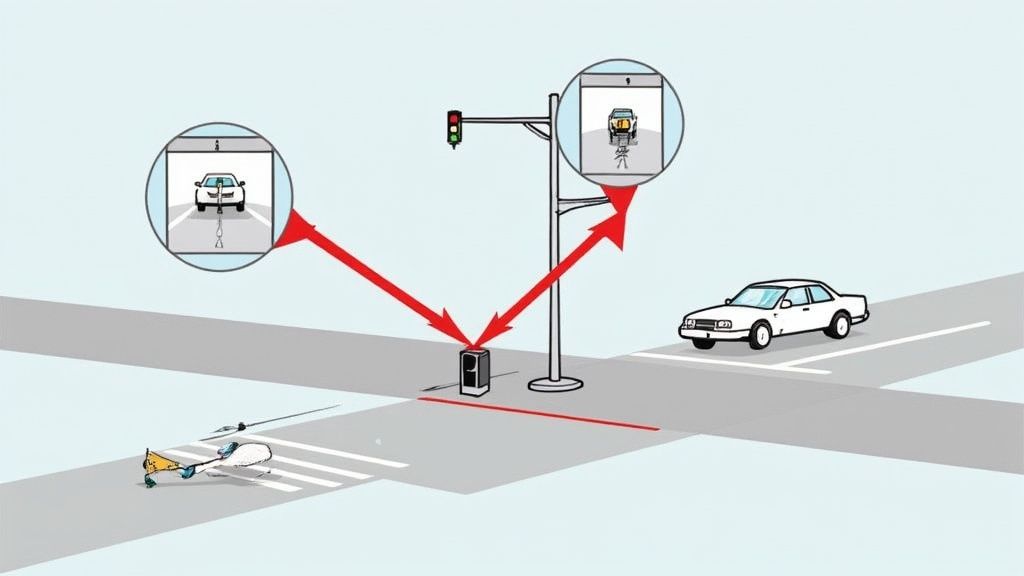
Ever been driving and seen that unmistakable flash from a traffic camera? It’s easy to think it’s just a simple camera snapping pictures, but there’s a lot more going on behind the scenes. Think of it as a smart, automated system with a digital tripwire that�s wired directly into the traffic signal itself.
This whole setup relies on some pretty advanced sensors. Sometimes they�re electromagnetic loops cut right into the pavement before the intersection, and other times they�re radar units mounted up on a pole. Whatever the tech, their job is the same: to know exactly where your car is and how fast it’s moving as you get to that stop line.
The second that light turns red, the system goes live. It establishes an invisible “do not cross” line right at the white stripe on the road. If any part of your car crosses that line while the light is red, you’ve just tripped the wire, and the cameras get to work.
The Two-Shot Evidence System
When a camera is triggered, it doesn’t just snap a single, random photo. It�s a very specific, two-step process designed to build a clear-cut case that a violation happened.
- The First Photo: The camera takes this picture the very instant your front tires cross the stop line. The goal is to show your vehicle clearly entering the intersection while the traffic signal is red.
- The Second Photo: Just a moment later, a second shot is taken. This one captures your car in the middle of the intersection, proving you continued through against the light.
This two-photo approach is pretty effective at showing that the car didn’t just accidentally roll a few inches past the line but actually proceeded through the intersection.
But it’s not all about still images. The system also records a short video clip, usually about 12 seconds long, that captures the entire event. This video is often the most critical piece of evidence if you decide to fight the ticket.
From Flash to Mailbox
Once the flash goes off, the process has really just begun. The camera system bundles up all the evidence it just gathered�the high-res shots of your license plate, the exact date and time, and even data like how long the yellow light was on before it turned red.
This package of information is first sent to a private, third-party company that manages the camera systems. They handle the initial processing, but they don’t have the authority to issue a ticket. That�s a common misconception.
The final, and most crucial, step is a manual review. Before a single notice goes in the mail, a sworn law enforcement officer from that city or county must personally examine all the evidence. They watch the video, look at the photos, and check the data to make the final call on whether you actually violated Florida law. Only if they give it the green light is a Notice of Violation mailed to the vehicle’s registered owner. This human oversight is a legal requirement for red light cameras in Florida, and it’s meant to ensure a trained officer validates every violation.
The Laws and Trends Behind Florida’s Camera Systems
When it comes to red light cameras in Florida, local governments can’t just set them up wherever they please. The entire system is governed by a single state law: the Mark Wandall Traffic Safety Program. This is the official rulebook that lays out everything from where cameras can be installed to the requirement for clear, visible signs warning drivers that an intersection is being monitored.
This law creates a standard playing field, ensuring that what counts as a violation is the same in Miami as it is in Pensacola. But that�s just one piece of the puzzle. The use of these cameras is a hot-button issue across the state, leading to a landscape that�s always in flux. Some cities are all-in, adding more cameras to busy intersections, while others have completely pulled the plug on their programs after facing public pressure and questions about whether the cameras truly make roads safer.
The Scale of Automated Enforcement
To really get a sense of the situation, you have to look at the numbers. Automated camera systems are now, by far, the most common way drivers get ticketed for running red lights in Florida. They’ve completely overshadowed the traditional traffic stop for this specific offense. The data clearly shows a massive shift from police officers writing tickets on the roadside to automated notices arriving in mailboxes.
Let’s look at the data from a recent fiscal year. As of June 30, 2023, Florida had 476 active red-light cameras in operation. Those cameras cranked out a staggering 976,478 Notices of Violation.
Now, compare that to the number of citations written by human police officers during that same time: just 50,751. You can dig into the complete official report to see the full data breakdown for yourself.
This means you are more than 19 times more likely to get a red light ticket in the mail from a camera than from a police officer pulling you over.
This trend is exactly why knowing the rules, your rights, and what to do next is so important. The odds are clearly on the side of automated enforcement, so every driver needs to understand how to handle these citations. The debate over red light cameras in Florida isn’t going away, but for now, they are a powerful and widespread presence on our roads. For a deeper look into this topic, check out our complete guide on red light cameras in Florida.
Your Options After Getting a Red Light Camera Notice
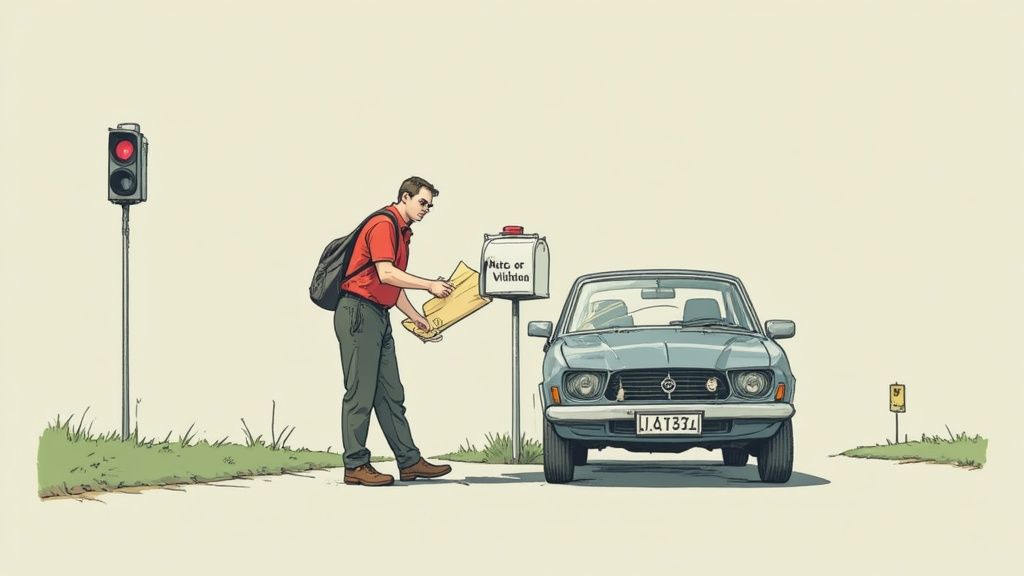
That sinking feeling when you open the mailbox and find an official-looking envelope with a picture of your car in an intersection… we’ve all been there. It�s unsettling, but the first thing to know is what you’re actually holding.
This initial letter isn’t a full-blown ticket just yet. It’s a Notice of Violation (NOV). Think of it as a preliminary warning shot from the city�a chance to settle things quickly and easily.
The good news? An NOV comes with a standard $158 fine and�this is key�zero points on your license. At this stage, it’s a civil penalty, more like a parking ticket than a moving violation. Your driving record is safe, and your insurance company won’t hear a peep about it. But what you do next is everything.
Three Paths Forward
With that NOV in your hand, you’ve got a decision to make. You can’t just toss it on the counter and forget about it. There are basically three ways this can go, and each has a wildly different outcome.
Your choices are:
- Pay the Fine: This is the simplest path. You pay the $158 online or through the mail, and the issue is resolved. No points, no stress, and you can move on.
- Transfer Liability: Was your friend or family member driving? You can submit a sworn affidavit identifying the actual driver, which transfers the responsibility to them.
- Do Nothing: This is, without a doubt, the worst possible move. Ignoring the NOV is a guaranteed way to make a manageable problem much, much worse.
This decision tree gives you a clear visual of how these choices play out.
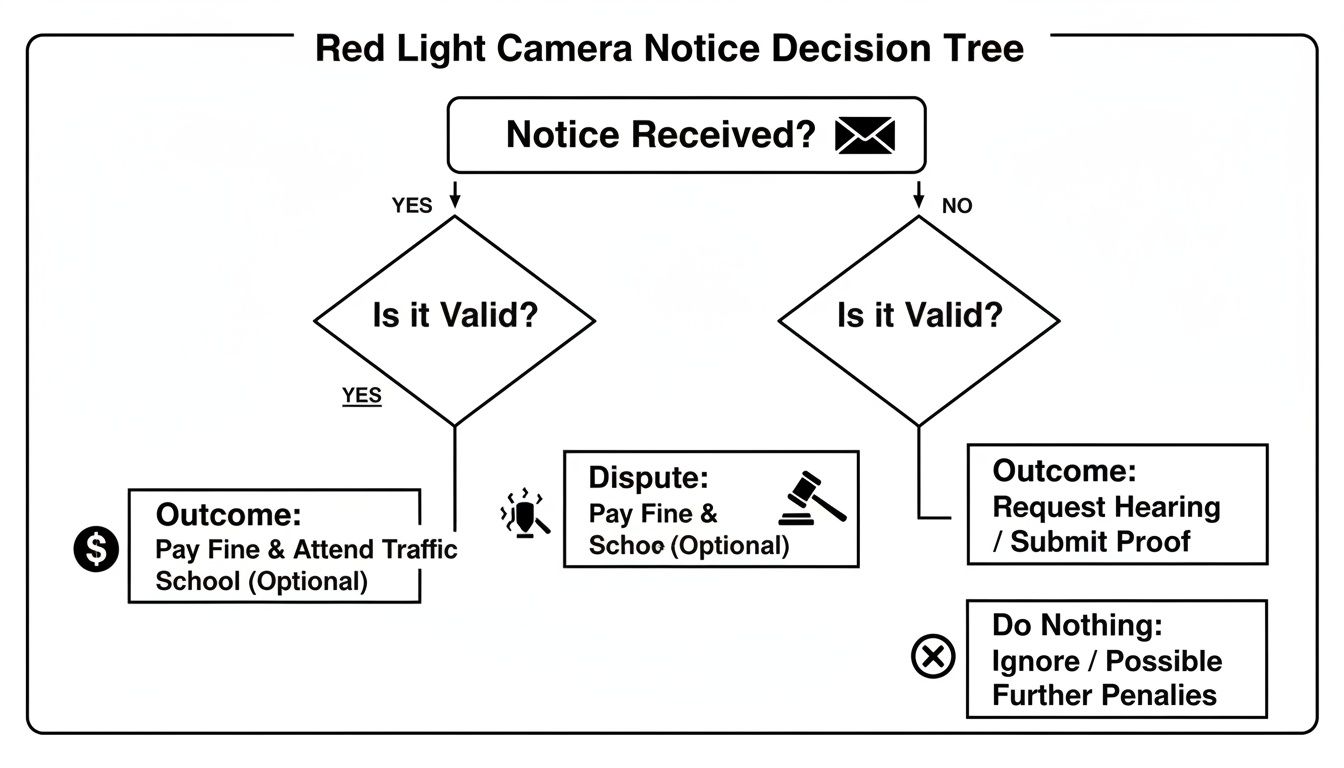
As you can see, being proactive keeps the damage minimal. Letting it slide? That’s when the real penalties kick in.
The High Cost of Ignoring the Notice
If you don’t respond to the NOV within the deadline (usually 30 days), the local government doesn’t just send a friendly reminder. They automatically escalate it.
Your simple civil penalty morphs into an official Uniform Traffic Citation (UTC).
What’s the big deal? A UTC is a formal moving violation. It gets reported straight to the Florida Department of Highway Safety and Motor Vehicles (FLHSMV) and becomes a permanent mark on your driving record.
The consequences of this escalation are steep. The fine jumps from $158 to around $262, and three points are slapped onto your license. Those points are exactly what insurance companies look for when they calculate your rates, so a hike in your premium is almost certain.
Understanding the two stages of a red light camera ticket is key to avoiding higher costs and points on your license.
Notice of Violation (NOV) vs Uniform Traffic Citation (UTC)
| Attribute | Notice of Violation (Initial Notice) | Uniform Traffic Citation (After Inaction) |
|---|---|---|
| Fine Amount | $158 | Approx. $262 (varies by county) |
| Points on License | 0 | 3 |
| Violation Type | Civil Penalty (like a parking ticket) | Moving Violation |
| Reported to FLHSMV | No | Yes |
| Insurance Impact | None | Likely rate increase |
Ultimately, a small problem becomes a big one with long-term financial consequences. Making a decision to ignore that first notice is a costly mistake that directly damages your driving record.
For a deeper dive, check out our guide on how to handle a red light ticket. And if you’re already at the citation stage and weighing your options, exploring professional legal services for traffic violations could be a smart next step.
The Great Debate: Safety vs. Revenue
So, what’s the real story with Florida’s red light cameras? Are they life-saving safety tools or just a clever way for cities to make a buck? That’s the million-dollar question at the heart of the fierce debate, and the answer depends entirely on who you ask.
This isn’t just a simple disagreement over traffic rules. It�s a fundamental clash over the true motivation behind these automated systems.
The Case for Safety
Ask any law enforcement agency or traffic safety group, and they’ll tell you these cameras save lives. Their argument is straightforward: the cameras deter the most dangerous kinds of intersection crashes.
The main target here is the notorious “T-bone” collision. These right-angle crashes are incredibly violent and far more likely to result in serious injury or death than almost any other type of accident. Proponents argue that the constant threat of a ticket makes drivers think twice before punching the gas on a yellow light.
And there is some data to back this up. Studies have shown that well-managed camera programs can cut down on fatal red-light-running accidents by as much as 21% in large cities. The idea is that the fear of a fine gradually changes driver behavior for the better.
But it�s not quite that simple. Those same studies often show an ironic twist: while T-bone crashes go down, rear-end collisions often go up. It happens when a driver sees the flash or remembers the camera at the last second, slamming on the brakes to avoid a ticket and getting hit by the surprised driver behind them.
This trade-off�swapping severe T-bones for more frequent, but usually less serious, fender-benders�is a major sticking point in the debate.
The Argument About the Money
Now, let’s talk about the other side of the coin: the money. There’s no denying that red light camera programs are a massive source of income for local governments and the private companies that install and manage them. This has left a lot of Florida drivers feeling like the cameras are more about padding city budgets than protecting public safety.
The numbers don’t lie. For some smaller towns, the revenue is game-changing. Take the city of West Miami, for example. With a population of just 7,000 people, officials projected that their six red light cameras would rake in $1.45 million in a single year. That�s a staggering figure that made up more than 15% of the city’s entire annual budget. You can read more about these financial impacts and how they affect local communities.
When a traffic program becomes a major budget line item, public trust tends to erode. This financial dependency has fueled skepticism and sparked political fights all over Florida. In fact, due to public pressure and lingering questions about their real impact on safety, several major cities have already pulled the plug on their camera programs.
This constant tug-of-war between safety claims and financial realities means the debate over red light cameras in Florida isn’t going away anytime soon.
How Traffic School Can Erase Points and Protect Your Insurance Rates
So, you missed the first deadline, and that red light camera notice has morphed into an official Uniform Traffic Citation (UTC). Before you panic, take a breath. You have a powerful card left to play�one that can shield both your driving record and your wallet from the long-term sting.
That card is the state-approved Basic Driver Improvement (BDI) course, which most people just call traffic school. Think of it as a safety net. When you choose to take this course, you can stop the points from that citation from ever touching your permanent driving record.
This is, hands down, the best way to keep your insurance premiums from shooting through the roof. Insurance companies look at points on your record to justify rate hikes. A clean record gives them no reason to raise your rates. No points, no problem.
Who Qualifies for This Option
Now, Florida doesn’t hand this option out for every single ticket. There are specific rules in place to make sure it’s used for the occasional slip-up, not for a pattern of bad driving.
Generally, you’re eligible to elect traffic school if:
- You haven’t taken a BDI course in the last 12 months.
- You haven’t used this option more than five times in your entire life.
If you check both of those boxes, you can choose the traffic school route and the court will withhold the points. This is a choice you have to actively make when you respond to the court about your UTC.
Choosing traffic school is like telling the court, “I’ll take responsibility for this and complete a safety course to keep the points off my record.” It’s a formal deal that, once you hold up your end, protects your driving history.
The Simple Path to a Clean Record
The process itself is refreshingly simple. First, you have to let the Clerk of Court in the county that issued the ticket know you’re electing to attend traffic school. It’s important to remember you’ll still need to pay the full fine for the citation.
Next, you just have to enroll in a state-approved program. The good news is you can find a flexible, state-approved BDI traffic school online and knock out the course on your own schedule. Once you’re done, you send the completion certificate back to the clerk, and just like that, the points are officially kept off your record. It’s also worth noting that violations can complicate other things, like getting a car rental after an accident, where your insurance and driving record play a huge role.
Your Top Questions About Florida Red Light Cameras, Answered
Getting a ticket in the mail can be confusing and stressful. Let’s cut through the noise and tackle the questions we hear most often from Florida drivers, so you know exactly where you stand.
Will My Car Insurance Rates Go Up?
This is the big one, and the answer comes down to how you handle the ticket. Think of it in two stages.
When you first get the $158 Notice of Violation (NOV) in the mail, it’s not yet a formal moving violation. If you pay it on time, no points are added to your license, and insurance companies are never notified. Your rates won’t be affected.
But if you ignore that initial notice, things change. The violation gets upgraded to a Uniform Traffic Citation (UTC), which is a real-deal moving violation. This does add points to your record, and you can bet your insurance company will see it. At that point, a rate hike is almost guaranteed.
Can I Really Get a Ticket for Turning Right on Red?
Absolutely. In fact, this is one of the most common ways people get snagged by red light cameras.
Making a right on red is perfectly legal in Florida, but there’s a catch: you have to come to a complete stop behind the white line first. Many of us are guilty of the “rolling stop,” where we slow down but never fully cease moving. The cameras are designed to catch exactly that.
A sworn law enforcement officer always reviews the footage. They’re looking for one specific thing: did your wheels stop turning completely before you entered the intersection? If not, you can expect a ticket in the mail.
What if I Wasn’t the One Driving My Car?
The ticket is automatically mailed to the registered owner of the car�that’s you. But you’re not on the hook for a violation you didn’t commit. The key is to act fast.
You’ll need to fill out and submit an Affidavit of Non-Responsibility before the due date on your notice. This is a sworn legal statement where you must name the person who was actually driving. Once you file it correctly, the notice against you is dropped, and a new one is sent to the person who was behind the wheel.
If that initial notice has already become a full-blown citation with points, don’t just accept the hit to your driving record. BDISchool offers a straightforward, state-approved online Basic Driver Improvement course designed to get those points removed and help you avoid an insurance spike. Protect your record and enroll today at https://bdischool.com.