
You finally have a free Saturday. You found a bike you like, priced out a helmet, and started picturing your first legal ride across town or out toward the Hill Country. Then Texas adds a reality check. Before you ride on public roads, you need to handle training, documents, and the right DPS steps in the right order.
That can feel like a hassle at first. It helps to view the license process the same way you would view pre-ride checks on a motorcycle. A few careful steps up front save time, money, and frustration later.
A texas motorcycle license is the point where interest turns into legal, safer riding. It also gives you a clear choice. You can complete an approved motorcycle safety course and use that completion to meet key licensing requirements, or you can pursue the direct DPS testing route if you qualify.
For a busy adult, that choice matters for practical reasons, not just legal ones. One path often costs more at the start but can save time and reduce the odds of retesting. The other may look cheaper on paper, but it can take longer if you need multiple appointments, extra practice, or another try at the skills test.
That tradeoff is where many new riders get stuck.
The goal here is to make the process easier to judge before you spend money or book time off work. Instead of listing rules and leaving you to sort them out, this guide compares the two main paths by time, total cost, and the likelihood of finishing in one clean attempt. Just as important, it explains why the training piece matters. New riders often underestimate slow-speed control, quick stops, and hazard awareness until they have to perform those skills under pressure.
Your Journey to Riding Legal in the Lone Star State
You finish work on a Friday, the weather is perfect, and a motorcycle in the garage is calling your name. Then the practical question shows up fast. What do you need before you can ride on Texas roads without risking a ticket, a failed appointment, or a very expensive mistake?
Texas asks you to earn the right to ride first. That is frustrating for some new riders, but it works like learning the friction zone in a parking lot. Slowing down at the start gives you more control later.
If you want to ride legally on public roads, you are working toward a Class M license or endorsement. That credential shows Texas has cleared you to operate a motorcycle, not just a passenger car. A regular driver license does not automatically cover two-wheel riding, and that catches plenty of first-time riders off guard.
The bigger point is not just legality. It is efficiency.
New riders often assume the fastest path is the one with the lowest upfront price. In practice, the better option is usually the one that gets you legal with the fewest delays, the least retesting, and the best chance of showing up prepared the first time. For a busy adult, that difference matters. One route asks for more money early but often saves hours of scheduling and lowers the odds of failing a skills test. The other can appear cheaper until you add extra practice time, another DPS visit, or time away from work.
That is why the licensing process deserves the same respect as your first helmet purchase. You are not just buying permission to ride. You are choosing how much structure, coaching, and test pressure you want in the process.
For many people, the decision comes down to two paths. You can complete an approved motorcycle safety course, or you can pursue the direct DPS testing route if you qualify. Both can lead to the same legal result. They do not usually feel the same on your calendar, in your wallet, or on test day.
A smart question is not �What is the cheapest way?� A better question is �Which path helps me finish once, with solid skills, and without wasting time?�
Confirming Your Eligibility and Gathering Documents
Before you think about road tests, permits, or course schedules, make sure your basics are in order. Most DPS frustration comes from one of two problems. A missing document, or an assumption that the office will �probably accept� something close enough.
That�s not how this process works.
Start with the essentials
For adults seeking a texas motorcycle license, the common starting point is an existing Texas driver license or applying while handling your driving credential paperwork. You should also expect to complete the required application steps in person at DPS, including identity review and vision screening.
Bring documents that clearly establish who you are and where you live. If your name differs across documents, resolve that before your appointment rather than hoping the clerk can sort it out on the spot.
A simple checklist helps:
- Primary identity document: Use a government-issued document that clearly proves your identity, such as a passport or another accepted identity record.
- Texas residency proof: Bring a document that ties you to your address, such as a utility bill.
- Social Security documentation: A Social Security card is a common example people use.
- Current Texas driver license or ID: If you already hold one, bring it with you.
- Course completion proof if you took the waiver path: Keep your certificate flat, readable, and easy to access.
Common points of confusion
New riders often ask whether a digital copy on a phone is enough. Don�t assume it is. If a document matters, bring the physical version or the form DPS expects.
Another confusion point is timing. People sign up for a motorcycle course, assume that means they�re �in the system,� and then wait too long to gather paperwork. The course is one piece. Your identity and residency documents are a separate piece. Handle both early.
Bring more organization than you think you need. A folder with labeled documents feels excessive until you�re standing at the counter and need one specific paper fast.
If you�re under 18
Minor applicants face a different process than adults and may need extra approvals or restrictions before receiving full riding privileges. If that�s your situation, check directly with Texas licensing authorities before scheduling anything. Don�t rely on advice meant for adults, because the path isn�t identical.
A pre-appointment document check
Use this short self-test the night before you go:
| Question | What you want |
|---|---|
| Can you prove identity clearly? | Yes, with accepted identification |
| Can you prove Texas residency? | Yes, with current address documentation |
| Do names match across documents? | Yes |
| Do you have your current license or ID? | Yes |
| If using the course path, do you have the completion certificate? | Yes |
If any answer is �not sure,� pause and fix it before booking your ride or taking time off work. That�s how you avoid the most preventable kind of delay.
The Two Paths to Your Texas Motorcycle License
This is the choice that shapes the entire experience. Most guides mention both paths and stop there. That leaves out the part riders care about. Which route makes the most sense if your schedule is tight, your budget matters, and you want the best chance of finishing without repeats?
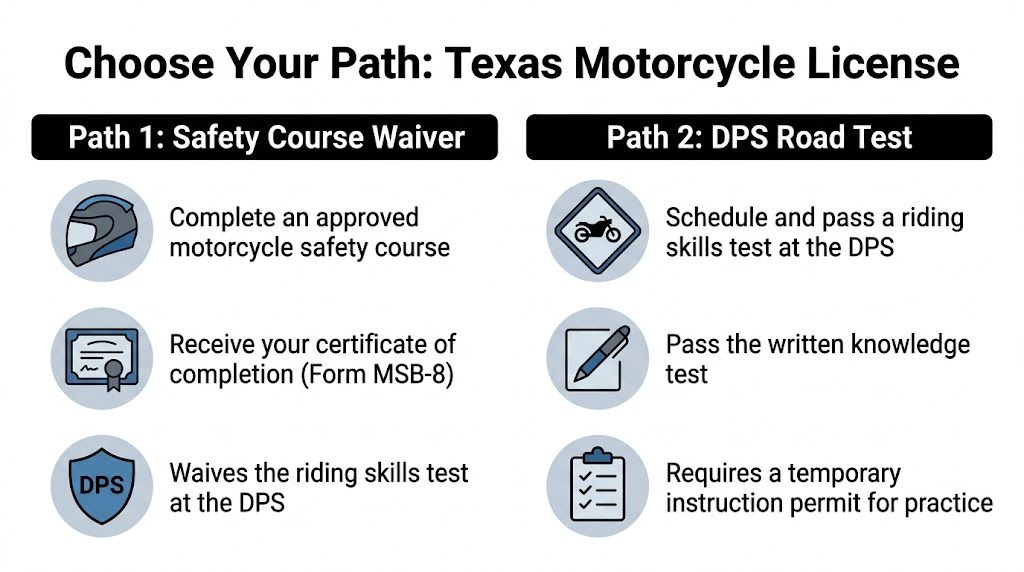
Texas gives many adult riders two main options. You can complete an approved motorcycle safety course and use that completion to waive key DPS testing requirements. Or you can try the direct DPS testing path.
Path one and path two in plain terms
The safety course waiver path asks for more commitment upfront. You spend time in structured training, then bring your completion certificate to DPS. That certificate can waive both the knowledge and skills tests if you meet the applicable requirements.
The direct DPS test path looks more straightforward. You prepare on your own, take the required tests, and try to pass without the course waiver.
The Texas Department of Public Safety notes that the course path requires around 10 hours of time and involves $30 to $50 in fees plus course cost, while also waiving the DPS knowledge and skills tests for qualifying riders, as explained on the Texas DPS motorcycle license page.
The real trade-off is efficiency
A lot of people assume the direct testing route saves time because it skips a class. Sometimes it does. But that depends on one thing. Whether you pass promptly and whether appointments line up with your preparation.
If you�re already comfortable with clutch control, low-speed balance, tight turns, quick stops, and road rules, self-prepping may feel reasonable. If you�re new, rusty, or nervous, �saving time� can turn into extra scheduling, retesting, and a lot of avoidable stress.
Here�s the side-by-side view most riders need:
| Decision point | Safety course waiver path | Direct DPS test path |
|---|---|---|
| Upfront time | Higher, because of the course | Lower at first |
| Upfront cost | Higher, because of course cost plus fees | Lower at first |
| Test waiver | Yes, for qualifying riders | No |
| Best fit | Beginners, returning riders, busy adults who want structure | Confident riders comfortable preparing on their own |
| Main risk | More money spent upfront | More chances for delays if you don�t pass promptly |
Cost versus value
Let�s consider the cost. The course path costs more because you�re paying for instruction. For some riders, that feels frustrating. But the value isn�t only in the waiver. It�s in guided practice, immediate correction, and learning the exact kinds of low-speed control problems that trip people up later.
The direct path can be the lower-cost option at the beginning. But lower upfront cost isn�t always lower total hassle. If you need more than one try, or you wait on another appointment, the practical cost rises even if the paperwork fee doesn�t.
The cheapest option is only the cheapest if it works the first time and doesn�t force you into delays.
Time for busy riders
If your weekdays are packed, the best route is usually the one with fewer moving parts after you�ve completed the initial training. Riders with demanding schedules often do better when they can finish the course, collect the certificate, and handle DPS in one clean administrative visit.
If scheduling is your bottleneck, it also helps to handle your appointment planning early. Some people use planning resources like this guide on how to schedule a DMV road test to think through timing and document readiness before they deal with state appointment systems.
Which path should you choose
Choose the safety course if any of these sound like you:
- You�re a true beginner: You haven�t built safe habits yet.
- You�re returning after years away: Old riding experience doesn�t always mean current skill.
- You get anxious in test settings: Coaching usually beats guessing.
- You want the most reliable route: Fewer testing hurdles usually means fewer surprises.
Choose the direct DPS testing path only if this sounds more accurate:
- You already ride confidently at low speed
- You�re comfortable learning independently
- You understand Texas testing expectations
- You accept the risk of retesting or delay
For most first-time adult riders, the course path isn�t just the safer choice. It�s usually the more efficient one when you count your time, your stress, and your odds of getting through the process cleanly.
A Deep Dive into the Safety Course Waiver Path
Saturday morning arrives. You�re standing in a parking lot with a helmet in your hands, wondering whether a safety course is just one more thing to schedule or the shortcut that saves you from wasting time later. For many first-time riders in Texas, it ends up being the faster route because it turns learning and evaluation into one guided process instead of several separate hurdles.
The waiver path works well for a simple reason. It teaches the same core skills you need on the road while also reducing what you must do later at DPS. If your goal is to get legal with the fewest retests, fewer nerves, and a better chance of riding safely right away, this path deserves a close look.
What the course changes
A TDLR-approved motorcycle safety course is more than a class. It works like supervised practice with a built-in checkpoint at the end. Instead of trying to teach yourself braking, clutch control, and low-speed turning, you learn them in a controlled setting with an instructor correcting mistakes before they become habits.
For a busy adult, that matters.
The direct DPS testing path can look cheaper at first glance because you skip course tuition. But that only holds if you already ride well enough to pass on the first try, have access to a legal motorcycle, and do not lose extra time to practice, rescheduling, or another testing day. The course path usually costs more upfront and less in uncertainty. That tradeoff is often worth it.
As noted earlier in the article, the Tipton Motorsports Texas motorcycle licensing summary explains that the course includes riding instruction, can waive the testing requirement at DPS for qualifying riders, and uses a completion certificate that remains valid for a limited period. The practical takeaway is straightforward. You do more guided work early so the state visit is usually simpler later.
What you actually practice
New riders often assume the hard part is memorizing rules. Usually, the harder part is making the bike do what your brain wants when you feel nervous.
That is why the course spends time on fundamentals such as:
- Starting and stopping smoothly: You learn how throttle, clutch, and brakes work together.
- Straight-line braking: You practice stopping with control instead of grabbing at the lever in a panic.
- Low-speed turns: This helps with parking lots, intersections, and test-style maneuvers.
- Swerving and quick direction changes: You learn how to avoid a problem without creating a new one.
- Looking where you want to go: Instructors repeat this constantly because beginners tend to stare at the hazard.
A motorcycle responds a lot like a shopping cart in one specific way. If you look down at the front wheel and tense up, your control gets worse fast. If you keep your eyes up and plan your path, the machine becomes easier to manage. The course gives you repeated chances to feel that difference.
Why the waiver path often wins on time and success
Here is the question busy riders usually ask: which path gets me licensed with the least friction?
For many beginners, the answer is the course.
You commit a block of time up front, but in return you usually avoid the separate DPS riding test and the preparation stress that comes with it. That makes the process more predictable. Predictability matters if you are balancing work shifts, family obligations, or limited access to a motorcycle for testing.
It also improves your odds of finishing cleanly. Riders who learn under supervision tend to make fewer basic mistakes than riders who practice alone and hope they guessed the test standard correctly. Even if the direct test path looks shorter on paper, it can stretch out quickly if you need more practice, miss a detail, or do not pass the first time.
For readers comparing how training requirements differ by state, this guide to a motorcycle license in Florida gives a useful contrast. The rules are different, but the same principle shows up in both places. Formal training often saves time by reducing avoidable mistakes.
A good course does not just help you qualify. It helps your first few weeks of real riding feel calmer and more controlled.
How to get the most out of the class
Treat the course like your first riding habit, not just a box to check.
A few simple choices make a big difference:
- Arrive rested. Fatigue makes clutch work and slow-speed balance harder.
- Expect the first drills to feel awkward. That is normal, not a sign you are failing.
- Focus on one correction at a time. If the instructor says �look through the turn,� work on that before anything else.
- Ask questions early. Confusion gets more expensive once a mistake becomes muscle memory.
- Dress for practice, not for photos. Wear what the provider requires and choose comfort you can move in.
This short video can help you get in the right mindset before training day:
What you leave with
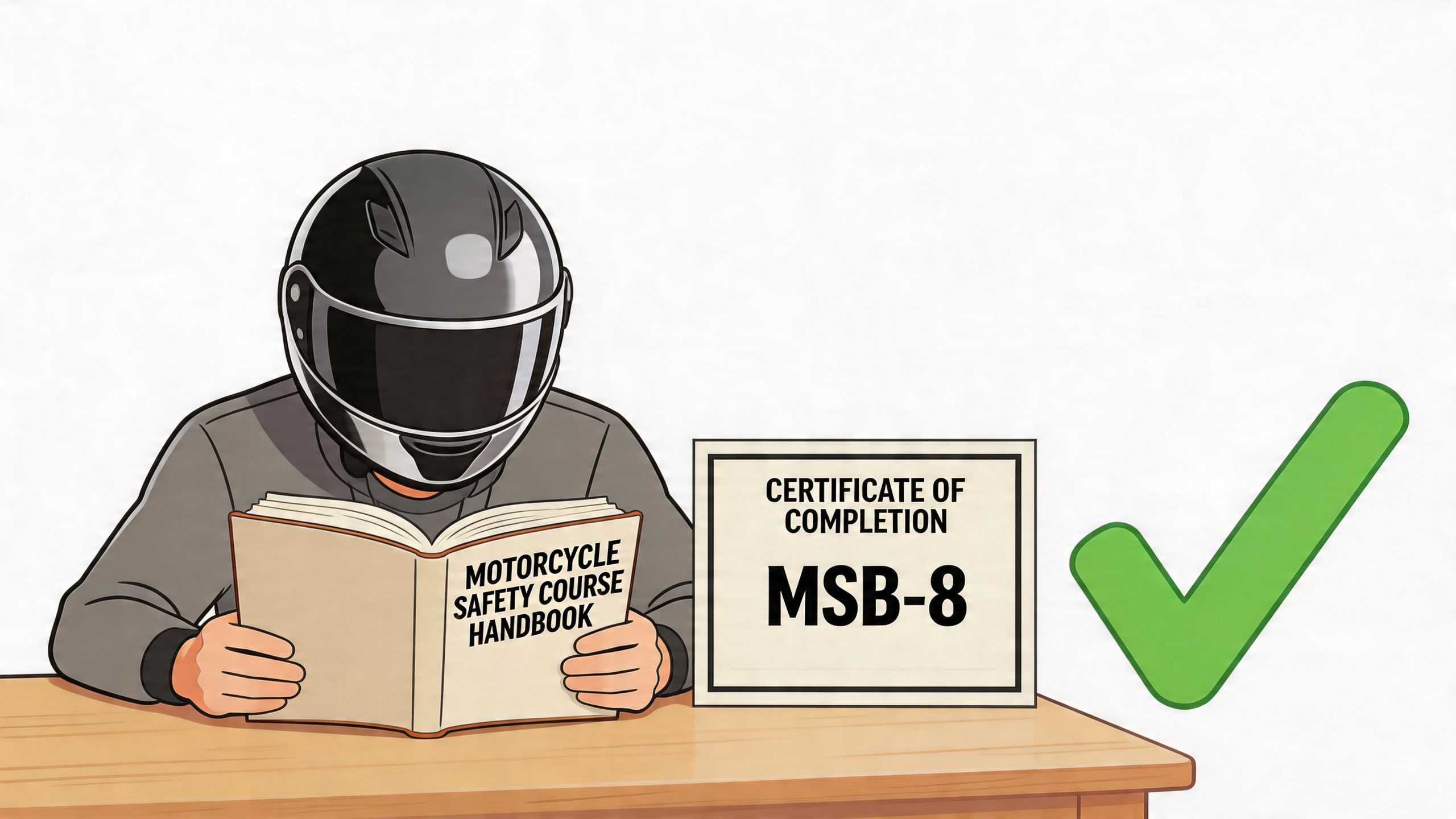
If you complete the course successfully, you receive an MSB-8 or MSB-8R completion certificate. That certificate is the document that makes the waiver path work, so treat it like any other licensing record.
Do not stuff it into a backpack and forget about it.
Put it with the documents you plan to bring to DPS. Riders sometimes finish the hardest learning part, then create delays by misplacing paperwork or waiting too long to use it.
Who gets the most value from this route
The course path is usually the stronger choice for these riders:
| Rider type | Why the course helps |
|---|---|
| First-time rider | Builds safe habits before traffic exposes your mistakes |
| Returning rider | Replaces rusty instincts with current technique |
| Nervous test-taker | Shifts pressure from one state test to coached practice |
| Busy professional | Bundles learning and evaluation into a more predictable schedule |
If you already ride confidently, have strong low-speed control, and are comfortable handling the direct testing route, DPS testing may still make sense. If you are starting from zero or close to it, the safety course usually gives you the better cost-benefit outcome in real life, not just on paper.
Navigating Your DPS Appointment and Final Steps
You finish your course on Saturday, feel relieved, and assume the hard part is over. Then Tuesday arrives, your DPS appointment is next, and you realize one missing document can undo all that progress.
That is why this step deserves the same attention as your riding practice.
For busy riders, the final stretch often decides which licensing path was more efficient. The safety course route usually saves stress at the appointment because your riding evaluation is already done. The direct DPS test route can look cheaper at first, but it often costs more time if you need extra practice, special scheduling, or a retest. If your goal is the fastest path with the fewest moving parts, treat the DPS visit like a checklist, not a guess.
Schedule with the calendar you actually live on
Do not wait until you �feel ready� to look for an appointment. If your work hours are packed, or you need childcare, a late booking can slow the whole process more than a missed practice session.
A good rule is simple. Once you know your course date or you have a realistic target for testing, start checking DPS availability. You can always adjust if needed. What hurts people is waiting, then discovering the only open slot is weeks away.
Build your document folder before appointment day
Your paperwork should work like your riding gear. Everything should be ready before you need it.
Bring the license or ID you already hold, plus the identity and residency documents you gathered earlier. If you completed the waiver path, bring your course completion certificate. If you are using the direct DPS testing path, confirm ahead of time what the office expects for your motorcycle, your gear, and your test setup.
For a broader reminder, this what to bring to DMV checklist is a helpful backup before you leave home.
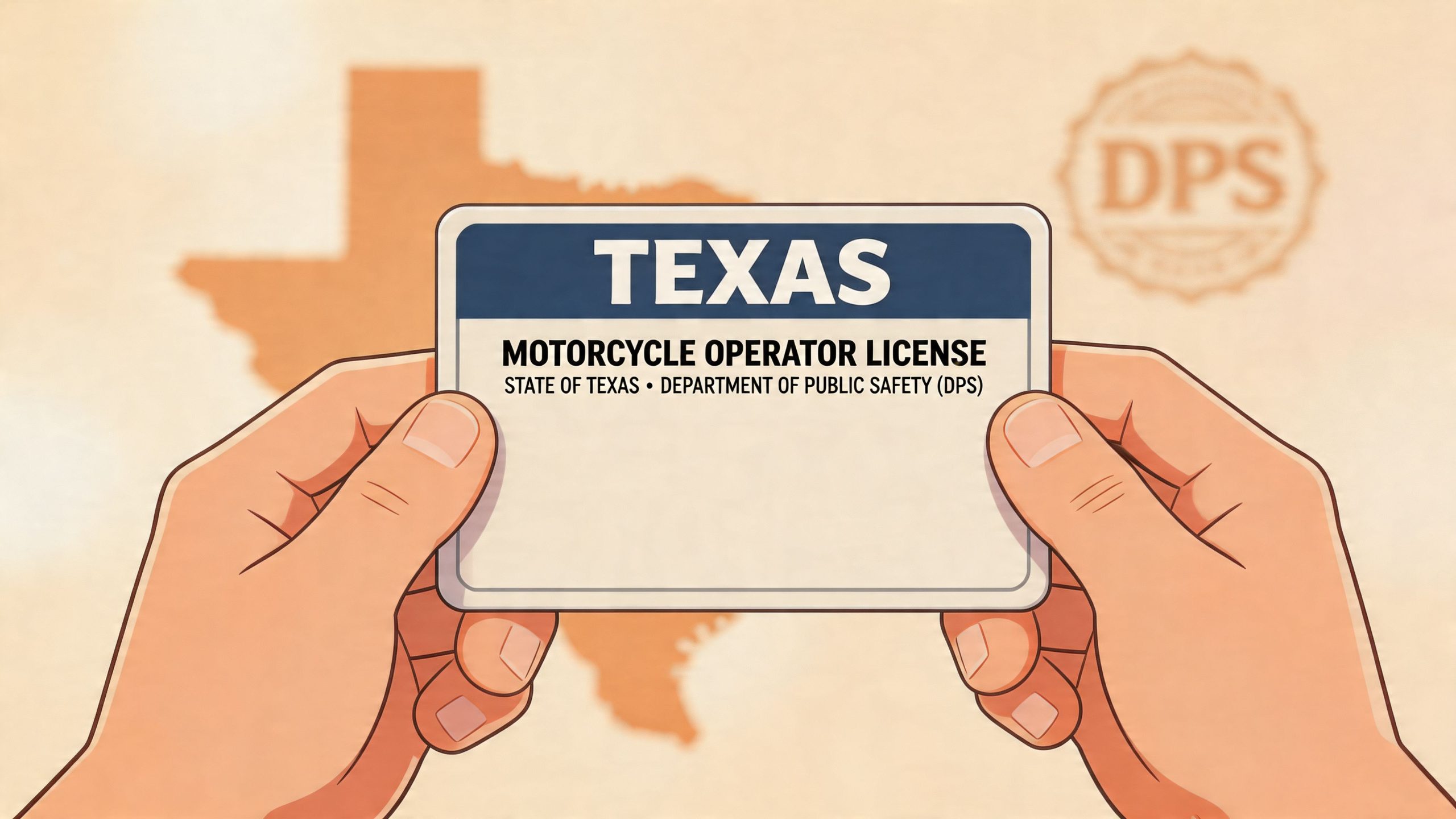
What usually happens at DPS
For riders using the waiver path, the appointment is often more like document processing than a riding event. Expect identity verification, a vision screening, a photo, and the normal application steps.
That sounds simple because it is, when your paperwork is clean.
If something is missing, the mood changes fast. A missing certificate, name mismatch, or expired document can turn a short visit into a reschedule. Arrive early, park without rushing, and walk in with your folder already sorted in the order you expect to hand things over.
If you chose the direct DPS skills test path
This route asks DPS to judge your riding on the spot, so small weaknesses matter more. Riders often worry about higher-speed traffic skills, but the common trouble spots are usually slower and less dramatic. Tight turns, balance, clutch control, clean stops, and smooth low-speed handling cause plenty of mistakes.
Use a parking-lot mindset here. A small wobble at walking speed tells an examiner more than a fast straight-line ride ever will.
Check three things before test day:
- Your motorcycle is in safe working condition
- Your required gear is ready and fits properly
- Your slow-speed control is reliable enough to repeat under pressure
This is also where the cost-benefit difference becomes clearer. The direct test path may save money if you already ride well and can pass on the first try. If you are still building basic control, the safety course usually gives you a better return because the coaching and waiver reduce the chance of repeating the process.
Final checks riders forget
Look at names, dates, and expiration dates. Put payment, identification, and any course paperwork in one folder. Confirm the office location, appointment time, and whether your visit is for processing only or includes skills testing.
One more practical point. After you are licensed, gear questions come up fast, especially helmets. If you want a plain-English legal overview, review the motorcycle helmet laws in Texas so your first rides are both legal and safer.
Calm beats rushed every time. If you show up prepared, the DPS appointment usually feels less like an obstacle and more like the final signature on work you already completed.
Life with Your New License and Common Mistakes to Avoid
Getting your texas motorcycle license is the beginning, not the finish line. Once you�re legal, the actual work is building judgment. Smooth starts, clean stops, lane position, scanning intersections, and staying humble when traffic does something stupid.
A new license means you can ride. It does not mean you�ve seen enough to relax your standards.
What changes after you�re licensed
Your focus shifts from passing a process to managing risk every ride. That includes gear decisions, regular practice, and understanding any restrictions or renewal details that apply to your license record.
Helmet questions come up right away. If you want a practical legal overview, this guide to motorcycle helmet laws in Texas is a useful follow-up because many riders know the basic licensing rules but stay unclear on gear-related legal obligations.
It�s also smart to keep improving your road judgment generally, especially if your riding life includes time behind the wheel of a car too. Safe traffic habits overlap more than people think, and this resource on how to improve driving skills is a good reminder that scanning, space management, and defensive thinking matter in every vehicle.
Mistakes that cause avoidable setbacks
Most licensing trouble comes from simple preventable errors:
- Waiting too long after the course: Your certificate has a validity window. Don�t treat it like it lasts forever.
- Showing up with incomplete paperwork: One missing proof document can waste the whole appointment.
- Assuming riding experience replaces test prep: It doesn�t. Informal experience often leaves gaps.
- Booking late: Appointment delays can drag the process out longer than the training itself.
- Treating the license as the end of learning: New riders improve fastest in the months right after licensing, if they stay deliberate.
The safest new rider usually isn�t the boldest one. It�s the one who keeps practicing basic skills after the license arrives.
Habits worth keeping
Try this approach for your first stretch of licensed riding:
- Ride familiar routes first. Reduce variables while your control skills settle in.
- Practice low-speed work regularly. Parking-lot turns and stops matter more than ego admits.
- Avoid showing off. New riders get into trouble when they ride for approval instead of control.
- Review your paperwork. Keep your license status and any renewal responsibilities in order.
The best riders I�ve taught aren�t usually the most naturally talented. They�re the ones who stay teachable after they pass.
Frequently Asked Questions About the Texas Motorcycle License
Do I need to own a motorcycle to take the safety course
Not always, but it depends on the training provider. Some approved programs provide motorcycles for class use, while others may have specific equipment rules. Ask before you register so you know what to bring and what the school supplies.
How long is the MSB-8 certificate valid
The MSB-8 completion certificate is valid for 24 months, according to the licensing details cited earlier from the Texas motorcycle licensing summary. Don�t wait longer than necessary to use it.
Is the safety course really the better route for most adults
For many first-time or returning riders, yes. It usually gives you better structure, more supervised practice, and a cleaner DPS visit because the certificate can waive required tests. If you�re busy or anxious about testing, that matters a lot.
What if I fail the direct written or skills test
If you go the direct path and don�t pass, you�ll need to follow DPS procedures for trying again. The practical lesson is to treat direct testing as a real performance event, not something to �just see how it goes� on.
What skills are usually hardest for beginners
Most beginners don�t struggle with going fast. They struggle with the slow stuff. Tight turns, clutch control, smooth braking, and keeping their eyes up through a maneuver are the usual sticking points.
Are scooter and moped requirements the same
That depends on the vehicle classification and how Texas treats that specific type of machine. Don�t assume a smaller engine means no motorcycle-related requirement applies. Verify the rule for your exact vehicle before you ride it on public roads.
What�s the fastest practical path
For many adults, the fastest reliable path is to complete the approved course, keep documents ready, and book the DPS appointment as early as you reasonably can. Fast and smooth usually beats fast and uncertain.
If you value clear instruction and flexible learning, BDISchool is a helpful place to continue building safe driving habits. Whether you�re brushing up on road awareness, handling a traffic requirement, or trying to become a more confident, responsible driver, their courses are built to make learning practical and convenient.