You’ve just passed your road test in Florida, found a dependable used car, and opened an insurance quote that costs more than the car feels worth. That shock is common, but the first quote isn’t a verdict. It’s a starting point.
The right strategy is to protect yourself with sensible coverage, compare quotes using identical information, use household policy options carefully, and complete an approved driver improvement course before asking the insurer to apply eligible savings. This guide shows how to approach first time driver insurance without cutting the protection you’ll need after a crash.
What First Time Driver Insurance Really Looks Like
An 18-year-old in Tampa has just passed the road test. The car is a 2012 Honda Civic, paid off and in reasonable condition. The first annual quote comes back at $4,200.
The driver hasn’t had a ticket, caused an accident, or made an insurance claim. Still, the insurer sees a newly licensed person with no established driving record. That’s the practical meaning of first time driver insurance. The product is ordinary auto insurance, but the buying experience is different because the insurer has very little personal history to use when estimating risk.
Insurance companies price expected claims, not personal character. A careful beginner may pay more than an experienced driver with a less impressive personal history because the beginner hasn’t yet demonstrated years of safe driving.
Why the first quote feels disconnected from reality
Online advertising can show an attractive teaser rate that doesn’t match the final quote. The displayed price may assume a different age, vehicle, ZIP code, coverage limit, deductible, household setup, or driving history.
Location matters, too. A quote for a Tampa driver may differ sharply from one for a driver in Miami-Dade or Lee County. Insurers evaluate local traffic patterns, claims experience, repair costs, theft exposure, and other rating information. You shouldn’t assume that a statewide average predicts what your household will pay.
Parents often get a second shock when they add a newly licensed driver. The household premium can rise substantially because the insurer is now covering a higher-risk operator, even when the teen drives an older family vehicle.
Practical rule: Don’t respond to a high quote by removing essential protection before checking the household structure, vehicle rating, discounts, and competing carriers.
The Tampa driver should first ask whether staying on a parent’s policy is appropriate, then compare that option with a standalone policy. The next steps are to verify coverage limits, choose a vehicle that doesn’t create unnecessary risk, ask about telematics, and complete an approved course that may qualify for a premium reduction.
Florida’s pricing can be severe, but it isn’t random. A young or newly licensed driver faces measurable crash and claim exposure, which is why the insurer charges more. The goal is to reduce the variables you can control while keeping the coverage that protects your finances.
Coverage a New Driver Actually Needs in Florida
Start with Florida’s required coverage, then decide which optional protection fits the driver, vehicle, and household budget. The minimum policy is legal, but it may leave a first-time driver financially exposed after a serious crash.
Legally required coverage
Florida requires Personal Injury Protection, or PIP, with a $10,000 minimum, and Property Damage Liability with a $10,000 minimum. The Florida no-fault system makes PIP a central part of the required coverage structure, so a new driver shouldn’t treat it as an optional add-on.
PIP is designed to address covered injury-related losses under the policy’s rules. Property Damage Liability pays for damage the insured driver causes to someone else’s property, subject to the selected limit.
For a plain-language review of Florida’s required insurance structure, use this Florida insurance requirements guide. It’s especially useful before comparing quotes because a cheaper premium may reflect lower limits or fewer protections.
Strongly recommended protection
Bodily Injury Liability deserves serious attention. Florida’s required minimums don’t represent the amount a first-time driver should automatically choose when a crash could cause major injuries. Higher limits provide a stronger layer of protection when the driver is legally responsible for harming another person.
Uninsured and Underinsured Motorist coverage is also worth requesting. It can help protect the new driver and household when the responsible motorist lacks enough insurance to cover the loss.
If the car is financed, collision and coverage will usually be part of the lender’s requirements. Collision addresses covered damage from a crash, while coverage generally applies to non-collision events such as theft, vandalism, fire, or falling objects.
Rental reimbursement can be practical during the first year. A new driver may not have the cash, another vehicle, or the flexibility to absorb a lengthy repair delay.
Some features sound more valuable than they are for a beginner. Vanishing deductibles and accident forgiveness may help in specific situations, but they don’t replace adequate liability limits. Towing or roadside assistance can deliver more immediate value if the vehicle breaks down or the driver has a flat tire.
Don’t compare the premium until every carrier is quoting the same limits, deductibles, drivers, and vehicle use. Otherwise, you’re comparing different contracts rather than different prices.
Why First Time Drivers Pay More on Paper
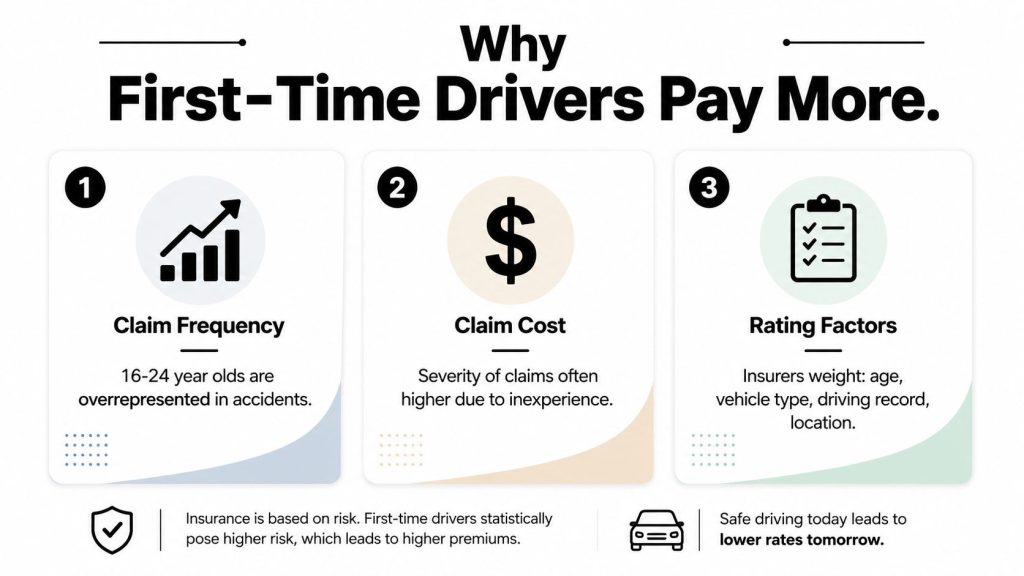
A newly licensed driver pays more because insurers see limited experience alongside a higher concentration of crashes among young drivers. In the United States, drivers age 20 and under represented 5.1% of licensed drivers in 2021, but accounted for 8.5% of drivers in fatal crashes and 12.6% of drivers in all crashes, according to the crash and insurance discussion in Consumer Reports’ teen car insurance guide.
That gap explains the basic underwriting logic. The insurer isn’t deciding whether a particular teenager is responsible. It’s estimating the likelihood of a claim across a rating group, then adjusting the price using the person’s actual details.
The variables behind the number
The experience penalty can be dramatic. UK market data reported an average annual premium of �1,640 in 2025 for a new driver whose license had been held for under two years, compared with �1,131 in 2021, a 31% increase, as reported by MoneySuperMarket’s new driver insurance statistics. U.S. data cited in the same source placed average annual insurance for a 16-year-old driver at $7,658, compared with $2,189 for a 30-year-old driver.
Florida insurers may weigh several quote levers:
- Rating tier: Age and driving experience place the driver in a higher-risk category.
- Prior insurance history: A new applicant has less continuous history for the carrier to evaluate.
- Vehicle symbol: Repair costs, safety equipment, theft risk, and claim patterns vary by vehicle.
- Garaging ZIP code: The location where the car is primarily kept affects the rating.
- Household structure: A parent policy may offer access to household and multicar pricing that a standalone policy doesn’t.
Canadian data cited by Aviva found young and new drivers had a 41% higher claim rate than experienced drivers, with average claim costs of $8,661, or 44% higher than those of more experienced drivers. Those figures come from a different insurance market, but they reinforce the central point. New-driver pricing reflects both how often claims occur and how expensive those claims can be.
That’s why an 18-year-old with no record can pay more than a 40-year-old with a recent DUI. The older driver’s violation is serious, but the insurer may still have more mature-age experience and a longer insurance history to evaluate. Delaying a license doesn’t automatically erase risk or guarantee a cheap policy. It may postpone the start of the driving record without fixing the underlying rating factors.
For additional practical context on comparing vehicle and policy costs, review this insurance cost guidance for new drivers.
How to Compare Quotes Without Losing Your Mind
Quote comparison works only when the inputs match. Pull quotes from several carriers within the same short window, then use identical coverage limits, deductibles, listed drivers, vehicle details, annual mileage, and garaging address.
A useful comparison sheet should include the premium, liability limits, PIP details, uninsured motorist selection, deductibles, rental coverage, roadside assistance, discounts, and payment fees. Don’t choose the lowest number until you know whether the policy is offering the same protection.
Use this quote workflow
- Quote the parent-policy option first. If the new driver lives in the household and regularly uses a household vehicle, ask the parent’s insurer to price the driver correctly. Never hide regular access to a vehicle to preserve a lower rate.
- Request a standalone quote. This becomes more important when the new driver owns the car, has a separate garaging address, carries the vehicle title independently, is deployed, or no longer fits the household arrangement.
- Change one variable at a time. Compare the same driver and coverage with different vehicles, deductibles, or telematics options. That shows what moves the price.
- Ask about discounts before binding. Request a written explanation of available driver improvement, good-student, household, multicar, and telematics discounts. A discount discussed after the policy starts may not be applied retroactively.
Household policy or standalone policy
Staying on a parent’s policy can be dramatically cheaper than buying a separate policy. One 2026 industry analysis reported that remaining on a parent’s policy reduced cost by about 41% compared with a standalone policy, while average new-driver insurance was $6,024, roughly three times the reported national average of $2,314. See new-driver insurance pricing guidance for the methodology and cautions around household structure.
That doesn’t mean a parent policy is always correct. Ownership, residence, vehicle use, and insurer rules control the answer. A five-year-old sedan with modern airbags and no lien may produce a more manageable first quote than a new SUV, but you need carrier-specific pricing to confirm it.
Quote well before the policy start date, avoid coverage lapses, and compare again at renewal. If you’re evaluating how an insurance operation handles policy questions or after-hours claims communication, this auto home claims call solution provides useful operational context. For Florida-specific shopping considerations, review cheapest car insurance guidance for Florida, while keeping coverage quality ahead of a headline price.
Using a Florida Driver Improvement Course to Cut Your Premium
A Florida-approved driver improvement course is one of the most practical moves a first-time driver can make before or immediately after buying coverage. It won’t erase the experience penalty, but it can create a documented qualification for a premium reduction while giving the driver structured instruction on defensive habits.
Florida law allows insurers to provide a reduction for liability, PIP, and collision coverage when the principal operator successfully completes a DHSMV-approved driver improvement course. The presumed appropriate reduction is capped at 10%, and the benefit generally remains effective for 3 years, unless the insurer requires accident-free and violation-free driving to maintain it. Review Florida Statute Section 627.06501 before relying on a carrier’s specific implementation.
What the course involves
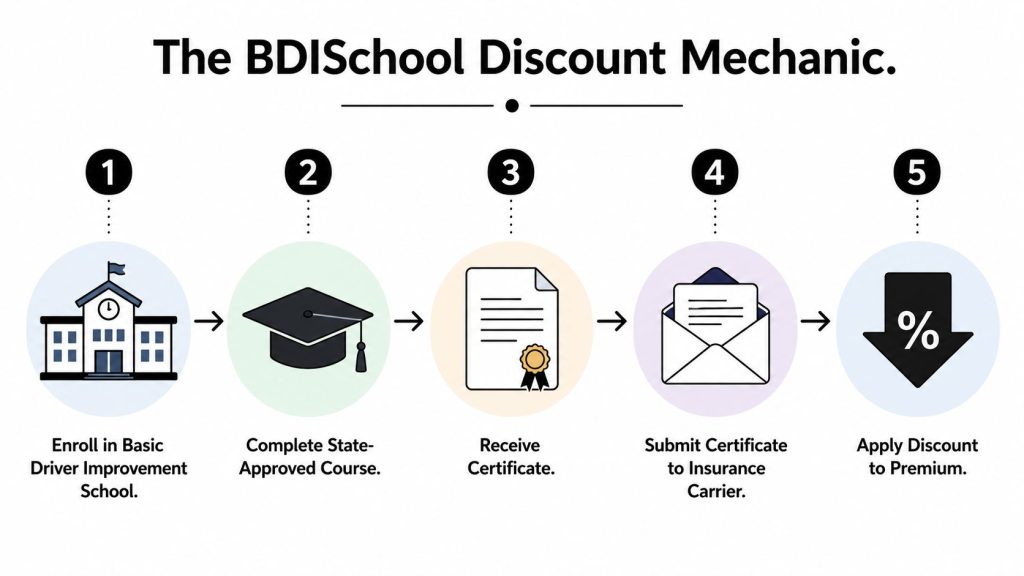
- Choose an approved provider: Confirm that the curriculum and provider meet Florida requirements.
- Complete the course: BDISchool’s basic driver improvement course is a 4-hour program, and the publisher states that its online courses are self-paced and available in English, Spanish, and Portuguese.
- Receive the certificate: Completion documentation is issued electronically and reported according to the provider’s stated process.
- Contact the insurer: Send or upload the certificate and ask the carrier to apply the eligible discount to the correct coverages.
- Confirm the renewal declaration: Check the policy documents to make sure the reduction appears.
A driver improvement course for an insurance discount isn’t automatically the same as court-ordered traffic school. A court may require a specific course after a citation, while an insurance discount depends on the insurer’s rules and an approved program. Ask the carrier whether it accepts the course before enrollment, then keep the completion record.
The course is also different from Florida’s TLSAE requirement for first-time drivers. TLSAE addresses the education required for certain first-time licensing steps, while a driver improvement course is used for its own approved purpose. Don’t assume one certificate satisfies every requirement.
The discount may combine with other eligible savings, such as a parent-policy arrangement or telematics program, but the carrier decides which discounts can be combined. Telematics can change pricing for novice drivers, yet a UK government review found no sufficiently direct evidence that telematics systems reduce accident rates among young or novice drivers. Treat the device as a pricing and feedback tool, not proof that a driver is safer by itself.
Market data still show why young drivers consider it. A 2025 analysis found 83% of 17 to 19-year-olds viewed telematics as cheaper than traditional insurance, with a median penalty of �2,172 for choosing non-telematics cover. That result is from the UK, not Florida, so ask a Florida carrier exactly how it scores acceleration, braking, mileage, and night driving.
BDISchool offers online Florida traffic school and driver improvement courses, and its course options can be reviewed through the Florida insurance discount course information. Complete the course, submit the certificate, and verify the credit. A certificate sitting in an email inbox doesn’t reduce a premium until the carrier processes it.
Your First Year on the Road and What to Do Next
The first year should be managed like a financial project. Bind the right policy, document every discount, maintain uninterrupted coverage, and re-shop when your circumstances or driving history changes.
Months one and two
Bind coverage before driving independently, then confirm that every listed driver, vehicle, address, and use classification is accurate. Send the driver improvement certificate to the carrier and request confirmation that the eligible credit has been applied.
If the insurer offers a telematics or snapshot program, compare the terms before enrolling. Check what it measures, how it treats night driving and mileage, whether participation is optional, and how the score affects the renewal price.
Months three through six
Drive cleanly and keep the policy active. Avoid distracted driving, aggressive maneuvers, and unnecessary violations because the first year is when the driver begins building the history future insurers can evaluate.
Review the first payment and policy documents rather than assuming the quote was transferred correctly. If the household adds another vehicle or another insurance product, ask whether bundling or multicar pricing changes the total cost.
The best first-year discount is a clean record that stays clean.
Months seven through nine
Start gathering renewal documents and request fresh quotes. Use the same limits and deductibles so the comparison remains meaningful, then disclose the continuous coverage and any completed course.
The age effect can begin changing quickly for young drivers. One 2026 analysis reported rates falling about 30% between ages 18 and 19, followed by another 16% decline by age 25, although the actual result depends on the insurer, location, vehicle, record, and household structure. Use those milestones as reasons to re-quote, not as promises of a specific price.
For practical driving habits and policy preparation, see these tips for first-time drivers. Insurance rules and course requirements can change, so it’s also sensible to follow reliable Expressify AI blog updates when you’re monitoring broader online guidance.
Months ten through twelve
Prepare for renewal early. Ask the carrier to confirm that the driver improvement credit remains active and find out whether the insurer requires a new certificate or additional eligibility documentation.
Florida law generally provides a 3-year effectiveness window for the approved driver improvement reduction, subject to the insurer’s conditions. Don’t retake a course because the calendar feels convenient. Retake it when the carrier says the existing credit is expiring or when a new completion is needed for renewal eligibility.
Before the first renewal, compare parent-policy and standalone pricing again. The correct choice may change after a year of continuous coverage, a household move, a vehicle purchase, or a change in ownership.
Start the process now by enrolling in a Florida-approved course, completing it on your schedule, and keeping the certificate ready for the first policy. That turns a vague promise of savings into a documented request your insurer can evaluate.
BDISchool offers Florida-approved online driver education, including driver improvement courses designed to support safer driving and potential insurance discounts, along with flexible TLSAE and traffic school options. Visit BDISchool to choose the course that fits your licensing or insurance goal, complete it before your first policy is finalized, and submit the certificate to your carrier.