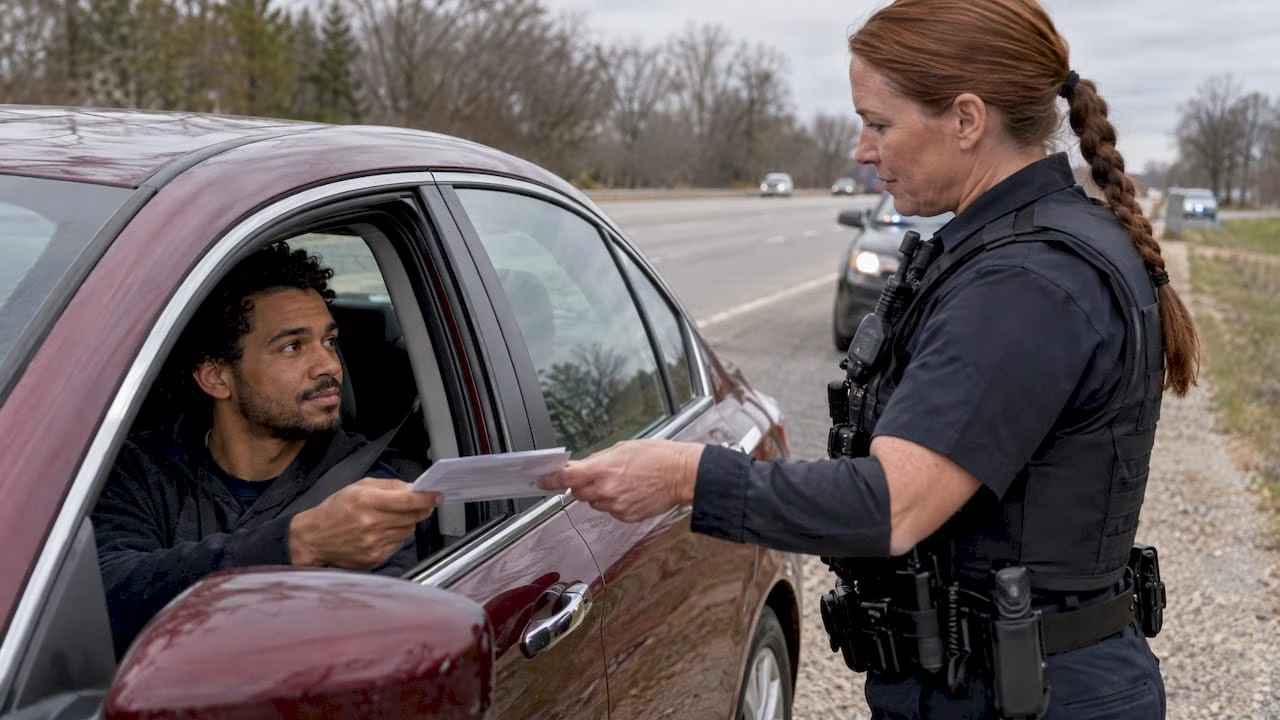
A speeding ticket in Michigan adds 2 points for 6 to 10 mph over the limit, 3 points for 11 to 15 mph over, and 4 points for 16 mph or more over. A ticket for 5 mph or less over is generally a zero-point ticket. Work zones and school zones raise the totals. Points stay on your driving record for two years from the conviction date. Some eligible drivers can keep points off altogether by completing a Basic Driver Improvement Course (BDIC).
Below you will find the full point chart, what changes in work and school zones, how long each part of a ticket stays visible, what happens when points pile up, and the one-time course option that may keep a ticket from costing you points.
Key Takeaways
- Michigan speeding points run from 0 (5 mph or less over) to 4 (16 mph or more over) on a normal road, and up to 5 in a work or school zone.
- Points come off your record two years after the conviction date, but the conviction itself stays visible for at least seven years.
- Reaching 12 points in two years, or 6 one-point violations in two years, can trigger a license reexamination.
- Eligible drivers can take a BDIC once to avoid points and keep the ticket from being reported to insurers.
- Driving record points and insurance points are two separate systems, so a ticket can matter to your insurer even when it carries no points.
Table of Contents
- Michigan speeding ticket points by speed
- Work zone and school zone speeding points
- What a Michigan speeding ticket costs
- How long points and tickets stay on your record
- What happens when points add up
- Does a speeding ticket affect car insurance?
- Can a course keep points off your record? Michigan�s BDIC
- Our view: use your one chance well
- Take the Michigan course online
- Contesting a speeding ticket
- A short checklist after getting a ticket
- FAQ
- Sources
Michigan speeding ticket points by speed
Michigan assigns points when you are convicted or found responsible for a violation, not when the officer writes the ticket. The Michigan Department of State�s What Every Driver Must Know guide lays out the scale, which is set by state law in MCL 257.320a.
| Speed over the limit | Points on a standard road |
|---|---|
| 5 mph or less | 0 (generally a zero-point ticket) |
| 6 to 10 mph | 2 |
| 11 to 15 mph | 3 |
| 16 mph or more | 4 |
The statute words the brackets as �more than 5 but not more than 10,� �more than 10 but not more than 15,� and �more than 15.� So a ticket for exactly 10 over is a 2-point ticket, and exactly 15 over is a 3-point ticket.
A zero-point speeding ticket is not a free pass. A Michigan attorney�s traffic ticket page notes that even a zero-point ticket such as 5 over on a highway can stay on the record for years and can still lead insurers to raise rates. We cover that in the insurance section below.
Work zone and school zone speeding points
Zones change both the fine and the points. Speed in a construction or work zone costs more than the same speed on an ordinary road.
Work zones
According to the Michigan Department of State, fines for moving violations in a work zone are doubled and points are raised:
- 10 mph or less over: 3 points
- More than 10 but not more than 15 mph over: 4 points
- More than 15 mph over: 5 points
School zones
The same guide says school zone fines are doubled and points are raised too:
- 1 to 10 mph over: 3 points
- 11 to 15 mph over: 4 points
- 16 mph or more over: 5 points
A 5-point result is the top of the speeding scale. It takes only a fast pass through a school or work zone to get there, which is why slowing down in those areas protects your record more than anywhere else.
What a Michigan speeding ticket costs
Fines vary by court, county and how far over you were. One 2026 fine guide estimates that a first-offense ticket around 15 mph over costs $106 to $190 once surcharges and court costs are included, with base fines running from $6 to $30 for 1 to 10 mph over and $60 to $100 for 16 mph or more over. Your citation or the court that issued it lists the exact amount you owe.
The fine is often the smaller part of the bill. The longer-term cost is on your insurance, covered below.
How long points and tickets stay on your record
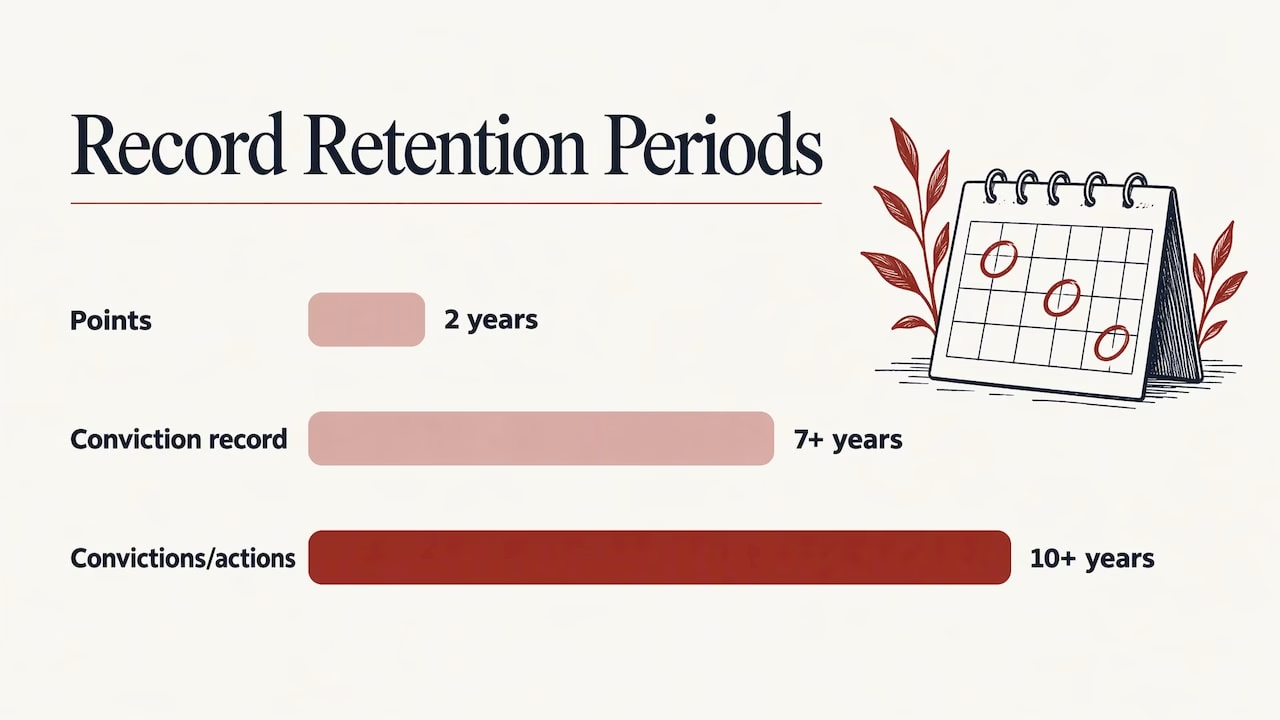
�On your record� means several different things, and each runs on its own clock. A Michigan legal explainer makes the same point: the citation, the court case, the conviction, the points and the insurer�s rating history all follow separate timelines.
| What | How long |
|---|---|
| Points | 2 years from the date of conviction |
| The conviction on your driving record | At least 7 years |
| Certain convictions and licensing actions | At least 10 years |
| Fatality or impaired driving convictions | Permanent |
The figures above come from the Michigan Department of State�s What Every Driver Must Know. The key point: when the points drop off after two years, the conviction itself is still visible. Courts and some employers can still see it.
Michigan�s Secretary of State cannot set aside a court conviction, according to the same guide. Our article on point dismissal options walks through the routes that exist before a conviction is entered.
What happens when points add up
Points matter most when they stack. Under MCL 257.320, the Secretary of State may investigate or reexamine a driver who has:
- 12 or more points within a two-year period, or
- 6 or more one-point violations within a two-year period
After a reexamination, the Secretary of State may restrict, suspend or revoke the license, or set other terms and conditions. A single 4-point ticket will not trigger a review on its own. Three 4-point tickets inside two years would.
A practical way to stay safe: count your points by conviction date, not ticket date, and remember that each one lasts two years. If you already have points, a new ticket deserves more care in how you handle it.
Does a speeding ticket affect car insurance?
Yes, it can, even with few or no points. The Michigan Department of State says the system that posts points to your driving record is separate from the points an insurance company uses to set your rates.
Insurers set their own rules, and the impact differs a lot between companies. A 2026 analysis from AutoInsurance.com found that a speeding ticket raises Michigan premiums by an average of 28%, from $3,013 to $3,852 a year, with some insurers raising rates far more and others far less. The same page says insurers typically look back about three years at your record. Some Michigan attorneys report that many carriers surcharge for five to six years after a ticket.

That is why keeping the ticket from reaching your insurer can be worth more than the fine itself.
Can a course keep points off your record? Michigan�s BDIC
For many drivers, yes. Michigan�s Basic Driver Improvement Course lets eligible drivers avoid points and prevent the ticket information from being sent to insurers. The Michigan Department of State�s BDIC page sets these rules:
- You hold a valid Michigan noncommercial license with two or fewer points.
- The violation is an eligible noncriminal one and was not committed in a commercial vehicle.
- The ticket was issued on or after December 31, 2010.
- You can pass the course only once.
- The course takes at least four hours.
- You must finish it within 60 days of the eligibility notice.
The ticket information is still placed on your record, and courts or probationary driver reexaminations may use it. What the course changes is the points and the notice to insurers. Course providers must meet state standards: the Department of State�s BDIC sponsor requirements call for at least four hours of instruction that meets or exceeds the National Safety Council�s Defensive Driving Course curriculum standards.
Because you can use the option only once, it helps to know your timing before you decide. Read the eligibility notice carefully and check the deadline date printed on it.
Our view: use your one chance well
We build our courses in-house with certified educators and safety specialists, and we update them for statutory requirements. For a Michigan driver with a first or early ticket, the BDIC is the most direct way to stop points from hitting your driving record.
Our experience is that most drivers who worry about a ticket are not worried about the fine. They worry about what it will do to their record and their insurance for the next several years. A one-time chance to avoid points and keep the ticket away from insurers is worth treating seriously, and worth finishing well before the 60-day deadline.
That is why we focus on a clear, self-paced experience that works on any device, with multilingual read-along features and transparent pricing, with no hidden fees and a money-back guarantee. You can start, pause and finish on your own schedule.
the author
Take the Michigan course online
If your eligibility notice has arrived, you can complete our Michigan Basic Driver Improvement Course online, at your own pace, on a phone, tablet or computer. Our courses are developed in-house, and we state our pricing up front with no hidden fees.

You can see everything we offer for Michigan drivers on our Michigan page, or browse all available courses. Drivers in other states can also find course options there.
Contesting a speeding ticket
You can plead not guilty and contest a ticket. A trial is the only route to a full dismissal, according to one legal guide on fighting speeding tickets. Outcomes vary widely by court, and there is no dependable statewide figure for how many contested tickets are dismissed, so plan around your own court�s process rather than a headline percentage.
Before you decide between contesting and a course, weigh these points:
- Eligibility. Check the BDIC rules above. A driver with more than two points, or with a disqualifying violation, may not be eligible.
- Timing. The course has a 60-day completion window after the eligibility notice.
- Your record. A conviction stays visible for at least seven years, so the result matters beyond the points.
- Your insurer. The BDIC prevents ticket information from being sent to insurers, which addresses the long-term cost.
If your ticket involves a court date, an unusual charge or a driver�s license already under review, talk to a Michigan attorney or the court clerk before you choose.
A short checklist after getting a ticket
- Read the citation for the violation, the court and the response deadline.
- Note the exact speed over the limit and whether it was a work or school zone.
- Count your current points and their conviction dates.
- Check your eligibility notice for the BDIC and its deadline.
- Choose how you will respond: pay, take an eligible course, or contest.
- Save your completion confirmation once you finish a course.
FAQ
How many points is a 5 mph over speeding ticket in Michigan?
A ticket for 5 mph or less over the limit is generally a zero-point ticket in Michigan. It can still appear on your record for years and some insurers may still raise your rates. Check your citation for the exact violation.
How long do points stay on your Michigan license?
Points stay for two years from the date of conviction, according to the Michigan Department of State. The conviction itself remains visible for at least seven years.
Does impeding traffic give you points in Michigan?
No. One Michigan court�s published fine schedule lists impeding traffic at 0 points, with a base fee of $200 ($225 if an accident is involved). Fees can differ by court.
How many points can get your license reviewed?
Twelve or more points in two years, or six or more one-point violations in two years, can lead to a reexamination under MCL 257.320. The result can include restrictions, suspension or revocation.
Can I take a course to avoid points?
Eligible drivers can. The BDIC can prevent points and keep ticket information from being sent to insurers, but you can use it only once and must finish within 60 days of the eligibility notice.
Sources
- What Every Driver Must Know, Michigan Department of State
- Michigan Senate Bill 1074 (MCL 257.320a text)
- MCL 257.320, Michigan Legislature
- Basic Driver Improvement Course (BDIC), Michigan Department of State
- BDIC sponsors, Michigan Department of State
- Speeding Ticket Impact on Insurance in Michigan, AutoInsurance.com
- Michigan Speeding Ticket Cost: Fines and Points
- How Long Do Traffic Tickets Stay on Your Record in Michigan
- Michigan Traffic Tickets, Catchick Law
- How to Fight a Speeding Ticket in Court
- 47th District Court fine schedule
Recommended
This article is provided for general information and is not a professional advice.