
Florida’s 8-hour Aggressive Driver course is for court-ordered aggressive behavior and repeated unsafe driving, while the 12-hour Advanced Driver Improvement course, or ADI, is primarily used for license reinstatement, habitual traffic offender matters, or severe point accumulation. They aren’t interchangeable, so choosing the wrong course can leave your legal requirement unresolved.
You may be looking at a citation, a court notice, or a license problem while trying to work out what to do before a deadline passes. The search results aren’t helping because many Florida traffic school pages use �aggressive driving course� and �12-hour course� as if they mean the same thing.
That confusion can cost you time and money. The correct course depends on the order you received, your license status, and the requirement set by the court or the Florida Department of Highway Safety and Motor Vehicles, known as FLHSMV.
Why You Need the Right Florida Aggressive Driving Course
A traffic citation creates two separate problems. You need to satisfy the legal requirement, and you need to limit the effect the incident may have on your driving record and insurance. Enrolling in the first online traffic school that appears in a search result doesn’t solve either problem if the course doesn’t match your order.
The practical answer is to read the wording on your notice before you register. Look for terms such as Aggressive Driver, Advanced Driver Improvement, ADI, habitual traffic offender, license reinstatement, or a specific court instruction. Those words point toward different programs.
Practical rule: The course title matters less than the requirement written by the court or FLHSMV.
Florida’s driver-improvement system includes several programs, and a standard moving violation may call for a different response from a suspended license or a repeated-offender designation. FLHSMV also states that drivers who want to elect a Basic or Advanced Driver Improvement course after receiving a citation must make that decision within 30 days of the citation, as explained in its driver education course guidance.
Treat enrollment as a recovery decision
The right course can help you address the specific issue instead of guessing at a general defensive driving class. The wrong one may produce a certificate that doesn’t satisfy the court’s order.
Choose a provider that clearly identifies its Florida approval, course duration, reporting process, and certificate procedure. Online options from BDISchool and floridanewdriver.com are designed around Florida driver-improvement requirements, with self-paced access and electronic certificate handling described by the providers.
Before paying, confirm four details:
- Required course: Match the exact name on your notice to the course name on the enrollment page.
- Completion deadline: Record the court or FLHSMV deadline before starting.
- Reporting process: Confirm whether completion is reported directly or whether you must submit proof yourself.
- Personal information: Enter your name and license details exactly as they appear in official records.
This simple check prevents the most avoidable mistake in Florida traffic school. You aren’t buying hours of education in the abstract. You’re completing a specific legal step tied to a specific driving problem.
Understanding Florida Aggressive Careless Driving Laws
Florida doesn’t define aggressive careless driving as one isolated action. The statute addresses a pattern made up of two or more listed violations committed at the same time or in succession. The qualifying behaviors include speeding, unsafe or improper lane changes, following too closely, failing to yield, improper passing, and violating traffic signals or control devices, as set out in Florida’s aggressive careless driving statute.
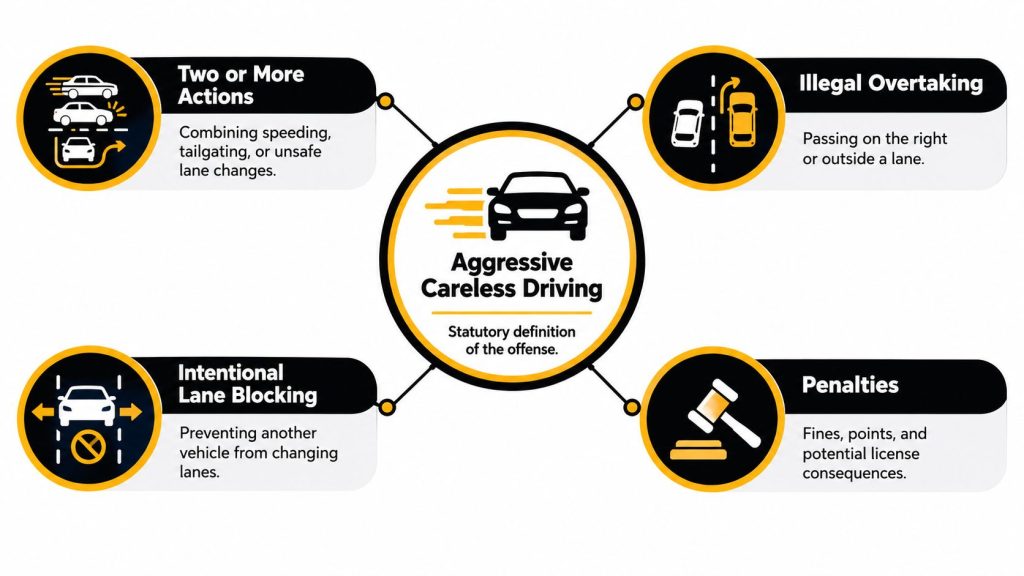
That two-or-more rule is the part drivers often miss. A driver may believe the case concerns only speed, while the enforcement description also includes following distance, lane movement, or signal compliance. The state evaluates the combination, not just the driver’s preferred description of the moment.
The behaviors form a pattern
Speed becomes more dangerous when it combines with a short following distance. An unsafe lane change becomes more serious when it happens alongside improper passing or failure to yield. Florida’s framework focuses on how these choices interact on a road shared with other people.
The Florida Department of Transportation describes aggressive driving as behavior involving multiple moving violations that endanger people and property. Its aggressive driving safety information supports a prevention approach centered on speed choice, gap acceptance, lane discipline, and compliance with signs and signals.
The distinction from reckless driving also matters. Florida defines reckless driving separately as operating a vehicle in willful or wanton disregard for the safety of people or property, according to the reckless driving statute. Aggressive careless driving uses the combination of listed acts as its defining mechanism, while reckless driving addresses a stronger level of disregard.
Florida’s crash data show why the state treats clustered unsafe conduct seriously. The 2023 annual crash report recorded 16,092 speeding or aggressive driving events, and the state’s earlier Strategic Highway Safety Plan reported that aggressive driving behavior contributed to 36% of fatalities and serious injuries from 2000 through 2004, according to the Florida traffic safety course material referencing those official data points. Those figures describe a continuing safety concern, not a minor administrative label.
If your citation involves a careless-driving allegation, review the specific legal issue before assuming an aggressive-driving course is required. This guide to a careless driving ticket in Florida can help you identify the distinction before you enroll.
The Critical Difference Between 8-Hour and 12-Hour Courses
The 8-hour Aggressive Driver course and the 12-hour Advanced Driver Improvement course serve different legal purposes. Online pages often blend them together, but a certificate from one course generally won’t satisfy an order requiring the other.
Use the wording on your official notice as the deciding factor. If the order specifically requires an aggressive-driver or road-rage program, look for the 8-hour Aggressive Driver course. If it refers to ADI, license reinstatement, habitual traffic offender status, or a severe point-related requirement, investigate the 12-hour course instead.
Florida driver improvement course comparison
| Course Type | Duration | Primary Use Case |
|---|---|---|
| Aggressive Driver course | 8 hours | Court-ordered aggressive behavior, road rage, or repeated unsafe driving requirements |
| Advanced Driver Improvement, or ADI | 12 hours | License suspension or revocation matters, habitual traffic offender status, license reinstatement, or a court or FLHSMV order |
| Basic Driver Improvement, or BDI | 4 hours | Eligible drivers addressing a qualifying moving citation through the basic driver-improvement election process |
The 8-hour program focuses on the behavior pattern behind aggressive driving. It addresses responsibility, decision-making, road rage, and repeated unsafe conduct. It isn’t just a longer version of a basic ticket course.
The 12-hour ADI course is more closely connected to serious administrative or reinstatement circumstances. A driver dealing with a suspended or revoked license, habitual traffic offender status, or an order for Advanced Driver Improvement should not substitute an 8-hour aggressive-driving class without written confirmation that the court or FLHSMV will accept it.
The basic course is a separate option again. Florida gives drivers 30 days from the citation to decide whether to elect a Basic or Advanced Driver Improvement course, according to FLHSMV’s driver-improvement school information. That deadline is different from the course duration and doesn’t automatically apply to every aggressive-driving order.
How to choose without guessing
- Read the order exactly. Don’t rely on a search snippet or a provider’s generic course description.
- Identify the trigger. Is the requirement tied to aggressive behavior, license reinstatement, habitual offender status, or point accumulation?
- Confirm with the issuing authority. Ask the court clerk or FLHSMV whether the selected course satisfies the order.
- Register only after confirmation. Save the enrollment receipt and completion instructions.
The Florida 8-hour driver improvement course is relevant when the order calls for that program. It isn’t a substitute for a 12-hour ADI requirement.
What You Will Learn in the Curriculum
A useful aggressive-driving course doesn’t just tell you to �be safer.� It shows how a driver moves from a normal traffic decision to a dangerous chain of actions.
You may start with a familiar situation. Traffic slows, another driver enters your lane, and you feel pressure to regain the space you lost. The course examines what happens next: closing the gap, changing lanes abruptly, accelerating to block another vehicle, or treating a signal as optional. The point isn’t to excuse the behavior. It’s to identify the moment when you can still choose differently.
The law becomes a driving tool
The curriculum connects Florida traffic rules to decisions behind the wheel. You work through right-of-way rules, safe following distance, lane discipline, passing, signal compliance, and speed selection. These aren’t abstract test subjects. They are the controls that prevent a tense interaction from becoming a series of violations.
Crash avoidance receives practical attention as well. A driver needs time and space to respond to a sudden stop, a merging vehicle, a pedestrian, or a blocked sight line. The course frames defensive driving as active preparation, not passive caution.
The psychological content is just as important. Aggressive driving often begins with attitude, impatience, perceived disrespect, or the belief that arriving sooner justifies taking greater risks. The course asks you to recognize those triggers before they influence your hands, feet, and attention.
A strong lesson also addresses impaired and distracted driving. Alcohol, drugs, fatigue, phone use, and emotional agitation can all weaken judgment. The safest decision is made before the vehicle moves, by refusing to drive when your ability to evaluate risk is compromised.
This resource on handling aggressive drivers reinforces the same principle: don’t turn another driver’s mistake into a personal contest. Create distance, avoid retaliation, and let the situation end.
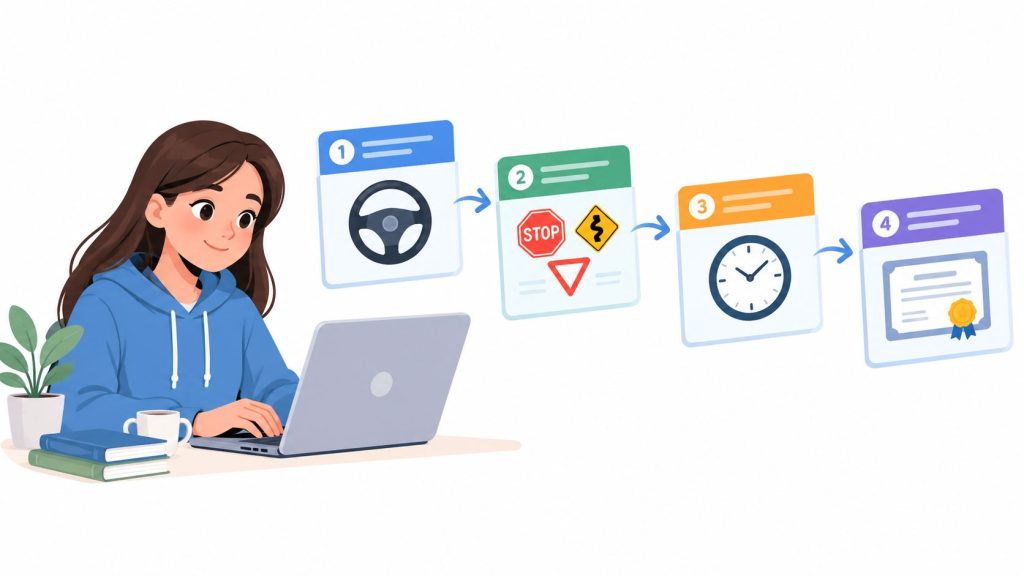
The visual lesson below shows how online instruction can combine explanation with practical driver education.
The result should be more than a certificate. You should finish with a clearer plan for managing pressure, choosing a safe gap, leaving room around your vehicle, and interrupting aggressive habits before they become another citation.
How to Enroll and Get Certified Quickly
Start with the document that created the requirement. Find the course name, completion deadline, case or citation information, and any instruction about submitting a certificate. If the wording is unclear, contact the court clerk or FLHSMV before registering.
Follow the enrollment sequence
First, select the correct program. Use the provider’s course description to confirm whether you need the 8-hour Aggressive Driver course, the 12-hour ADI course, or another Florida driver-improvement program. floridanewdriver.com presents online course options for drivers who need flexible access and state-compliant instruction.
Next, create your student account. Enter your legal name, date of birth, driver’s license information, and contact details carefully. A mismatch can create unnecessary delays when completion information is processed.
Then, complete the lessons. Online, self-paced access lets you study around work, family responsibilities, and court deadlines. The available material is designed for access from a connected device, and language options may include English, Spanish, and Portuguese depending on the course.
Finally, finish the required assessment and certificate process. Don’t assume that opening every lesson is enough. Follow the platform’s completion instructions, confirm that the course shows as completed, and save the electronic certificate or confirmation.
Confirm who receives the result
A course provider may report completion electronically to FLHSMV, while a court order may also require a certificate to be delivered to the clerk. Those are separate administrative questions. Ask who receives the result, how quickly reporting occurs, and whether you must take an additional step.
BDISchool offers Florida traffic school programs through an online, self-paced format, with electronic certificate delivery and direct reporting described by the provider. You can review available courses at its Florida traffic school course page or compare options through floridanewdriver.com before choosing.
Keep your records after completion. Save the certificate, receipt, confirmation email, and any message showing that the course was reported. If a clerk, insurer, or licensing office asks for proof later, you won’t need to reconstruct the transaction.
Don’t wait until the final day if you can avoid it. Technical problems, incorrect account details, or an unanswered court question can turn a simple enrollment into a deadline problem.
Your Path to a Clean Record and Lower Rates
The right course addresses more than a classroom requirement. It can help you respond to a citation, satisfy a court or FLHSMV instruction, and reduce the risk that one driving event develops into a larger license problem.
Don’t promise yourself that any course will automatically remove points or lower an insurance premium. Those outcomes depend on your eligibility, the underlying order, your driving record, and your insurer. Florida does state that eligibility for driver improvement can be triggered by accumulating 18 points within 18 months, which makes prompt, accurate action important when points are already mounting, as explained in FLHSMV’s driver-improvement guidance.
The immediate priority is simpler: identify the required course, meet the deadline, complete every requirement, and keep proof. This guide to removing points from a Florida driving record can help you evaluate the next administrative step, but your official notice remains the controlling document.
If your order specifically says 12-hour ADI, enroll in ADI. If it says 8-hour Aggressive Driver, choose that program instead. Don’t let a vague search result decide a legal requirement that belongs to your record.
BDISchool offers online Florida traffic school programs for aggressive-driving, ADI, and other driver-improvement requirements, with self-paced lessons and electronic completion handling. Visit BDISchool now, match the course to your court or FLHSMV order, and start the correct program before your deadline.