You’ve received a Florida traffic citation, the deadline is approaching, and every search for �Advanced Driver Improvement Course Answers� seems to promise a shortcut. The problem is that copied answer keys rarely match your course, and they don’t prepare you for the scenario questions that test judgment rather than memory.
A better approach is to treat the course as both a legal requirement and a practical reset. You’ll finish more confidently, submit the correct certificate, and gain habits that can help prevent another citation or suspension.
Why Passing Your Advanced Driver Improvement Course Matters
A second citation can turn a simple ticket into a licensing problem. Points may accumulate, driving privileges may be suspended, and the behavior behind the original violation can continue creating risk if it remains unchanged.
Florida’s point-based suspension thresholds are 12 points within 12 months, 18 points within 18 months, or 24 points within 36 months, according to Florida’s official driver improvement school guidance. Review the current Florida traffic laws before you calculate your point position. Separate mistakes can matter together, so check the rule and your deadline instead of relying on a remembered answer.
Practical rule: Choose a course based on the requirement attached to your citation or suspension, not on a search for the shortest answer key.
Passing matters because the course should change decisions, not just complete a requirement. A driver may know that following distance matters and still close the gap in heavy traffic, react late at an intersection, or accelerate when visibility is poor. Use each lesson to identify the risky choice, the safer alternative, and the cue that should trigger it on the road. That process builds understanding that copied answers cannot provide.
Education has limits. A major 2004 meta-analysis found modest overall effects, with crash involvement dropping by about 6% and violations falling by about 3% for treated drivers. Stronger results tended to appear when education was paired with warnings, hearings, suspension, or other administrative measures. The meta-analysis is available through the National Library of Medicine. Expect the course to sharpen judgment, not guarantee a crash-free record.
The practical payoff is twofold: satisfy the applicable requirement and leave with better habits. Attention, restraint, and consistent defensive driving still determine what happens after the certificate is submitted.
Strategic Preparation for Your Online Traffic School
Online learning works best when you treat it like a scheduled appointment rather than background entertainment. Set aside quiet blocks, keep your citation details nearby, and remove the distractions that encourage passive clicking.
Start with a deliberate schedule
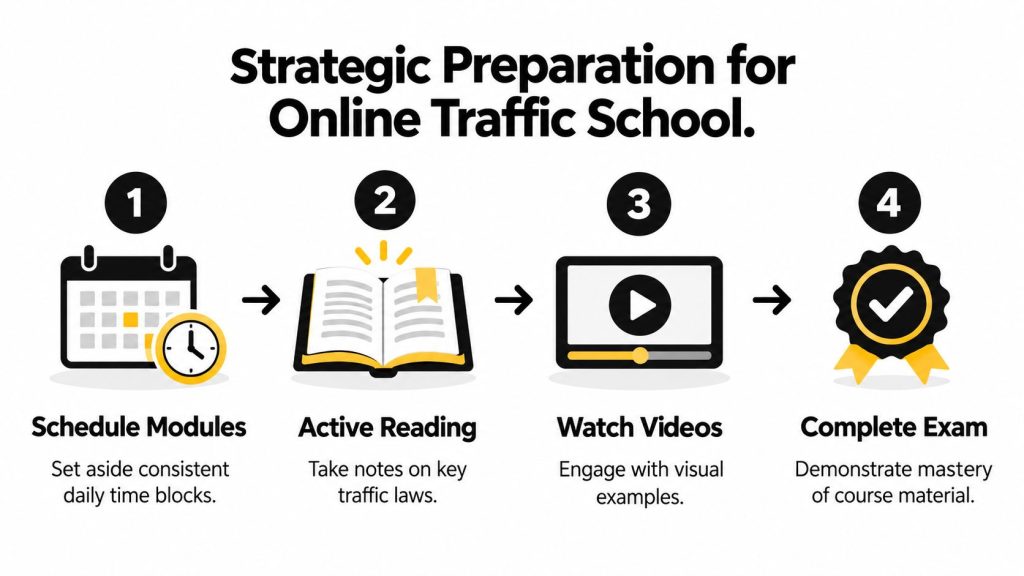
Begin by checking your court or licensing deadline. Then divide the course into manageable sessions instead of waiting until the final available day. A self-paced format, such as the one described on self-paced online course options, gives you flexibility, but flexibility only helps when you use it deliberately.
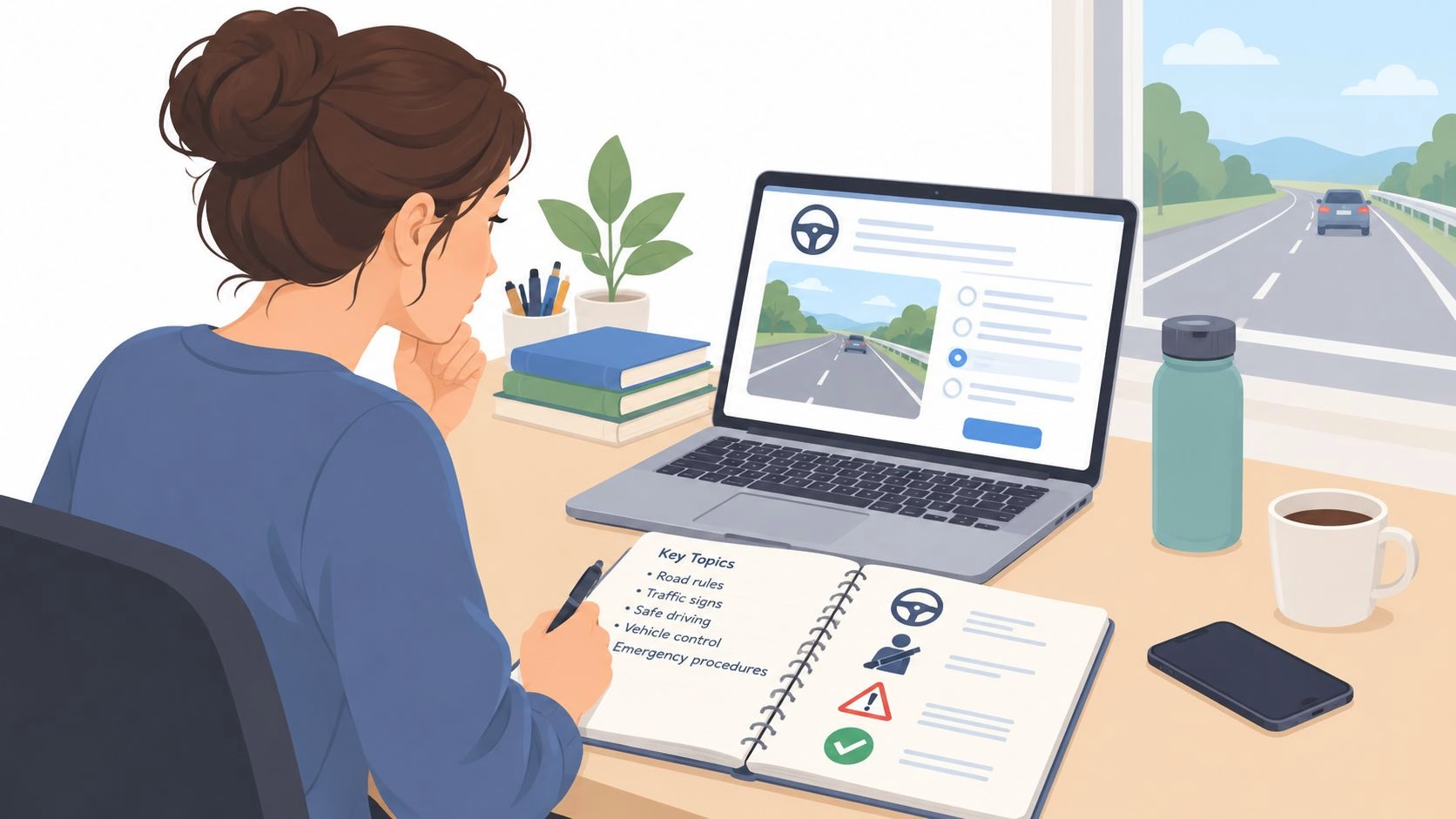
Read each lesson actively. Write down the rule, the situation where it applies, and the defensive response it requires. Notes such as �yield at an uncontrolled intersection� are more useful when paired with a practical reminder, such as �slow early and scan for a driver who may not yield.�
If the course includes video examples, watch them for decisions, not just completion. Ask yourself what the driver saw, what the driver missed, and which action created more space. That habit prepares you for questions that describe a developing hazard rather than naming the rule directly.
Use breaks to reinforce memory
Current Florida ADI course descriptions identify a 12-hour online structure with a mandatory 24-hour break after the first six hours, along with scenario-based lessons and short-response questions in some provider formats. The course format and study demands are described by Safe2Drive.
Use a required break as a memory checkpoint. Before stopping, summarize the main rules in your own words. When you return, review those notes before starting new material. That simple retrieval step is more effective than repeatedly replaying content without testing yourself.
Before the final exam, review your notes, course examples, traffic signs, right-of-way principles, and impaired-driving material. Don’t memorize isolated statute language if you can’t explain how the rule changes a driver’s decision.
Key Topics You Must Master for the Exam
The exam is easier when you understand the logic behind the rule. Most mistakes happen because students memorize a phrase, then encounter a question that changes the road layout, traffic condition, or driver behavior.
Defensive driving and space management
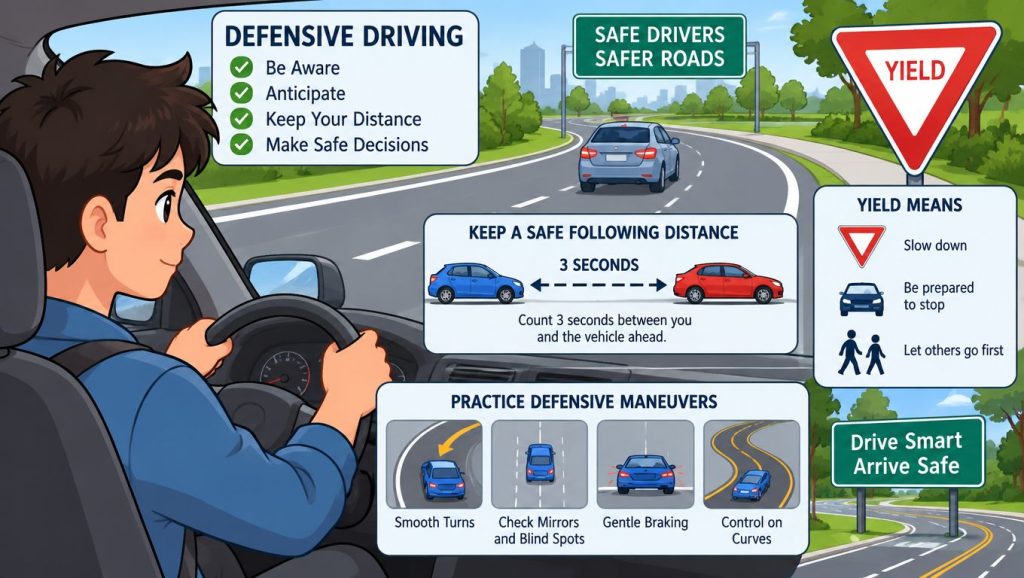
Following distance gives you time to see, decide, and act. Speed matters, but a driver traveling within the limit can still create danger by leaving too little room to stop when traffic compresses or visibility changes.
Study how scanning works in practice. Look beyond the vehicle directly ahead, check mirrors regularly, identify escape space, and notice pedestrians, cyclists, motorcycles, and vehicles entering from side streets. The strongest answer in a scenario question usually reduces conflict and preserves options.
Right-of-way and traffic control
Right-of-way rules don’t give a driver permission to proceed blindly. Even when another road user should yield, you still need to recognize the possibility that they haven’t seen you.
Learn the difference between a legal priority and a safe response. At an intersection, identify who arrived first, whether a signal or sign controls movement, and whether a pedestrian or emergency vehicle changes the situation. Then choose the action that avoids forcing another person to brake or swerve.
Impairment and distraction
Impairment includes more than alcohol. Fatigue, drugs, some medications, emotional agitation, and divided attention can all reduce a driver’s ability to notice hazards or judge speed.
The exam may present a choice that sounds convenient but creates risk, such as checking a phone at a red light or driving after taking medication that affects alertness. Focus on the principle behind the rule. A safe driver removes the source of impairment or distraction before moving.
Hazard recognition and crash prevention
A good answer anticipates risk instead of reacting at the last possible moment. Watch for blocked sight lines, changing weather, crowded lane merges, tailgaters, and drivers who appear uncertain.
The following video provides a visual refresher on defensive decisions and hazard awareness:
Education alone doesn’t always produce measurable safety improvements. A 2021 systematic review concluded that driver education generally did not reduce crashes or injuries, while a California evaluation found different outcomes between home-study and in-person mature-driver programs. The review and evaluation are discussed in the medical literature. That’s why real mastery matters more than remembering a list of Advanced Driver Improvement Course Answers.
Choosing the Right Course for Your Situation
The correct course depends on why you’re taking it, not merely on which course appears first in a search result. Registering for the wrong program can delay certification and create problems when the clerk or licensing agency reviews your completion.
| Situation | Course direction | What to confirm |
|---|---|---|
| Eligible moving violation | Basic Driver Improvement | Confirm that traffic school election is available for the citation |
| Court-ordered driver improvement | Intermediate Driver Improvement | Check the exact course named in the order |
| Habitual or aggressive driving concern | Aggressive Driver Course | Verify whether the order identifies behavioral or habitual-offender requirements |
| Suspension or reinstatement requirement | Advanced Driver Improvement | Match the course to the suspension notice and agency instructions |
Basic Driver Improvement, or BDI, is generally associated with eligible traffic violations and point-related relief. Intermediate Driver Improvement, or IDI, is used for more involved court requirements. The Aggressive Driver Course focuses on road rage, hostile decision-making, and behavioral change rather than a single isolated mistake.
An ADI course is a different level of obligation. Florida guidance identifies ADI completion after certain suspensions, including point-based suspensions, habitual traffic offender situations, or a court order. Read the notice carefully before enrolling, because the course name on the notice controls the decision.
A practical online interface also matters when you’re working around employment, childcare, or a court deadline. Review the user-friendly course interface before registering so you understand how lessons, progress, exam access, and certificates are handled.
You can compare available programs through the Florida traffic course catalog or review alternatives through DriverEducators’ course options. Select an approved course that matches the legal requirement, then confirm where and when the certificate must be filed.
Ethical Study Strategies Instead of Cheating
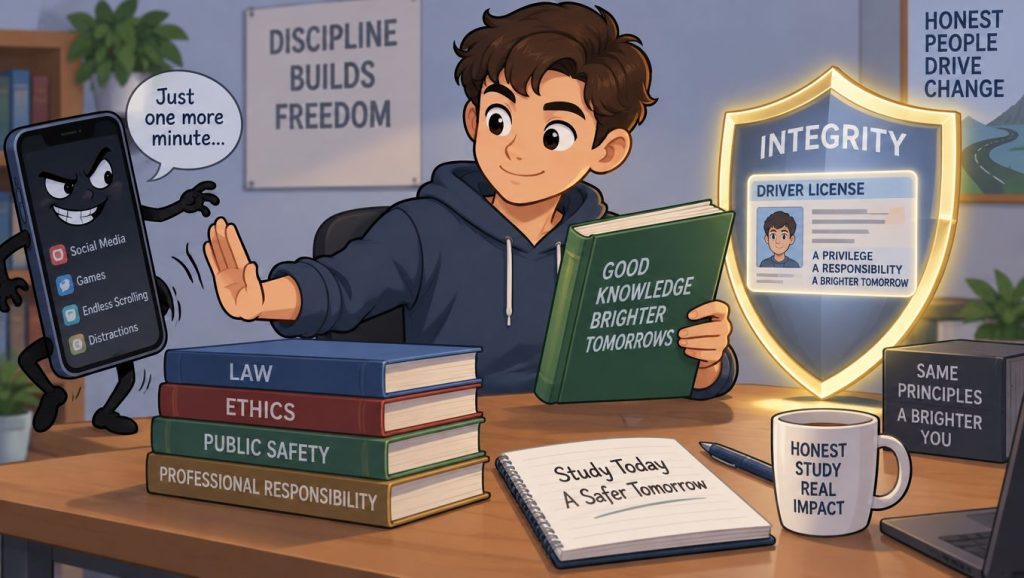
Searching for Advanced Driver Improvement Course Answers is understandable when you’re anxious and short on time. It’s also a weak strategy because a copied list may be outdated, incomplete, or based on a different provider’s question set.
The course material is the dependable reference. Read the explanation behind each answer, because scenario questions often test whether you can apply a principle when the road conditions change.
Use study aids that improve recall
Create flashcards for traffic signs, right-of-way decisions, impairment risks, and defensive driving terms. On the front, write the situation. On the back, write the safest response and the reason for it.
Practice with your own scenarios. Ask, �What would I do if the vehicle ahead stopped suddenly?� or �What changes if rain reduces visibility?� Answer aloud before checking the course material. Explaining the decision exposes gaps faster than rereading a paragraph.
A study partner can also help, but don’t turn the session into an exchange of unverified answers. Have each person explain why an option is correct and identify the safety principle that supports it.
The fastest honest preparation is active recall followed by verification in the approved course material.
Course design affects outcomes, too. In a North Carolina evaluation, the treatment group averaged 18.1% fewer violations per driver than the comparison group. An Arizona impact study found that nonparticipants had 32% more traffic violations within one year of the initial incident than program participants. The evaluation details are available from the Highway Safety Research Center.
Those findings don’t prove that every course produces the same result. They do support measuring behavior after completion rather than treating a quiz score as proof that driving habits changed.
Handling Difficult Questions and Exam Anxiety
A difficult question usually contains a clue. Read the entire scenario, identify the hazard, and ask which answer gives the driver the most time, visibility, and control.
Start by eliminating choices that require speeding up, tailgating, abrupt lane changes, or assuming another road user will behave perfectly. Then compare the remaining options against the course principle. The safest answer is often the one that creates space instead of claiming priority.
Break down scenario questions
Use this sequence:
- Identify the conflict. Is the issue speed, visibility, right-of-way, distraction, impairment, or following distance?
- Find the controlling rule. Look for the sign, signal, roadway condition, or behavior that changes the decision.
- Choose the lowest-risk response. Favor slowing, yielding, increasing space, or waiting when those actions prevent conflict.
- Check the wording. Watch for words such as �most appropriate,� �first,� or �safest,� because they may ask for the immediate response rather than the final outcome.
Anxiety can narrow attention and make a familiar question look unfamiliar. Take a slow breath, keep both feet grounded, and return to the facts in front of you. If test anxiety extends beyond this exam or interferes with daily life, Florida telepsychiatry for anxiety can provide context on professional support options.
You can also review strategies for overcoming driving anxiety before studying. If you don’t pass on the first attempt, don’t guess your way through a repeat. Note the topics that caused uncertainty, revisit those lessons, and retake the exam with a slower reading pace and a clear reference process.
Next Steps: Register and Start Your Course Today
Start by confirming the requirement on your notice, selecting the approved course that matches it, and allowing enough time to study. Florida’s official guidance says eligible drivers may receive an 18% reduction in citation fees and have points withheld by completing a driver improvement course, provided the election is made within 30 days. The certificate must then go to the Clerk of Court where the election was made. Review Florida’s traffic citation instructions before registering.
Course completion may be only one part of the process. Check whether your situation also requires advance notice to the clerk, payment of specific amounts, submission of a physical or electronic certificate, or compliance with a suspension-related instruction. Keep copies of every confirmation and submitted document.
The right course can help protect your driving record, satisfy a court or reinstatement requirement, and build safer habits beyond the exam. An insurer may offer a discount, depending on its rules and your eligibility. Ask what documentation the carrier accepts instead of assuming the discount applies automatically.
Study in a focused setting, organize your notes by topic, and explain each answer in your own words. You can access the VideoLearningAI platform for structured video learning, but verify driving information against your approved course material and Florida requirements. A direct answer key may seem faster, yet it leaves the reasoning untested and does little for real-world decisions.
Register through BDISchool, compare the available DriverEducators programs, and select the course that matches your notice. Give yourself time to understand the decisions behind the questions. That preparation is more reliable than guessing, and it carries onto the road after the certificate is issued.