Florida roads see over 400,000 crashes annually, with preventable errors causing the majority. Driver safety tips matter because they directly reduce your risk of becoming part of that statistic.
We at floridanewdriver.com know that safer driving starts with understanding what actually works. This guide covers defensive techniques, common hazards, and tools that make a real difference on the road.
Maintain Proper Following Distance
The Three-Second Rule Saves Lives
The three-second rule isn’t a suggestion-it’s the minimum distance that keeps you alive. When the vehicle ahead passes a fixed object like a sign or road marking, start counting 1,001, 1,002, 1,003. If you reach that same object before you reach 3, you’re too close. Conditions demand adjustments: rain or fog require four or five seconds, while snow demands six seconds minimum.
Most drivers dramatically underestimate stopping distance. At 55 mph, your vehicle travels about 121 feet per second. Full braking takes roughly 300 feet, and reaction time adds another 55 feet. Three seconds provides approximately 165 feet of buffer-that’s why the rule exists.
How to Count the Three Seconds Correctly
Pick a fixed object ahead-a road sign, utility pole, or pavement marking. When the vehicle in front passes it, start counting: “one-one-thousand, two-one-thousand, three-one-thousand.” If you pass the object before you finish counting, you’re tailgating. This method works at any speed and adapts instantly to changing conditions. Wet roads, heavy traffic, or tired drivers all warrant longer intervals.
Reading Traffic Patterns Two Moves Ahead
Defensive drivers scan far down the road, not just at the bumper ahead. Alternate regularly between scanning the road ahead and checking your mirrors every few seconds. Watch for patterns in traffic flow-when multiple vehicles start braking, something’s changing ahead.
Anticipate other drivers’ movements by noticing small signals: a vehicle drifting slightly toward your lane, a pedestrian stepping toward the curb, a driver checking their phone. These visual cues appear seconds before dangerous actions happen. Aggressive drivers and impaired drivers often exhibit erratic lane position changes and unpredictable speed adjustments (sudden acceleration followed by hard braking signals impairment or distraction). When you spot these patterns, increase your following distance and avoid positioning yourself beside them.
Positioning Yourself for Safety
Your job is to predict what others will do, not react after they do it. Stay out of blind spots where other drivers can’t see you. Position your vehicle so you have an escape route if the car ahead stops suddenly. Avoid the middle lane on three-lane highways-it traps you between faster and slower traffic. On two-lane roads, stay toward the right side to maximize your reaction space if an oncoming vehicle drifts into your lane.
These defensive positioning strategies work together with proper following distance to create layers of protection. The next section explores how distracted driving and phone use destroy your ability to execute these techniques effectively.
Common Driving Hazards and How to Avoid Them
Phone Use Kills More Than Alcohol
Phone use while driving kills more people than alcohol impairment in many years, yet drivers treat it as a minor distraction. The National Highway Traffic Safety Administration reports that distracted driving creates enormous potential for deaths and injuries on U.S. roads. One glance at your phone takes your eyes off the road for five seconds, which at 55 mph means traveling the length of a football field blind.
Your brain cannot simultaneously process text messages and driving decisions. Some drivers believe they can handle it because they’ve done it hundreds of times without crashing. That’s survivorship bias, not skill.
The solution isn’t willpower; it’s elimination. Put your phone in the trunk, glove compartment, or backseat before driving. Apps like Safe 2 Save reward users for not touching their phones during trips, turning abstinence into a competition that actually works.
Fatigue Destroys Your Reaction Time
Impaired driving and fatigue operate through different mechanisms but produce identical results: delayed reaction times and poor decision-making. NHTSA estimates that in 2017, 91,000 police-reported crashes involved drowsy drivers, leading to an estimated 50,000 people injured and nearly 800 deaths.
Drivers who’ve been awake for 18 hours drive as impaired as someone with a blood alcohol content of 0.05 percent. Unlike alcohol impairment, which drivers recognize as dangerous, fatigue creeps up gradually. You don’t suddenly become unsafe; you gradually lose the ability to process threats.
The three-second rule you learned earlier becomes impossible to execute when your reaction time doubles. If you feel your eyelids drooping, pull over immediately-not at the next exit, but at the nearest safe shoulder. Coffee doesn’t fix fatigue; it masks it temporarily while your cognitive decline continues.
Aggressive Drivers Force Confrontations
Aggressive driving and road rage represent a choice, not an involuntary reaction. Aggressive drivers deliberately speed, tailgate, brake-check other vehicles, and cut people off to express anger or dominance. NHTSA estimates that aggressive driving contributes to two-thirds of fatal crashes.
The difference between defensive driving and aggressive driving is simple: defensive drivers assume others will make mistakes and prepare escape routes; aggressive drivers force confrontations. If someone tailgates you, don’t brake-check them-increase your following distance and let them pass.
If someone cuts you off, don’t accelerate to block them. Your job isn’t to punish bad drivers; your job is to reach your destination safely.
Road Rage Escalates Into Violence
Road rage incidents have escalated since 2020, with more drivers carrying weapons in their vehicles. Engaging with an aggressive driver transforms a traffic incident into a potential violent confrontation.
The safest response is always disengagement: avoid eye contact, don’t gesture, and create space between your vehicle and theirs. Technology now offers tools to monitor your own driving behavior and reinforce safer habits, which we explore in the next section.
What Actually Works to Prevent Crashes
Automatic Braking Systems Cut Crashes in Half
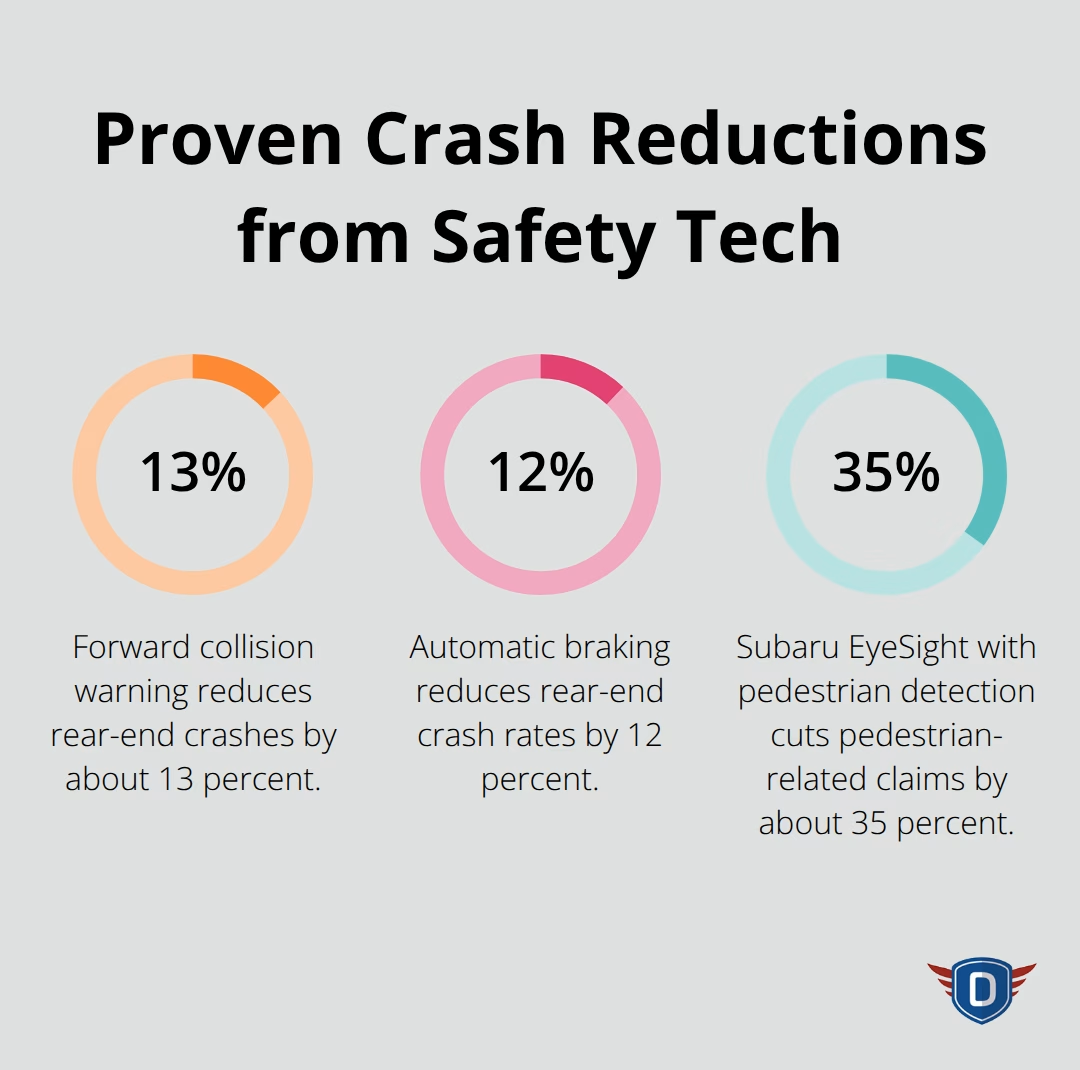
Automatic braking systems reduce rear-end crashes, according to the Insurance Institute for Highway Safety. Forward collision warning alone reduces rear-end crashes by about 13 percent, while automatic braking reduced rates by 12 percent. These aren’t theoretical improvements-they’re real reductions measured across thousands of insurance claims.
Subaru EyeSight with pedestrian detection reduced pedestrian-related claims by about 35 percent, proving that bundled safety features work better than single systems. Modern vehicles catch threats your brain misses, which is why manufacturers now bundle multiple crash avoidance technologies into standard packages.
Dashcams Document What Prevention Misses
A dashcam like the Vantrue N4 provides front, cabin, and rear recording with collision and motion detection, serving a different purpose than automatic braking. It documents what happened after a crash occurs, giving you evidence for insurance claims and liability disputes. The Vantrue N4 offers high-resolution footage across three angles, making it the most practical choice for drivers who want protection beyond what their vehicle’s safety systems provide.
GPS Trackers Reveal Dangerous Habits
A GPS tracker such as Bouncie plugs into your OBD-II port to monitor driving behavior, location, and vehicle health, with alerts for erratic driving patterns that signal you’re developing dangerous habits. These tools work together: your vehicle’s automatic braking prevents the crash, your dashcam records it if prevention fails, and your behavior tracker helps you spot dangerous patterns before they cause an accident.
Defensive Driving Education Reduces Crashes
Defensive driving education programs deliver measurable results that crash avoidance technology alone cannot achieve. Defensive driving courses reduce auto insurance premiums by 5% to 15% depending on your insurer and state, but the real benefit is improved hazard recognition and faster decision-making.
Defensive driving curriculum covers emergency techniques, fatigue management, road rage de-escalation, and the specific traffic laws that cause the most crashes on Florida roads. Video-based instruction with real-world driving scenarios keeps engagement high, and completion certificates are delivered electronically and reported directly to the Florida Department of Highway Safety and Motor Vehicles.
Technology and Education Work Together
The combination of technology, tools, and education creates the strongest defense against becoming part of Florida’s 400,000 annual crashes. Technology catches what your attention misses; education teaches you what to look for before technology needs to intervene. Your vehicle’s automatic braking system handles split-second reactions your reflexes cannot match, while defensive driving training sharpens your ability to anticipate threats before they require emergency intervention.
Final Thoughts
Florida’s 400,000 annual crashes stem from preventable errors: poor following distance, distracted driving, fatigue, and aggressive behavior. Driver safety tips work because they address these root causes directly, and technology like automatic braking and dashcams provides backup when your attention fails. Your judgment and attention remain irreplaceable, however, and no safety system can substitute for an alert, defensive driver.
Three elements combine to create safer streets: defensive techniques that anticipate threats before emergencies occur, awareness of hazards that destroy your reaction ability, and tools that reinforce safer habits over time. When you maintain proper following distance, you prevent chain-reaction crashes that injure multiple drivers. When you refuse to engage with aggressive drivers, you eliminate escalation that transforms traffic incidents into violent confrontations. When you stay alert and fatigue-free, you protect pedestrians and cyclists who depend on your reaction time.
We at floridanewdriver.com offer Florida-approved traffic school courses that strengthen your defensive driving skills and keep your record clean. Our courses cover the exact techniques discussed here, delivered through self-paced online instruction with completion certificates reported directly to the Florida Department of Highway Safety and Motor Vehicles. Enroll at floridanewdriver.com to start practicing safer driving today.