
A standard Florida Class E original license or renewal is $48. A replacement is $25, and a late renewal adds $15, before any office or online fee.
That sticker is not the number people remember. An eight-year Class E works out to about $6 a year before a tax-collector or portal charge, which is why two neighbors can both say they “just paid the FL drivers license fee” and still leave with different receipts. One renewed on time. The other paid after the card expired, in a different lane, with a service charge stacked on the delinquent add-on. The card price and the citation bill are separate purchases. A driving course does not pay for the plastic, and the plastic does not pay a ticket.
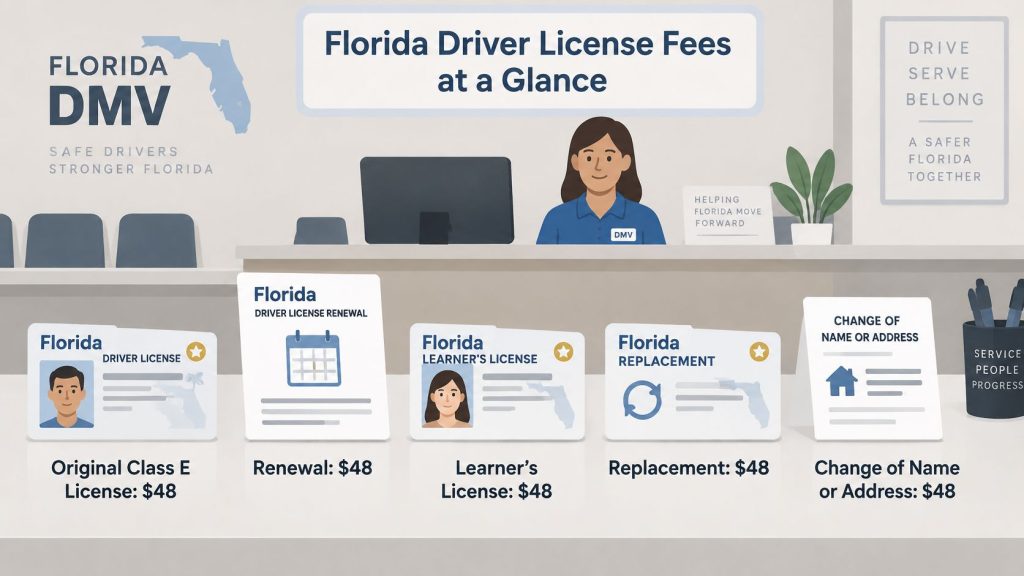
Florida Driver License Fees at a Glance
The Florida Highway Safety and Motor Vehicles FAQ sets the standard Class E fee at $48 for an original license and for a renewal. FLHSMV states that a Class E license is generally valid for eight years for drivers younger than 80, and that drivers aged 80 and older typically receive a six-year credential. The same page puts a learner’s license at $48, a replacement at $25, and a renewal after expiration at $48 plus a $15 delinquent fee, for a basic late total of $63.
Say two neighbors both renewed a Class E last month. One finished online while the card was still valid. The other waited until it was expired and paid at a county tax collector. Both will tell you Florida has “one price.” Their receipts will not match, because the FL drivers license fee follows the transaction, not a single statewide sticker.
Four buckets on the receipt
Keep these buckets apart or the math gets muddy.
- Base credential fee: The published charge for the card itself, before any lane add-on.
- Channel add-on: A tax-collector service fee or an online processing fee, charged because of where you pay.
- Class or waiver exception: A commercial class, an age-based term, or a stolen-card waiver that changes the row.
- Citation bill: The fine, court costs, and any traffic course. That purchase does not buy the license.
Florida base driver license fees in 2026
These rows are the base credential fees from FLHSMV and statute, before any channel or office charge. They are licensing charges, not a driving-school price.
| Transaction | Base fee | Term or note |
|---|---|---|
| Original Class E | $48 | Generally 8 years if under 80 |
| Class E renewal | $48 | Typically 6 years if age 80 or older |
| Original or renewal learner’s license | $48 | Same base as Class E |
| Replacement for lost, stolen, or changed credential | $25 | Base fee before any office charge |
| Renewal after expiration | $63 | $48 plus $15 delinquent fee |
| Class A commercial license | $75 | 2026 FLHSMV Class A fee |
An eight-year card at $48 is about $6 per year before service or processing charges. A driver who is 80 or older pays that same $48 and receives the shorter term. Age changes the length of the credential. It is not a discount off the base.
Practical rule: Quote the base from the row that matches the transaction, then add only the charge for the lane you actually use.
The next comparison is the channel math. There is no single universal FL drivers license fee once the office or the portal touches the transaction.
Counter and Online Totals Compared
Treat the published fee like a menu price, then read the service charge on the receipt. The Class E sticker can be $48 while the total you pay is not.
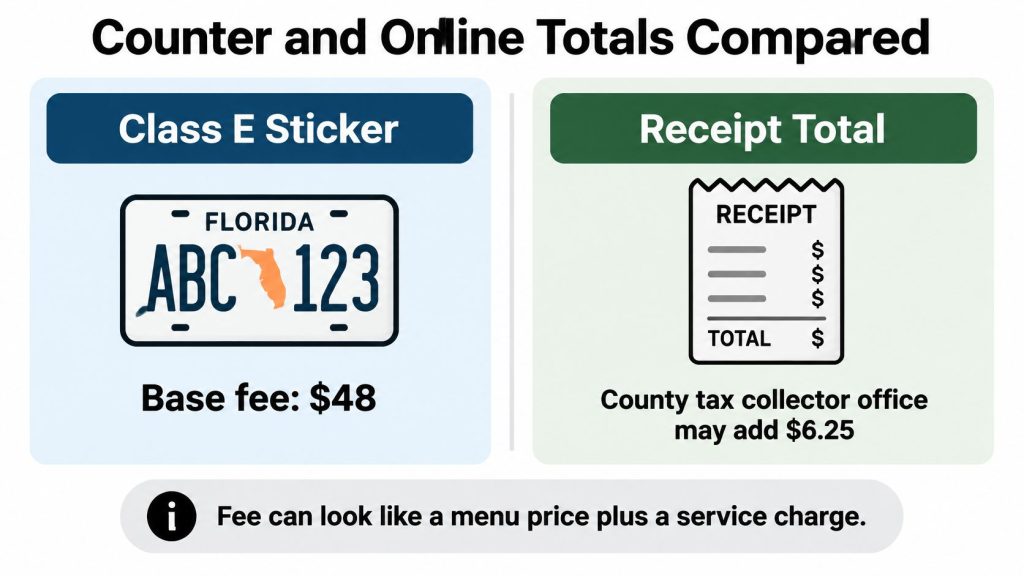
The FLHSMV fee page reports that county tax collector offices may add a $6.25 service fee to an applicable driver-license transaction. Online transactions through the state’s MyDMV Portal include a non-refundable $2 processing or convenience fee. The credential is the grocery item. The portal or the tax office is the lane fee. Paying in the wrong lane does not change the state’s base.
Three finished totals
An on-time $48 renewal may total $50 online or $54.25 at a participating tax collector, depending on the channel and eligibility. A replacement listed at $25 can become $31.25 at a tax collector office. Those are finished receipt totals, not guesses layered on top of a mystery fee.
| Where and what | Base fee | Add-on | Estimated total |
|---|---|---|---|
| On-time Class E renewal online | $48 | $2 non-refundable | $50 |
| On-time Class E renewal at tax collector | $48 | $6.25 | $54.25 |
| Replacement at tax collector | $25 | $6.25 | $31.25 |
| Stolen replacement in person with police report and no changes | $25 listed | Fee may be waived | $0 |
Rows that break the pattern
Online renewal is only for eligible customers. Florida’s renewal cycle is generally every eight years, and the state permits online renewal when you qualify. A customer who used the online service at the last renewal may need to appear in person next time. Eligibility is a gate, not a coupon.
A stolen license replacement fee may be waived when the applicant provides a police report in person and makes no changes to the credential. That row is a waiver, not a discount code you type at checkout. Mail the report, change the address, or skip the counter, and you should not expect a zero receipt.
If you are eligible and on time, online is the lower add-on. If identity, a waiver, or eligibility forces a visit, budget the $6.25.
Commercial, Age, and Waiver Exceptions
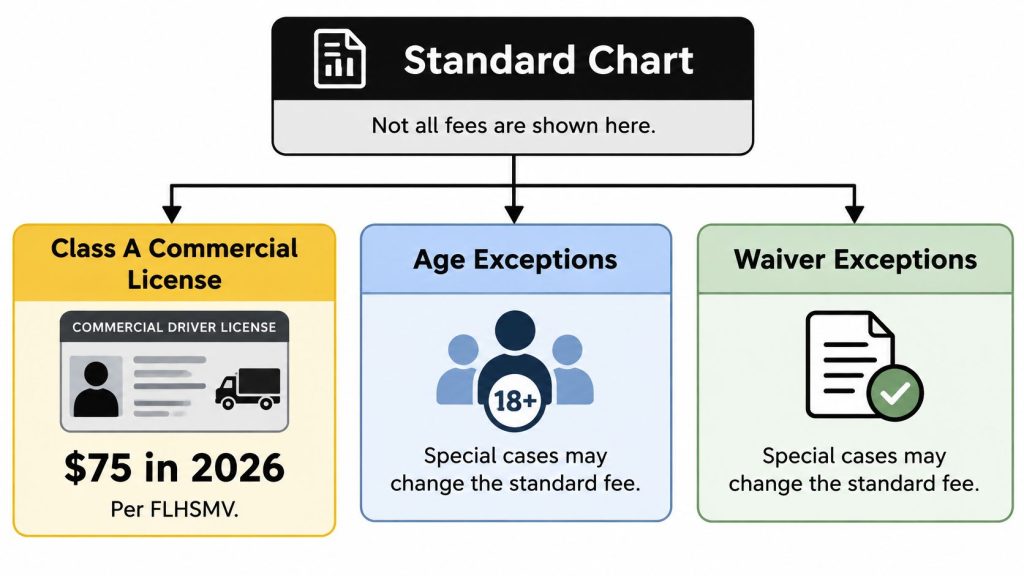
A Class E renewal sticker is not the price of every card Florida prints. A commercial class, a shorter senior term, and a stolen-card waiver each change the receipt you should expect. None of them folds a citation or a traffic-school charge into that same total.
In 2026, the Florida commercial driver license (Class A) fee is $75.00, according to FLHSMV’s new-resident guidance. That published figure is the base. A new Class A applicant starts there, before any office add-on the counter may attach.
Class B, Class C, and endorsement amounts are not on the base chart above. Confirm them on the current FLHSMV fee page before a commercial visit. An endorsement is its own credential, with its own eligibility. Guessing a price for it sends you to the window with the wrong cash.
Age changes the term, not the sticker
Age works like a shorter subscription sold at the same cover price. An 82-year-old renewing a Class E on time still starts at the standard renewal amount and receives a six-year card.
The shorter credential is the whole difference. Nothing in that rule cuts the base in half or waives a lane charge.
If you are sorting out when a younger driver can hold a card at all, those rules sit on a different page from the fee chart, including when a Florida license can be issued by age.
A stolen card is a narrow exception
A stolen-card replacement can be a narrow exception to the listed replacement fee. It is not a courtesy you can reshape. A replacement that also updates an address or a name should not be described as free. People lose the exception by editing the request until it is no longer the same credential coming back.
The license receipt still stops at the credential. A citation bill, and any course you take because of that citation, stay in their own budget.
�
How to Pay the Office
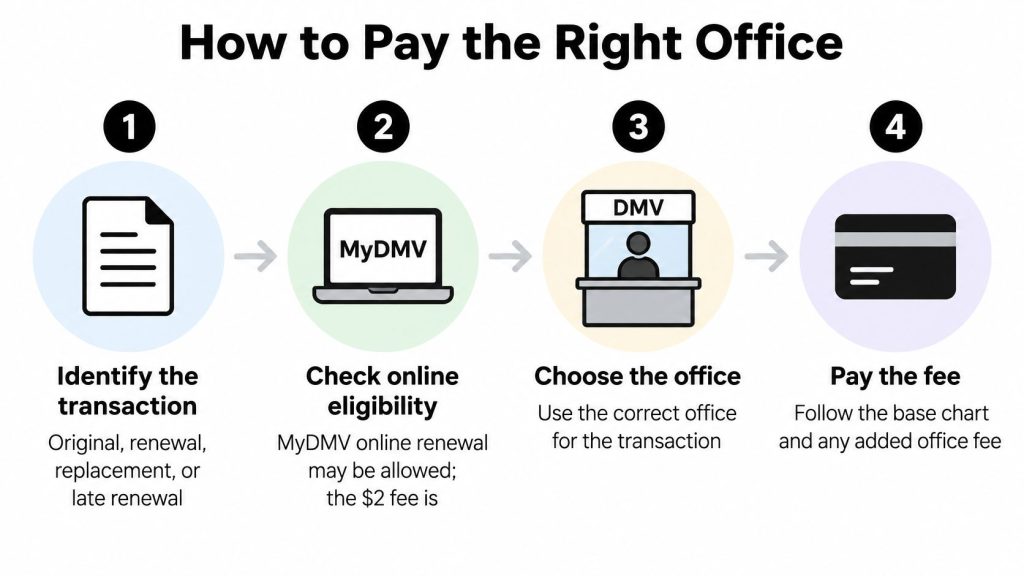
- Name the transaction on the base chart. Original, renewal, replacement, or late renewal. If you label a late card as a plain renewal, you will under-budget before you ever pick a lane.
- Check whether MyDMV online renewal is allowed. The online processing fee is non-refundable, so an ineligible attempt still costs you the convenience charge without producing a card. A customer who used online convenience last cycle may need to appear in person this time. That is the toll-lane problem: the cheap lane can be closed even when the sign is still up.
- If a visit is required, use a driver license service center or a county tax collector. Budget the possible service fee at the tax collector. Choosing the office because it is closer does not remove that add-on.
- Bring the identity and residency documents FLHSMV requires for that transaction, and bring the old card if it still exists. A missing document turns a renewal into a second trip. The documents to bring to a Florida DMV visit are the practical packing list, separate from the fee itself.
- For a stolen license, bring the police report, request the waiver in person, and avoid credential changes if the goal is a waived replacement fee. A report sent by mail, or a visit that also changes the name, is a different transaction.
- If the card is already expired, expect the renewal amount plus the delinquent fee before any lane charge. Forgetting that add-on is the most common underpayment at the counter.
- Pay with a method that office or portal accepts, and keep the receipt. The receipt is the proof of which add-on was charged. Without it, you cannot tell a base fee from a service fee later.
Done looks specific. The credential term matches your age, and the total matches one channel row: online with the small processing fee, counter with the service fee, late with the delinquent fee included, or a stolen replacement at zero only when the waiver conditions were met.
Citation Costs That Sit Beside the License Fee
The card fee does not pay a ticket, and a traffic course does not replace a renewal. Florida sets license charges in statute, and the English driver handbook treats those charges as separate from traffic-school or court costs. Drivers answering a citation should budget the civil fine, the approved course, and any licensing fee that happens to fall in the same month. The course is not a substitute for every required payment.
The 30-day election
A driver who receives an eligible non-criminal moving violation may elect a state-approved Basic Driver Improvement course instead of having points assessed. The FLHSMV driver improvement schools page says the election must be made through the appropriate county court within 30 days of the citation. You must also pay the citation fine and fees within that period and complete the course by the court’s deadline.
Missing the election or the payment deadline can result in points. Failing to complete the course can lead to license suspension. Florida limits this option to once in any 12-month period and no more than eight elections during a lifetime, effective July 1, 2024.
Speed cases are where people miss the window. If the citation is a speed case, read the Florida speeding rules that sit next to a citation before you assume every ticket qualifies.
What a correct election does
When the election is done correctly, adjudication is withheld, no points are assessed for that violation, and an insurer generally may not impose an additional premium or refuse renewal solely because of that non-criminal infraction. The FLHSMV traffic citations page also states that electing a course may reduce citation fees by 18%, although the exact civil fine remains a matter for the county clerk or court.
The protection has exceptions. A second infraction within 18 months, a third within 36 months, or speeding more than 15 mph over the limit can take the insurance shield off the table. Do not treat the course as a blanket eraser.
Three checks, not one: the civil fine the clerk quotes, the course fee, and any license fee due the same month. Fill the first number from the clerk. Do not borrow it from the license chart.
Start a State-Approved Course on Time
The fee chart cannot decide this part. If the only task is a renewal or a replacement, pay the matching FLHSMV total and stop. A course will not shrink that receipt.
If an eligible moving violation is still inside the 30-day window, elect a state-approved Basic Driver Improvement course with the county court, pay the clerk, and start the course before the court’s deadline. The course helps drivers avoid points on their driver license. It is state-approved and meets the requirements set by the Florida DMV, and it is four hours long. Finishing it is the path that helps eligible drivers avoid points on the license. The cheapest license math is wasted if a missed election adds points and a possible suspension.
Browse the course lists at BDISchool courses and Driver Educators courses for Basic Driver Improvement, intermediate or aggressive-driver programs, and mature-driver refreshers. Confirm each course is state-approved and matches the court or insurance requirement before you register. A first-time permit student is a different enrollment from a citation election, which is why the Florida driver permit course is not the same signup as a four-hour traffic school after a ticket.
Match the citation to an approved course today, and match the card transaction to the fee chart separately.
BDISchool offers Florida-approved Basic Driver Improvement and related traffic courses for drivers who need to answer an eligible citation without confusing that bill with the license fee. You can study online, on your schedule, and keep the card payment as its own transaction at FLHSMV. Visit BDISchool to register and start the course that matches your court or insurance requirement.