Getting your Florida learner's permit is a huge step toward independence, but the rules of the road are changing before you even get on them. Big updates are coming in 2026, and if you're a teen driver (or the parent of one), you need to know what�s ahead to avoid any roadblocks in your application process.
Understanding The New 2026 Permit Requirements
Florida is overhauling its approach to teen driver education. For years, teens could knock out a simple, four-hour online course to meet the state's requirements. That's all changing. The old system is being replaced with a much more thorough program designed to give new drivers a stronger foundation from the start.
The biggest shift is the new mandatory six-hour Driver Education Traffic Safety (DETS) course. This new rule kicks in on August 1, 2025, and completely replaces the old Traffic Law and Substance Abuse Education (TLSAE) course for all first-time teen drivers. A key difference? The DETS course must include live instruction, a significant change from the self-paced, online-only format many are used to.
Why The Change to a New Course
This wasn't just a random update; it was a decision driven by some pretty serious statistics. Data consistently shows that teen drivers have a fatal crash rate nearly three times higher than drivers over the age of 20. To tackle this, Florida lawmakers introduced the DETS course to provide a more robust education on traffic laws, defensive driving, and how to manage real-world risks.
The goal is straightforward: better, more comprehensive training before a teen gets behind the wheel leads to safer driving habits. It's a proactive step to give young drivers the critical thinking skills they need for today�s busy roads.
The new rules also set a clear timeline. You can now take the six-hour DETS course as soon as you turn 14 � years old. Just remember, you still have to wait until you are at least 15 years old to actually go to the DMV and apply for your permit.
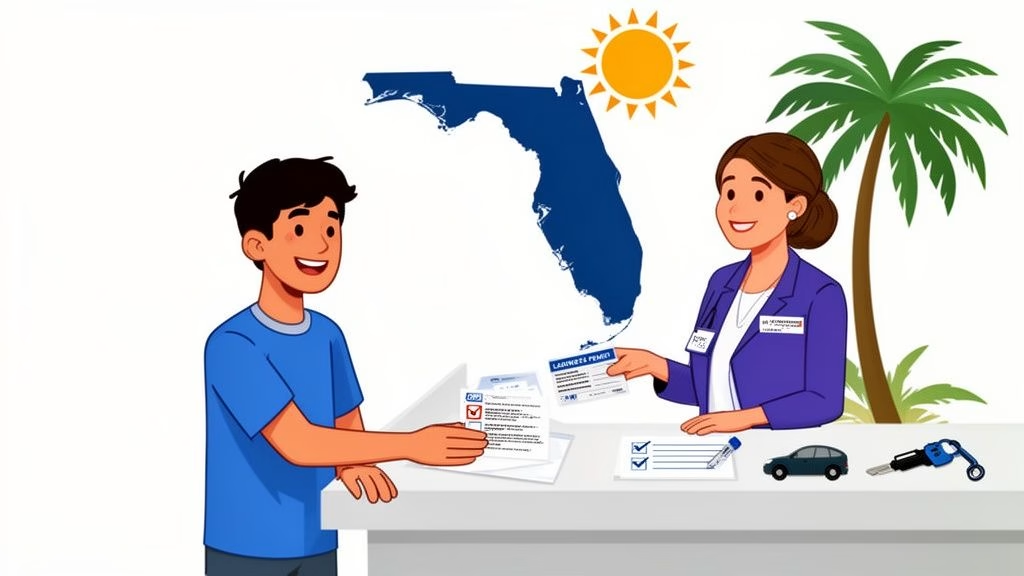
This graphic breaks down the new process perfectly.

As you can see, completing the DETS course is a non-negotiable first step that has to happen after you turn 14 � but before you can apply for your permit at 15.
To keep everything clear, here's a quick summary of the essential requirements you'll need to meet.
Quick Checklist for Your Florida Learner's Permit
Here's a quick summary of the essential eligibility criteria and requirements you must meet to apply for your learner's permit in Florida.
| Requirement | Details |
|---|---|
| Minimum Age | You must be at least 15 years old to apply. |
| Required Course | You must complete the six-hour DETS course, which can be taken at age 14 �. |
| Live Instruction | The DETS course includes a mandatory live instruction component. |
| Parental Consent | A signed Parental Consent Form is required for all applicants under 18. |
| Knowledge & Vision Tests | You must pass both the vision and the Class E Knowledge Exam. |
This checklist covers the high-level points you need to tick off before heading to your appointment.
How This Affects Your Permit Plan
So, what does this all mean for you? It means you have to plan ahead. The old TLSAE course could be finished in an afternoon, but the new DETS course is a bigger commitment. Since it involves live instruction, you can't just log on whenever you want.
Here's what I recommend:
- Start Early: Don't wait until you're a month away from your 15th birthday. Begin looking for an approved DETS course provider as soon as you're 14 �.
- Factor in Scheduling: Live classes mean set schedules. You'll have to find a course that fits your availability, which might take some coordination.
- Budget Accordingly: A longer, more involved course will likely have a different price tag than the old four-hour program. Be sure to factor this into your budget.
Getting ahead of these changes will save you a lot of stress. While the old system was quick, the new one is all about building safer drivers for life. If you previously took the old TLSAE, it�s a good idea to review our guide on the drug and alcohol course in Florida to see how it compares to these new requirements.
Gathering Your Essential Documents and Forms
I can't tell you how many times I've seen teens walk out of the driver's license office disappointed. The single biggest reason? Showing up unprepared. The Florida Department of Highway Safety and Motor Vehicles (FLHSMV) is incredibly specific about the paperwork they need, so getting everything organized before you go is the secret to getting your permit on the first try.
Think of it less like an application and more like building a file to prove who you are and that you live in Florida.

Florida uses a system to verify your identity, and it�s not as simple as just flashing one ID. You�ll need specific documents for a few different categories. Getting this part right is the difference between a quick, successful trip and a frustrating one.
Proving Your Identity and Social Security Number
First things first, you have to prove you are who you say you are. This means bringing a primary identification document, and it absolutely must be an original or a certified copy. They will not accept photocopies, so don't even bother bringing one.
Your best bets for primary ID are:
- An original U.S. Birth Certificate (the official one from the office of vital statistics, not the hospital keepsake).
- A valid, unexpired U.S. Passport.
- A Certificate of Naturalization.
Next, you'll need to prove your Social Security number. The most straightforward way is to bring your original Social Security card. If that card has gone missing�which happens more often than you'd think�you can also use other official documents like a W-2 form, a pay stub that shows your full SSN, or an SSA-1099 form.
Pro Tip: Don't start hunting for your birth certificate or Social Security card the night before your appointment. These documents can take weeks to replace if you can't find them. Locate them the moment you decide to start the permit process.
With your identity established, it's time to prove you're a Florida resident.
Verifying Your Florida Residential Address
This is where a lot of people stumble. You need to bring two separate documents showing your current residential address. Bringing only one, or bringing documents that aren't on the approved list, is a guaranteed way to get turned away.
The name and address on these documents have to match what you put on your application.
Acceptable Proofs of Address:
- Mail from a bank or other financial institution (like a bank statement).
- A utility bill in your name (power, water, etc.).
- Your school transcript for the current academic year.
- Official mail from a government agency (federal, state, or local).
So, for example, you could use a recent electric bill and your latest report card. If you're a minor and all the bills are in a parent's name, don't worry. Your parent can come with you and sign a certification form on-site to attest that you live at their address.
The Critical Parental Consent Form
If you are under the age of 18, there is absolutely no way to get a learner's permit without parental consent. This isn't just a verbal "okay"�it has to be done officially using the Parental Consent for a Driver Application of a Minor form (HSMV Form 71142). You can find and download this form right from the FLHSMV website.
Your parent or legal guardian has to sign it, but here's the key: they must sign it either in front of the driver's license examiner at your appointment or in front of a notary public beforehand. If your parents are divorced, the parent with legal custody is the one who needs to sign.
If you go the notary route, double-check that the seal is clear and the date is correct. A sloppy notarization can get your form rejected, and you'll have to come back another day. Nailing your paperwork is just as important as knowing the rules in the official Florida driver's manual, as it�s your ticket to a smooth and successful first visit.
Passing the Florida Class E Knowledge Exam
Alright, with your paperwork sorted, it�s time to focus on the biggest hurdle for most aspiring drivers: the Class E Knowledge Exam. I've seen countless teens (and parents) get worked up about this test, but a little smart preparation makes all the difference. Think of it less as a memory test and more as learning the actual rules of the road you'll use every day.
The exam itself is a 50-question multiple-choice test. It pulls everything directly from the Official Florida Driver License Handbook�consider that book your bible for the next few weeks.
To pass, you need to answer at least 40 questions correctly, which is an 80%. If you miss the mark, don't panic. You can take it again, but you�ll have to pay another fee for each attempt. A bit of studying upfront will definitely save you time and money.
How to Actually Study for the Permit Test
Just reading the handbook from front to back probably won�t cut it. You need a real strategy. I�ve seen what works, and it�s all about studying actively. Break it down into smaller pieces and really get a feel for the material.
Here�s an approach that gets results:
- Hit the Important Stuff First: Some topics are guaranteed to show up. Spend extra time on right-of-way rules, what to do at different intersections, all the various speed limits, and the laws around parking. Fines and penalties are big ones, too.
- Don't Just Look at the Signs: The test is split into two parts: road rules and road signs. Seriously, make flashcards. You need to know the meaning of every shape and color instantly, not just guess.
- Take Practice Exams: This is non-negotiable. You have to see what the real questions feel like. Taking a Florida DMV permit practice test is the best way to find out what you don't know before it counts.
This method helps you study smarter. You�ll be prepared for the tricky questions that often trip people up.
The number one reason people fail the permit test is because they don't take it seriously. They figure it's all common sense and barely crack open the handbook. Treat it like a final exam at school, and you'll walk in there ready to ace it.
Taking the Test Online vs. In Person
You've got a choice to make: take the exam online from home or head down to a driver license service center to do it in person. Each route has its ups and downs.
Let�s break down how they compare.
| Feature | Taking the Test Online | Taking the Test In Person |
|---|---|---|
| Convenience | Can't be beat. Take it from your own computer, on your own time. | You have to book an appointment and drive to the service center. |
| Environment | Much more relaxed. Being in a familiar space can really help with test nerves. | Formal, structured setting. Some find it a bit distracting. |
| Supervision | A parent or guardian has to proctor you and sign a form. | A state examiner watches you directly. |
| Cost | You'll pay a fee to the third-party company that provides the test. | The first attempt is included in your standard permit application fee. |
| Retakes | If you fail the online test, your next attempt must be in person. | All retakes are handled right there at the service center. |
For a lot of families, taking the test online is a no-brainer. It's just easier and a lot less stressful. But�and this is a big one�if you are under 18 and you fail the online test, you lose that privilege. All your future attempts have to be made in person at a service center.
The upside of testing in person is that it�s a one-stop-shop. Once you pass the knowledge exam, you can move straight to the vision test, get your picture taken, and walk out with your learner's permit in hand. The best option really just comes down to what works for you and your test-taking style.
Your First Year of Supervised Driving
Getting your Florida learner's permit is a huge moment�congratulations! But the real learning starts now. Think of this next year not as a waiting period, but as your hands-on apprenticeship in becoming a safe, confident driver.
This is where you'll build the judgment and muscle memory that will stay with you for life.

Before you even think about putting the car in drive, know this: you are never to drive alone with a learner's permit. Florida law is strict and for good reason�you must always have a licensed driver who is at least 21 years old right there in the front passenger seat. No exceptions.
Mastering the Driving Curfews
Florida also puts time-based rules on your driving to keep you out of higher-risk situations while you're still new to the road. It�s a phased approach.
For the first three months with your permit, you can only drive during daylight hours. After that initial period, you get a little more freedom, but you still need to be off the road by 10:00 p.m.
I always tell new drivers to see these curfews as a training roadmap. Your first goal is to master driving in broad daylight before tackling the added challenges of night driving.
The 50-Hour Driving Log: Your Key to the Next Level
This brings us to a crucial piece of the puzzle: your driving log. To be eligible for an intermediate license, Florida requires you to document at least 50 hours of supervised driving. Don't take this lightly�the FLHSMV expects this log to be accurate and complete.
A non-negotiable part of that log is that 10 of those 50 hours must be at night. Driving after dark is a completely different skill set, involving headlight glare, poor visibility, and difficulty judging speed and distance. Getting these practice hours is essential.
Here�s how to make those 50 hours truly count:
- Get Detailed: Don't just jot down "1 hour of driving." Log the specific date, start/end times, and note what you worked on. For example: "Practiced three-point turns and parallel parking in the neighborhood" or "Drove on I-4 during moderate traffic."
- Seek Out Variety: Sticking to your quiet subdivision won't prepare you for the real world. Make a point to practice in different settings: downtown traffic, multi-lane highways, winding rural roads, and chaotic mall parking lots.
- Don't Fear Bad Weather: Anyone can drive when it�s sunny and 75 degrees. Ask your supervising adult to take you out in the rain. Learning to manage slick roads and low visibility is one of the most valuable lessons you can get.
Logging your hours isn't just busywork; it's about building a library of experiences. For those who want to accelerate their learning and build an even stronger foundation, a formal drivers ed course can offer structured lessons on defensive driving techniques that go far beyond the basics.
Learner's Permit vs Intermediate License Rules
It�s helpful to know what�s next. Once you�ve held your permit for a year and logged your hours, you can apply for an intermediate license. The rules loosen up, but you�re not totally free just yet.
Here�s a quick comparison of the key differences between a learner's permit and an intermediate license for drivers under 18.
| Restriction Type | Learner's Permit Rules | Intermediate License Rules (Age 16-17) |
|---|---|---|
| Supervising Driver | Required at all times (21+ licensed driver in the front seat). | Not required (unless driving during curfew hours or with non-family passengers). |
| Driving Curfew | First 3 months: daylight only. After 3 months: must be off the road by 10:00 p.m. | Age 16: Not allowed to drive between 11:00 p.m. and 6:00 a.m. Age 17: Not allowed to drive between 1:00 a.m. and 5:00 a.m. |
| Passenger Limits | Limited to the required supervising driver in the front seat. | Restrictions are based on age and generally limit you to family members unless a supervising driver is present. |
As you can see, the intermediate license grants more independence but still has important guardrails in place.
This first year of driving is your chance to build the safe habits that will protect you for a lifetime. Take it seriously, use your supervised time wisely, and you'll be more than ready for the responsibility of driving on your own.
From Permit to Intermediate Driver's License
You�ve put in the time. After a full year of supervised driving, logging your hours, and getting comfortable behind the wheel, you're finally ready for the next big step: trading in your learner's permit for a Florida intermediate driver's license. This is a huge milestone that brings a lot more freedom, but it also comes with a final test and its own set of rules.
Think of it less like a final exam and more like graduating from your driving apprenticeship. The state just needs to verify that you�ve built up the skills and good judgment necessary for more independence on the road.
Checking Off the Final Requirements
Before you can even think about booking your driving test, you have to make sure you have all your ducks in a row. These requirements are strict and non-negotiable. I've seen countless teens get sent home for missing just one thing, so double-check this list to make sure it doesn't happen to you.
Here�s what you absolutely must have squared away:
- You need to be at least 16 years old.
- You must have held your learner's permit for one full year (with no traffic convictions).
- Your driving record for the past 12 months has to be completely clean. A single moving violation can reset the clock on your one-year holding period.
- Your parent or guardian has to certify you�ve completed 50 hours of supervised driving, with 10 of those hours happening at night.
Expert Tip: Don't treat that 50-hour driving log as a last-minute chore. It has to be filled out completely and signed by a parent or guardian. An incomplete or unsigned log is probably the single most common reason teens are turned away at their road test appointment.
Scheduling and Preparing for Your Road Test
Once you've confirmed you meet every requirement, it's time to schedule your driving test. You can usually book an appointment online through your county's FLHSMV portal. A word of advice: schedule it a few weeks out. These appointments, especially around school holidays, fill up fast.
The road test itself can feel intimidating, but remember, the examiner's goal is to confirm you can safely operate a car. They aren't there to trick you�they just need to see that you�re in command of the vehicle and aware of your surroundings.
You'll be expected to perform several basic maneuvers, including:
- Three-Point Turn: A classic for a reason�it shows you can handle the car in tight spaces.
- Quick Stop: You�ll need to brake smoothly and safely from around 20 mph.
- Backing Up: Reverse for about 50 feet in a straight line without weaving.
- Parking: Straight-in parking is a given. Some locations will also test you on parallel parking.
- General Road Skills: This is the core of the test. They'll watch to see if you're correctly using turn signals, obeying signs, and staying centered in your lane.
The best way to get ready is simple: practice. Head to an empty parking lot with your supervising driver and run through these maneuvers until they feel like second nature. Building that muscle memory is the key to staying calm and confident when it�s showtime.
Understanding Your New Driving Restrictions
Passing your road test and getting that intermediate license is an incredible feeling. But it doesn't mean you have total freedom just yet. Florida's Graduated Driver Licensing (GDL) program includes specific rules for new teen drivers to help ease them into driving alone.
If you're 16 years old, you are not allowed to drive between 11:00 p.m. and 6:00 a.m. The only exceptions are if you're driving to or from work, or if you're with a licensed driver who is at least 21.
When you turn 17, the rules relax a bit. The curfew shifts to 1:00 a.m. to 5:00 a.m., with the same exceptions for work or having a supervising adult in the car.
These curfews exist for a very good reason. Statistics show again and again that nighttime is the highest-risk time for inexperienced drivers. Following these rules isn't just about avoiding a ticket�it's about making smart choices while you're still building critical on-road experience.
Common Questions About the Florida Permit Process
Alright, you've got your plan mapped out, but a few nagging questions are probably still floating around. That's completely normal. The path to getting a Florida learner's permit has a few twists and turns, and even the smallest details can be confusing.
Let's clear up some of the most common questions we hear from teens and parents. Think of this as your go-to guide for those "what if" scenarios.
Can I Take the Permit Test Online at Home?
Yes, you can take the Class E Knowledge Exam online, but there�s a catch. The test has to be given by a state-approved third-party provider, not just any website. Taking it at home is a great option�it's way less stressful than a crowded government office, which can make a real difference on test day.
If you�re under 18, a parent or legal guardian has to be your proctor. This means they need to be present and sign a form swearing they monitored you to make sure everything was above board.
Crucial Detail: If you are under 18 and you fail the online permit test, you lose the privilege of testing online. Any future attempts must be done in person at a driver license service center. This is a big one, so make sure you're truly prepared before that first online attempt.
What Happens If I Fail the Knowledge Exam?
First off, don't panic. Failing the knowledge exam happens more often than you might think, so it's not the end of the world. You can absolutely retake it, but you'll have to pay a retesting fee for each try after your first one.
Instead of getting discouraged, use the failure as a roadmap. Your test results will usually highlight the areas where you struggled, whether it was road signs, specific traffic laws, or questions about penalties. This is priceless feedback. It tells you exactly what to study before you go back for round two.
How Long Is My Florida Learner's Permit Valid?
Your learner's permit is good for one year from the day it's issued. It's not meant to be a long-term license; its whole purpose is to give you a set period to get comfortable behind the wheel with supervision.
Remember, you have to hold this permit for at least 12 consecutive months without any traffic tickets before you can even apply for your intermediate license. If you get a moving violation, that 12-month clock can reset. Driving safely isn't just a good idea�it's a requirement.
Are the Rules Different for Applicants Over 18?
Yes, if you're an adult getting your first license, the process is a bit more straightforward. The state has different expectations for applicants 18 and older.
Here�s how it breaks down for adults:
- No Parental Consent: You won't need a parent to sign off on your application.
- Different Course: You still have to take a traffic law and substance abuse education (TLSAE) course, but you don't need the newer, six-hour DETS course required for teens. The standard four-hour TLSAE is for you.
- No Driving Log: The 50-hour supervised driving log isn't required.
- No Waiting Period: You don't have to hold the permit for a full year. Once you feel you have enough practice and are ready for the road test, you can schedule it.
Even though the requirements are looser, don't rush it. We strongly recommend getting plenty of practice with another licensed driver. Experience is what makes you a safe driver, no matter your age.
What if My Vision Isn't Perfect?
To get your permit, you have to pass a vision test that checks your visual acuity and peripheral vision. Florida requires you to have at least 20/40 vision in one or both eyes. This can be with or without corrective lenses. If you need glasses or contacts to pass, a restriction will be printed on your permit, meaning you must wear them every time you drive.
If you don't pass the vision screening at the service center, they'll give you a form (HSMV 72119) to be filled out by an eye doctor. To get this sorted out quickly, finding a place that offers a walk-in eye exam in South Florida can save you a lot of time and hassle.
At BDISchool, we believe that a well-informed driver is a safe driver. Our state-approved courses are designed to give you the knowledge and confidence you need to not only pass your exams but to become a responsible member of the driving community for life. Check out our range of driver education programs at https://bdischool.com.