
You open the mailbox, sort through the usual stack, and see a notice with words like Toll Enforcement Invoice, due date, and administrative fee. If you don’t remember running a toll, or you thought your transponder handled it, that letter can feel unfair and confusing fast.
A lot of Florida drivers end up in this exact spot. The notice looks simple at first, but the consequences can grow if you guess wrong, put it aside, or assume it�s just another small bill. Florida toll enforcement is built to keep toll roads funded and to push drivers to resolve unpaid charges quickly.
That Unsettling Letter Florida’s Toll Enforcement System
A driver borrows a family car, takes an expressway to save time, and never hears another thing about it. Weeks later, the registered owner gets a notice in the mail. The owner thinks it must be junk mail. The driver thinks the toll was probably charged automatically. Nobody acts. That�s how a minor toll charge turns into a much bigger problem.
Florida has a lot of toll roads, and that matters. In June 2007, the state strengthened its approach by changing failure to pay a required toll from a nonmoving violation to a moving violation, and Florida now has over 700 miles of toll roads, more than any other state, according to this overview of Florida toll violations and enforcement.
That change is the reason these notices deserve your attention. An unpaid toll in Florida isn’t just a customer service issue. It can move into the traffic enforcement system.
Practical rule: If you receive a toll notice, treat it like a traffic matter, not like a utility bill.
Many drivers get tripped up because they don’t know which rules apply, when a mailed notice becomes a citation, or whether points can affect their license. If you need a broader refresher on how toll rules fit into state traffic law, BDISchool�s summary of Florida state driving laws is a useful starting point.
The good news is that toll enforcement follows a pattern. Once you understand that pattern, the notice becomes a problem you can solve instead of a mystery hanging over your head.
How Florida Tolls Are Recorded and Billed
The easiest way to understand Florida toll enforcement is to think about two payment paths.
One path is automatic and preplanned. The other is reactive and more expensive.
SunPass works like a prepaid toll wallet
When you drive with a compatible transponder such as SunPass, the system is designed to detect the device and pull the toll from your account. The simplest way to think about it is a prepaid card for road use. You load funds in advance, then the toll comes out when you pass through.
That setup usually feels invisible when it�s working correctly. Drivers pass under gantries, keep moving, and don�t have to wait for a bill.
But that only works if the account is active, the transponder is recognized, and the account has enough funds. If one of those pieces fails, the toll doesn�t just disappear.
TOLL-BY-PLATE is the backup billing system
When no compatible transponder is detected, Florida uses TOLL-BY-PLATE. According to Florida�s Toll-By-Plate information, the system captures the vehicle�s license plate image, groups toll activity over a 30-day period, and mails an invoice to the registered owner with a $2.50 administrative fee added.
That�s why many drivers are surprised by the letter. The notice may arrive long after the drive itself, and it goes to the vehicle owner on record, not necessarily the person who was behind the wheel that day.
Think of TOLL-BY-PLATE as an itemized bill after the trip. It�s the fallback system, not the discounted one.
Why the bill may not match what you expected
Drivers often assume one of these things:
- �I have a transponder, so I�m covered.� Sometimes the device wasn’t detected, the wrong vehicle was linked, or the account balance created a payment problem.
- �I wasn’t driving.� The first notice still goes to the registered owner because that�s the contact information tied to the plate.
- �I never stopped at a booth.� Many Florida toll roads use overhead tolling equipment, so there may be no gate arm, no cash collection point, and no obvious reminder at the moment you pass through.
- �This is probably a mistake, so I can ignore it.� Ignoring it is what creates the bigger enforcement problem.
A simple comparison
| Method | How it works | What drivers usually experience |
|---|---|---|
| SunPass or other compatible transponder | Toll is charged to a funded account when the system detects the device | Faster, simpler, and designed to avoid mailed billing |
| TOLL-BY-PLATE | License plate image is captured and a bill is mailed to the owner | Delayed notice, added administrative fee, and a greater chance of confusion |
The key lesson is straightforward. Receiving a toll bill doesn�t always mean someone deliberately skipped payment. Often, it means the system didn�t match your trip to a working prepaid account, so the charge moved into the owner-billed process instead.
If you�re holding that letter right now, start from that assumption first. Then verify the details before the matter escalates.
The Escalation Ladder From Invoice to Collections
Most drivers don’t get into serious trouble over the first notice. Problems usually begin when the first notice is misunderstood, misplaced, or ignored.
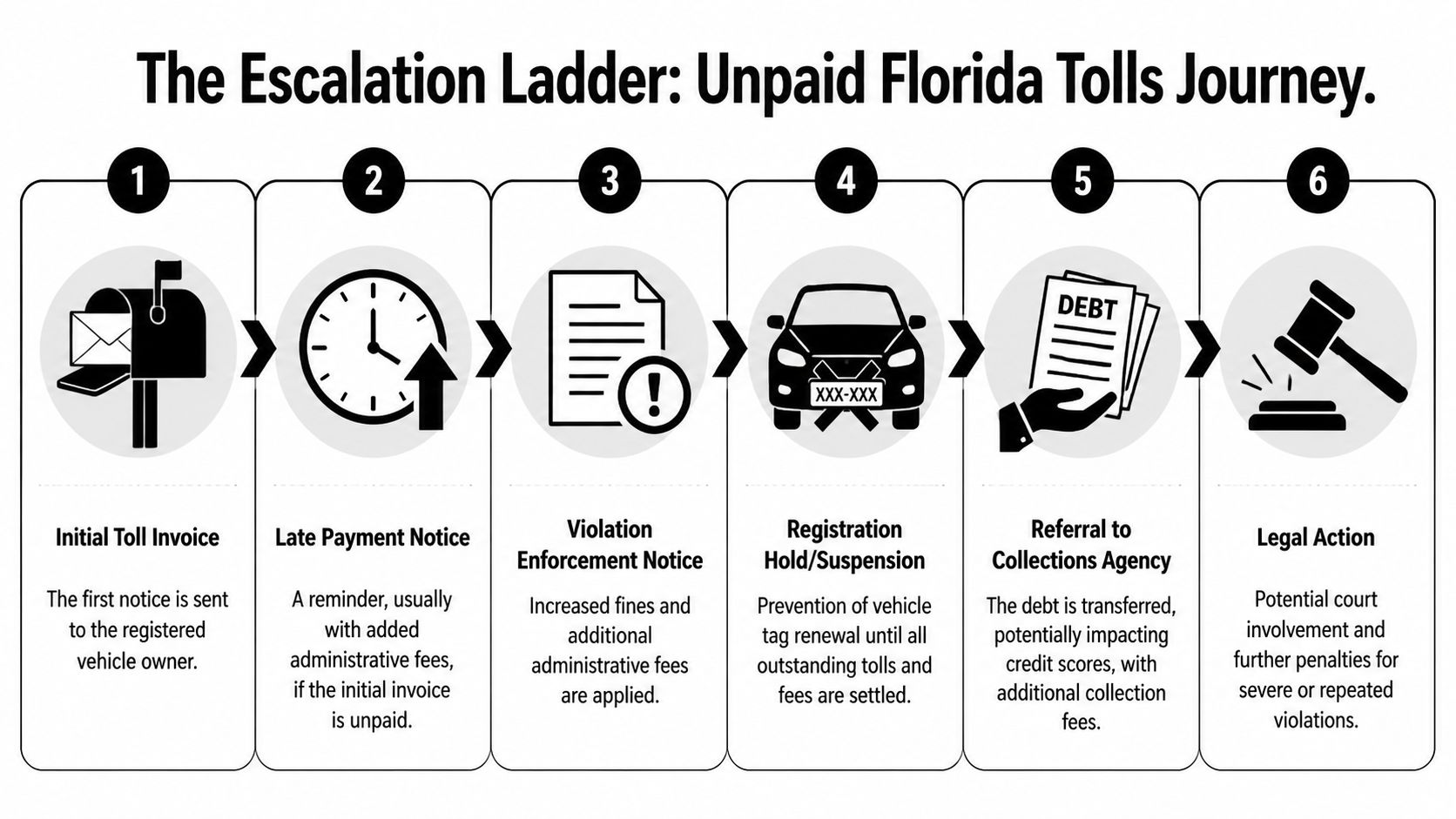
Florida toll enforcement follows an escalation path. Each step brings in more pressure, more agencies, and usually more cost.
The process usually starts with a mailed invoice
The first stage is the Toll Enforcement Invoice sent to the registered owner. This is the point where the system is still functioning like a billing process. You�re being told a toll was recorded, payment wasn’t resolved through a transponder account, and the matter now needs your attention.
If the invoice isn’t paid by the due date, the issue doesn’t stop there. A later notice may follow, and continued inaction can move the matter out of ordinary toll billing and into formal enforcement.
The cost jumps when a formal citation is issued
Once unpaid tolls move past the invoice stage, the financial risk changes sharply. According to this summary of Florida unpaid toll penalties, court assessments require a $100 fine per unpaid toll, and the total can reach approximately $262 per violation when the toll amount and administrative fees are included.
That number catches drivers off guard because they remember a small original toll. The system they�re facing now is no longer a simple toll collection issue. It has become a citation and court matter.
Here�s the practical timeline many drivers need to understand:
-
Initial invoice arrives
This is your best chance to resolve the matter quickly. -
Follow-up notice appears
The tone gets more urgent, and the account is already moving deeper into enforcement. -
A formal citation can be issued
At this point, the court system may become involved. -
Collection activity may begin later
If the debt remains unresolved, outside collection efforts can add stress and more fees.
Who gets involved as things get worse
At the start, you�re mainly dealing with a toll agency and its billing system. Later, other parts of the state enforcement structure may become involved, including motor vehicle and court processes.
That�s why drivers often feel lost. The paperwork may come from different entities, and each document can look like it belongs to a different problem. In reality, it’s usually one unresolved toll issue moving through a chain of enforcement.
Once a toll issue becomes a citation, don’t treat it like a customer service complaint. Treat it like a deadline-driven traffic case.
If your unpaid toll has already been referred beyond the original billing stage, it helps to understand how collection pressure works in general. Superior Credit Repair’s collection guide gives a useful plain-English overview of how to deal with collection companies, what to document, and why quick organization matters.
One point that confuses drivers is timing. They wonder whether an old notice can still matter or whether delay somehow fixes the problem. It usually doesn�t. If you want context on how traffic-ticket timing questions work more broadly, this explanation of the statute of limitations on traffic tickets can help you frame the issue.
The real mistake is waiting without checking
Some drivers ignore a notice because they believe it must be an error. Others wait because they plan to deal with it �when things calm down.� The risk with both choices is the same. The system keeps moving while you�re doing nothing.
A better approach is simple:
- Open every notice right away
- Match the plate, dates, and roadway
- Check whether the matter is still just an invoice or already a citation
- Pay or dispute it before another agency gets involved
That�s the difference between solving a toll problem and inheriting a larger legal and financial one.
Severe Consequences of Unpaid Florida Tolls
At a certain point, the issue stops being annoying paperwork and starts interfering with your ability to drive legally and keep your vehicle current.
That�s why unpaid tolls deserve a faster response than many drivers give them.
Registration problems are one of the harshest outcomes
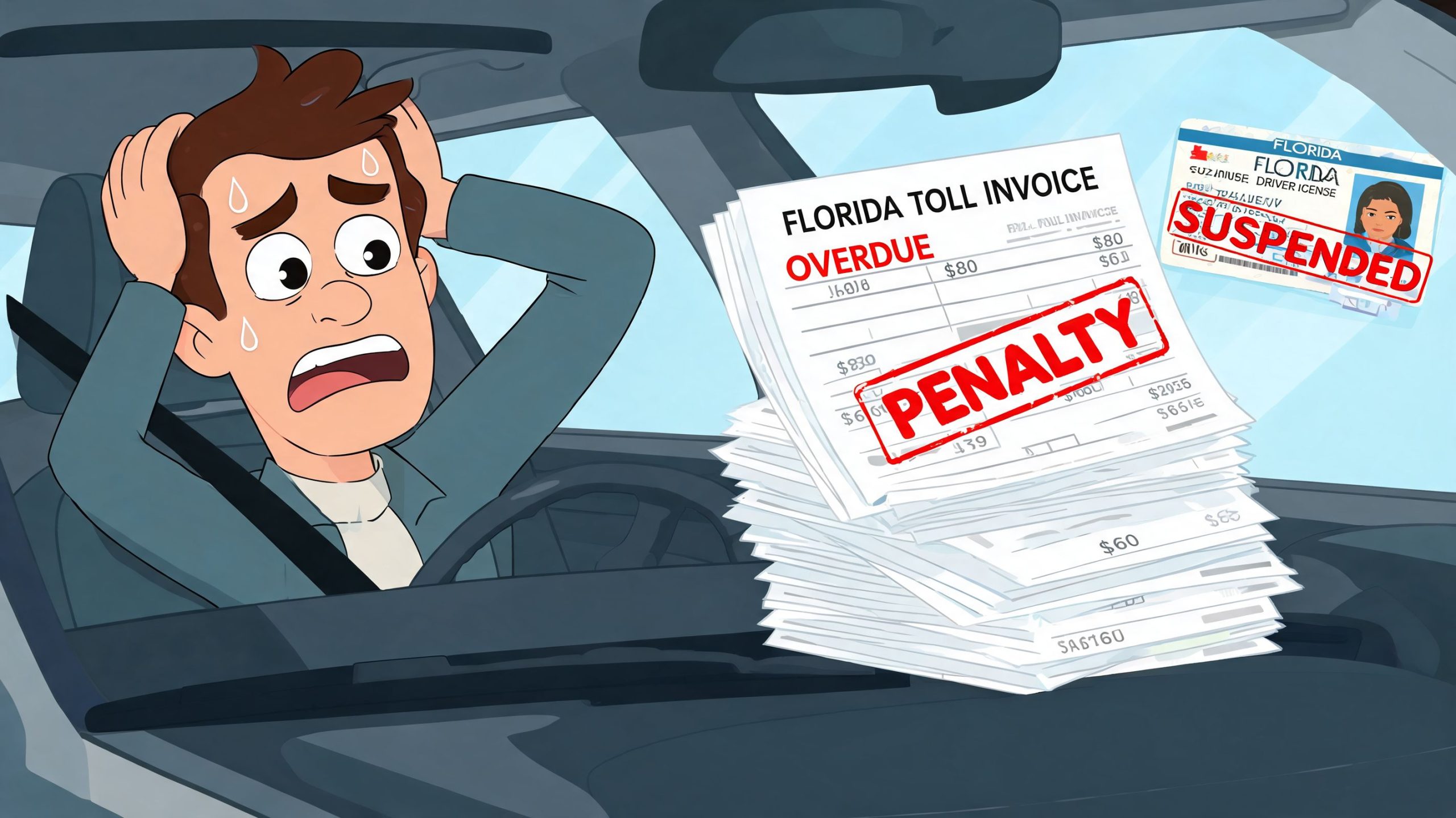
A toll invoice can eventually lead to a Vehicle Registration Stop or similar registration-related hold. In practical terms, that means you may not be able to renew your tag until the outstanding toll matter is cleared.
For many drivers, this is the moment the problem becomes real. The unpaid toll may have started as mail you set aside on the kitchen counter. Later, it affects your registration status and creates a scramble before renewal deadlines or other motor vehicle transactions.
If you�ve already run into a larger licensing issue tied to unresolved traffic matters, BDISchool�s guide to driver’s license suspension in Florida helps explain how these problems can expand.
A toll case can become a moving violation issue
One of the most misunderstood parts of florida toll enforcement is that unpaid toll matters can become traffic citations with consequences for your driving record. That makes them very different from parking-style paperwork or ordinary monthly bills.
When a matter reaches citation level, the stakes change. You may be dealing with fines, court obligations, license points, and pressure to act by a firm deadline.
Here are the consequences drivers most often underestimate:
-
Your registration can be blocked
That can affect renewals and create a separate headache beyond the toll itself. -
Your driving record can be affected
Once the issue becomes a moving violation, the problem reaches beyond money. -
Collection pressure can continue
Even after you realize the problem is serious, old balances can still be pursued.
Managed lanes can be even less forgiving
Managed express lanes operate under stricter rules. On 95 Express, for example, transponder use is required and TOLL-BY-PLATE is not allowed. According to the 95 Express violations and enforcement page, a non-transponder vehicle can face a $25 daily violation charge in addition to tolls and administrative fees, and the Florida Highway Patrol handles enforcement.
That�s a different environment from a driver receiving a mailed plate-billed invoice on another toll facility. It�s one reason drivers can’t assume all toll roads work the same way.
If you drove on an express lane, verify the specific road rules before you assume a mailed payment option was available.
Why unresolved toll debt can keep following you
Once a toll matter has moved into enforcement or judgment-related collection territory, the issue can become more complicated than the original road charge. For readers who want a broader understanding of how collection and enforcement can continue after legal action, this guide for businesses on judgment enforcement gives a helpful overview of the collection mindset and why unresolved obligations don’t fade on their own.
The big takeaway is simple. A toll violation is easiest to fix when it�s still just a bill. It becomes much harder once it begins affecting registration, driving status, or formal enforcement records.
Your Action Plan How to Check Pay and Dispute Tolls
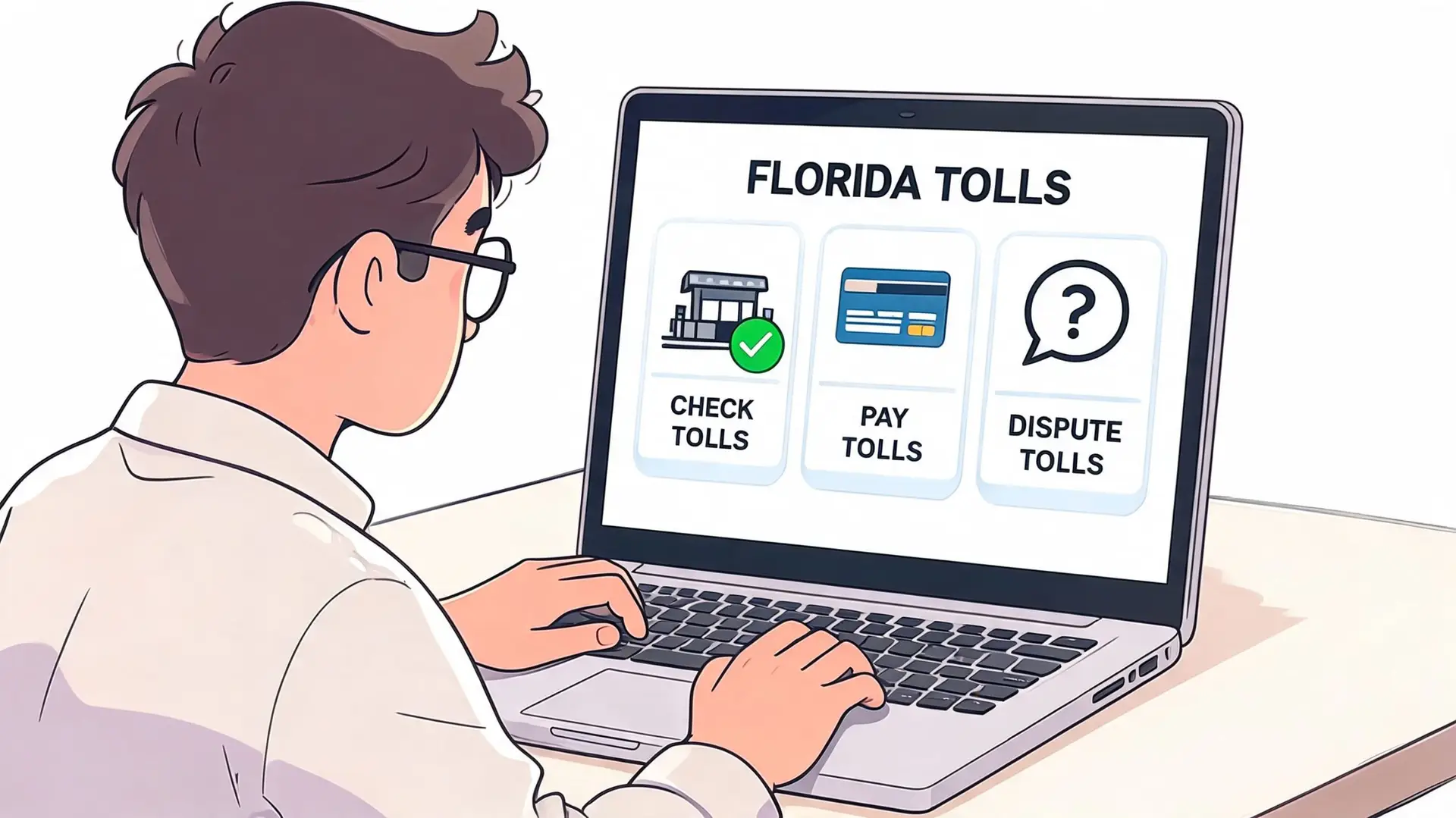
If you�ve got a notice in hand, or you suspect a toll issue may be sitting in the system under your plate, don’t start with worry. Start with verification.
The right next move depends on one question. Are you dealing with a valid charge, a billing issue, or a true dispute?
Step one check what the notice actually says
Read the document slowly. Drivers often miss the difference between an invoice, a later notice, and a traffic citation because they all look official and stressful.
Check these details first:
-
Vehicle information
Make sure the plate number and vehicle description match yours. -
Travel date and roadway
Ask yourself whether you, a family member, an employee, or another authorized driver used that road. -
Notice type
Look for language that tells you whether this is still a billing notice or whether it has escalated. -
Amount due and due date
Those two lines usually determine how urgent your response needs to be.
If the paperwork mentions a citation number and you need help figuring out what record you�re looking at, this guide to citation number lookup in Florida can help you decode the document trail.
Step two decide whether to pay or dispute
Once the notice is confirmed, most drivers fall into one of two categories.
You likely need to pay if
- The plate is yours and the trip happened
- Your transponder account had an issue
- You used a toll road but assumed it had already been covered
- You borrowed or lent the vehicle and the owner received the notice
In these cases, speed matters. Paying early usually keeps the matter from moving further up the enforcement ladder.
You may have grounds to dispute if
- The vehicle had been sold before the toll date
- The plate was stolen or misused
- The vehicle information doesn’t match
- You have records showing the charge belongs to another situation
A dispute works best when it’s supported by documents, not just a statement that the charge seems wrong.
Step three gather proof before you contact anyone
Drivers often call first and search for proof later. Reverse that order.
Collect anything that supports your position, such as:
| Situation | Helpful record |
|---|---|
| Vehicle sold | Bill of sale or transfer records |
| Plate issue | Theft report or supporting correspondence |
| Wrong vehicle | Registration details showing mismatch |
| Account confusion | Transponder account records or payment history |
Keep copies of every notice, screenshot, confirmation number, and email. Toll disputes are much easier when your timeline is organized.
Step four use official channels and avoid panic payments
Many drivers make a second mistake after receiving a notice. They rush to pay through the first message that mentions a toll. That’s dangerous, especially with scam texts and unofficial payment links circulating.
Use the official toll authority or customer service route tied to your notice. If you�re unsure, go directly to the official provider rather than clicking a random message link or relying on a text.
This short video gives a helpful visual walkthrough for drivers trying to handle toll matters online:
Step five confirm the matter is closed
Paying or disputing isn’t the last step. You need confirmation that the system reflects your action.
After payment or a dispute submission:
- Save the confirmation page
- Watch for follow-up email or mail
- Check whether any later notice still arrives
- If the issue had escalated, verify that no hold or citation remains unresolved
This last step is where busy people get tripped up. They pay, assume everything is over, and then months later discover a related record was never fully cleared.
If your goal is to protect your license and avoid extra trouble, don�t stop at �I paid it.� Stop at �I confirmed it was resolved.�
Resolving Violations and Protecting Your Driving Record
Some readers are past the invoice stage already. The toll matter has become a Uniform Traffic Citation, and now the question isn’t just how to pay it. The primary question is how to limit the damage to your driving record.
That�s where many online guides stop helping. They explain the billing process but say very little about the driving-record side of the problem.
Why traffic school becomes part of the conversation
Under Fla. Stat. 316.1001, toll nonpayment is a noncriminal traffic infraction that is punishable as a moving violation. This summary of Florida Statute 316.1001 highlights the key unanswered issue many drivers care about most. Whether a Basic Driver Improvement course can be used to dismiss the points tied to a toll-related citation.
That matters because once a toll issue becomes a moving violation, you�re no longer deciding only how to clear a balance. You�re deciding how to protect your license and reduce the chance of longer-term insurance consequences.
A paid citation and a protected driving record are not always the same thing. Drivers need to think about both.
The strategic move after a toll citation
If your toll matter has already reached citation status, traffic school may be the smartest path to explore. Not because it makes the ticket vanish from history, but because it may help you avoid points being added in the usual way when you handle the case properly.
The practical logic is simple:
-
Points can create problems beyond the ticket itself
Drivers often focus on the immediate payment and forget the record impact. -
Traffic school can be a defensive decision
You’re trying to stop a short-term mistake from becoming a long-term cost. -
Florida treats toll citations differently than many people assume
Since the issue can function as a moving violation, the usual traffic-school question becomes relevant.
What drivers should do before assuming they qualify
This is the area where details matter. Court handling can vary by county, and toll citation paperwork can create confusion. Before you elect any course option, confirm the procedure with the clerk or the instructions attached to your citation.
Ask direct questions:
- Is this citation eligible for a traffic school election?
- What deadline applies to that election?
- How should proof of completion be submitted?
- Does the court require any additional form or fee with the election?
A patient, organized approach works best here. Drivers get into trouble when they enroll in a course first and verify court acceptance later.
Why this step protects more than your current case
From an instructor�s perspective, this is the most important mindset shift. Don�t think only about �getting through� the notice. Think about preserving your ability to drive without extra complications later.
A toll citation that touches your record can affect more than one week of your life. If traffic school is available to you, it may be the cleanest way to contain the fallout and move on with less risk.
Frequently Asked Questions About Florida Tolls
Drivers usually understand the basic idea once they�ve read the notice closely. The confusion remains in the edge cases. These are the questions people ask when the facts aren�t neat.
What if I was driving a rental car
Rental car tolls are often handled through the rental company�s own billing process. But if a toll matter wasn’t resolved that way, paperwork may still reach the registered owner first, which is usually the rental company, not you. If you’re dealing with a rental situation, review your rental agreement and any toll addendum carefully.
What if I wasn’t the person driving my car
That doesn’t automatically make the first notice disappear. TOLL-BY-PLATE and related notices are generally tied to the registered owner because the plate leads back to that owner record. If the case has escalated, the driving-responsibility question may matter more, so gather your documents early.
Can out-of-state drivers get pursued too
Yes, they can still face collection and enforcement efforts connected to unpaid toll use in Florida. Even if you live elsewhere, treating the notice casually is risky. The safer approach is to verify the charge and resolve it directly.
How long do I have to pay
The exact deadline should be on your notice, and you shouldn’t guess at it. Florida toll enforcement matters are deadline-driven, so the paper in your hand controls your next step. If you�ve lost the document, contact the relevant toll authority directly and ask what status your plate shows.
Why is the amount higher than the toll I remember
Because the toll itself may only be the starting point. Depending on the stage of the matter, you may also be looking at an administrative charge, a later enforcement amount, or citation-related costs. The mistake many drivers make is comparing the current demand only to the original road charge.
Can I just wait for another notice before acting
You can, but it�s a poor strategy. Waiting gives the system more time to escalate the matter while reducing your simplest resolution options. If you already know the notice is real, acting early usually gives you more control.
I have a transponder. Why did I still get a toll notice
A transponder account can still create issues if the device wasn’t detected, the vehicle information didn’t line up, or the account setup wasn’t current. That�s why checking your account details matters even if you normally drive through toll roads without problems.
Are all Florida toll roads handled the same way
No. Some roads and managed lanes have special requirements. If you drove on an express facility, don’t assume the same mailed billing option applied there.
Is a toll text message safe to pay from
Be careful. If a payment demand arrives by text and pushes you to click immediately, verify the matter independently through the official toll authority connected to your notice or account. Never let urgency make you careless.
If I pay, am I done
Maybe, but don’t assume so. Save proof, watch for follow-up correspondence, and confirm that any related citation or registration issue is fully resolved. Closure means the record is cleared, not just that money left your account.
If your toll issue has already turned into a moving violation, don�t wait until points hit your license to look for options. BDISchool offers Florida-approved online traffic school courses designed to help drivers handle moving violations, protect their record, and complete requirements on a flexible schedule.