

Yes, in many states you can keep points off your license after a traffic ticket, but only if you act before the points are assessed. In most places, points are added when a ticket becomes a conviction, which usually happens when you pay the fine or are found guilty. The usual ways to stop that are to contest the ticket, to ask for diversion or deferral, or to elect a state-approved driver improvement course. If you are in Florida or Michigan, we offer that course online, and this guide shows what each state requires and where drivers lose the benefit by mistake.
Key Takeaways
- Points are normally added when the ticket becomes a conviction, so the choice you make in the first days after the ticket matters most.
- Florida, Michigan, Arizona and California all let eligible drivers complete a course so the points are not assessed. Rules on how often you can use it, which tickets qualify and the deadline differ by state.
- Missing the certificate deadline can bring the points back, along with extra fees or a suspension.
- Commercial license holders and drivers with criminal charges are usually excluded from these options.
- Points and insurance are separate systems. Even so, many states keep a course-completed ticket from insurers, and Florida limits premium increases for it.
Table of Contents
- Why the First Decision After a Ticket Matters
- Three Ways to Keep Points Off Your Record
- How the Rules Differ by State
- Preventing Points in Florida, Step by Step
- Preventing Points in Michigan
- Mistakes That Put the Points Back
- What Points Mean for Your Insurance
- How Long Points Stay and When They Trigger Suspension
- Ready to Enroll in a Florida Course
- FAQ
- Sources
Why the First Decision After a Ticket Matters
A traffic ticket is an accusation. Points come only after the state records a conviction. If you pay the fine without electing anything else, that payment usually counts as a plea of guilty or no contest, and the court reports it to the licensing agency.
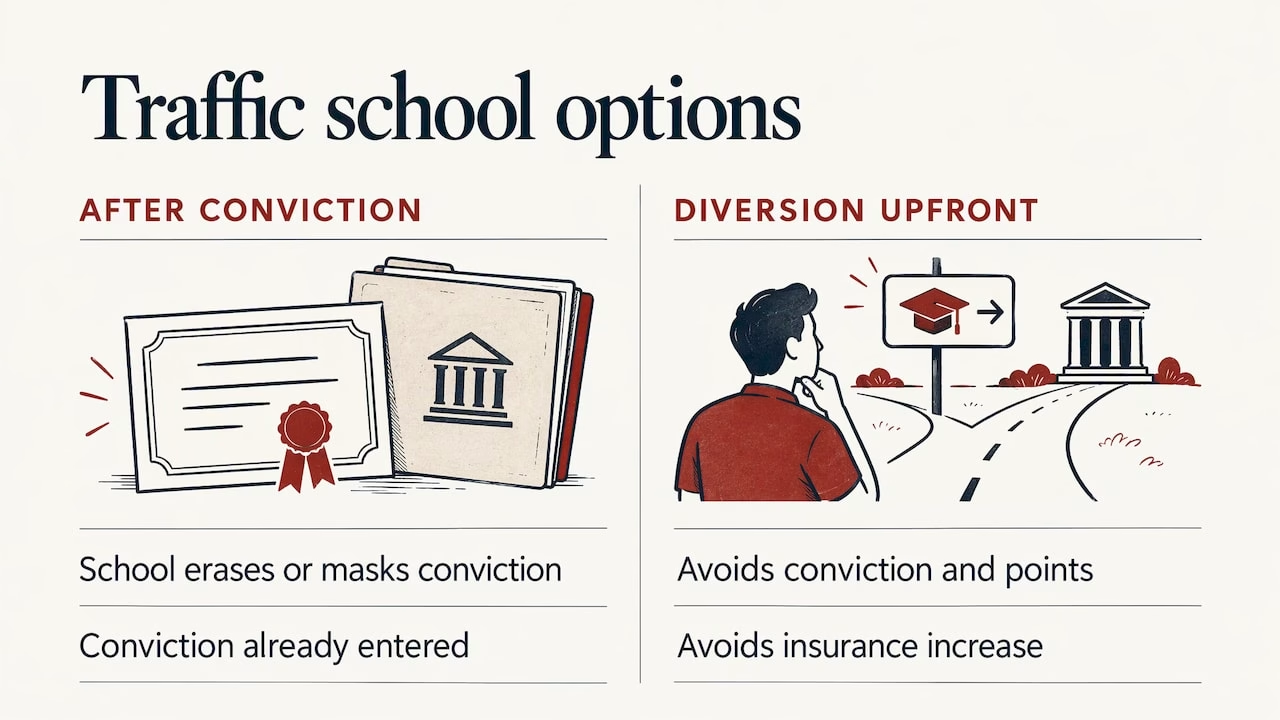
Law guides describe two broad models. In some states, completing traffic school erases or masks a conviction that has already been entered. In diversion-style states, choosing school up front avoids the conviction, the points and the insurance increase altogether. Which model applies to you depends on where you were cited, and that is why the first step is always to read the ticket and the court�s instructions.
The ticket itself usually lists a response deadline. Treat that date as the real clock. In several states the right to choose a course expires within days of the citation, long before the court date.
Three Ways to Keep Points Off Your Record
1. Contest the ticket
If the charge is dismissed, there is no conviction and no points. Dismissal can happen when the officer does not appear or the evidence is weak. This route takes time, may need a court appearance and carries the risk of a guilty finding.
2. Diversion or deferral programs
Some courts offer their own programs. Utah, for example, offers Deferred Traffic Prosecution, which keeps points off if you stay clean for a year. You must apply within 21 days, be 21 or older and hold a valid noncommercial Utah license. Programs like this carry strict eligibility rules and short application windows. Our guide to court diversion options for traffic violations explains how they compare with a course.
3. Elect a state-approved course
This is the most common route for drivers with an eligible non-criminal ticket. You pay the court�s required amount, choose the course option, finish an approved course and submit proof by the deadline. In return, the points are not assessed. Our overview of point dismissal options walks through how the choices line up.
How the Rules Differ by State
The same idea works very differently from state to state. Here is what official pages say.
| State | What the course does | Key limits |
|---|---|---|
| Florida | Withholds adjudication, so no points are assessed | Once in any 12 months, no more than eight times in a lifetime; criminal violations and CDL holders excluded |
| Michigan | State adds no points and does not show the ticket to insurers | 2 or fewer points on your record, ticket worth 3 or fewer points, complete within 60 days of the eligibility notice, one time only |
| California | Point stays off the DMV record | Noncommercial ticket, no traffic school in the last 18 months; equipment and alcohol or drug tickets do not qualify |
| Arizona | No points, citation dismissed | No diversion course in the past 12 months, eligible citation, finish at least 7 days before the court date |
| New York | Subtracts up to 4 points for suspension calculations only | Points stay on the record for up to 4 years; once per 18 months |
| North Dakota | Up to 5 points not added | Notify the clerk within 14 days of the citation, certificate to the state within 30 days, once per 12 months |
| Ohio | Earns a 2-point credit, which does not remove points | Once in any 3-year period, up to five times in a lifetime |
Two lessons stand out. First, �prevent� and �reduce� are different promises. Florida, Michigan, California and Arizona stop points from being assessed. New York and Ohio use the course to give you more room before a suspension, and the points themselves can stay. Second, every state has a limit on how often you can use the option, so using it on a small ticket can leave you without it when a bigger one arrives.
If your state is not in the table, your court clerk or the state licensing agency�s website is the authority that sets your deadline. Confirm your eligibility there before you pay anything.
Preventing Points in Florida, Step by Step
Florida�s licensing agency says any driver charged with a moving or non-moving violation that would add points may elect a driver improvement course, except for criminal violations and CDL holders. Here is the routine.
- Read the citation. Check that it is a civil infraction, not a criminal charge, and note the deadline on the ticket. Camera-based red-light, toll and certain other violations are excluded in some counties. Miami-Dade�s clerk, for example, lists those exclusions.
- Check your eligibility. You may elect a course once in any 12-month period and no more than eight times in a lifetime. Miami-Dade describes a 4-hour course as available once every 12 months and up to five times in a lifetime, with an 8-hour course once if you are not eligible for the 4-hour class.
- Pay the civil penalty and elect the course with the clerk. The court still collects its fine. The course does not replace it.
- Choose a state-approved course. Our Florida Basic Driver Improvement course is $30 and is state-approved. It runs fully online, on any device, at your own pace.
- Finish within the court�s time. Miami-Dade gives 120 days from payment or court appearance. Other counties may differ, so use the date your own clerk gives you.
- Make sure the completion is on file. If you pay the fine and then fail to attend within the court�s time, the infraction is adjudicated guilty and points are added.
Where a driver goes wrong is almost always timing. The ticket sits in a drawer, the deadline passes and the points go on the record. Starting the course as soon as you elect it removes that risk. For a Florida-specific walkthrough, see our guide on how to avoid points on your license in Florida and our explanation of points on your driving record in Florida.
Preventing Points in Michigan
Michigan works through the Secretary of State. If you hold a valid noncommercial Michigan license with 2 or fewer points, and your ticket is worth 3 or fewer points, is not criminal and was not in a commercial vehicle, you may be eligible to take the Basic Driver Improvement Course. Passing it means the state adds no points and the ticket is not shown to insurance companies.
Three details matter:
- You must finish within 60 days of the eligibility notice.
- You may pass the course only once, ever.
- You still owe the court fees and fines.
Because it is a once-in-a-lifetime option, use it deliberately. Our Michigan Basic Driver Improvement Course page covers enrollment, and the Michigan page lists what we offer there.
Mistakes That Put the Points Back
- Paying the ticket and forgetting the course. In Florida, paying the fine without attending in time turns the infraction into a guilty adjudication with points.
- Missing the certificate deadline. Miami-Dade warns of suspension, point assessment and extra fees when proof is late.
- Choosing the wrong option. In North Dakota, electing the course means you give up the separate point-reduction option under state law.
- Assuming every ticket qualifies. Criminal charges, commercial vehicles and certain equipment or alcohol-related tickets are commonly excluded.
- Holding a commercial license. A federal rule, 49 C.F.R. �384.226, bars CDL holders from using traffic school to dismiss or mask a ticket.
- Using the option too early. Because most states limit it to once every 12 to 18 months, a minor ticket can use up the option you need later.
If you are unsure whether you qualify, call the clerk of court named on your ticket. Eligibility is decided by the court and the state, not by the course provider.
What Points Mean for Your Insurance
Points and insurance are two systems. New York�s DMV stresses that its points and insurers� own point systems are separate, so a point reduction on the record does not change what an insurer assigns.
Still, keeping the ticket from becoming a conviction has a direct insurance benefit in several states:
- In Florida, when you complete a course, insurers cannot raise your premium or refuse renewal solely because of that non-criminal infraction. The exceptions are a second infraction within 18 months, a third within 36 months, or speeding more than 15 mph over the limit.
- In Michigan, the ticket is not shown to insurers after you pass.
- In Arizona, completing the course means your insurance rate does not go up because of the citation.
- In New York, the PIRP course gives a separate 10% discount on base auto premiums for three years, and you must retake it every 36 months to keep it.
Drivers 55 and older in Florida have another route to savings. Our Florida Mature Driver Insurance Discount course is $14.50.
How Long Points Stay and When They Trigger Suspension
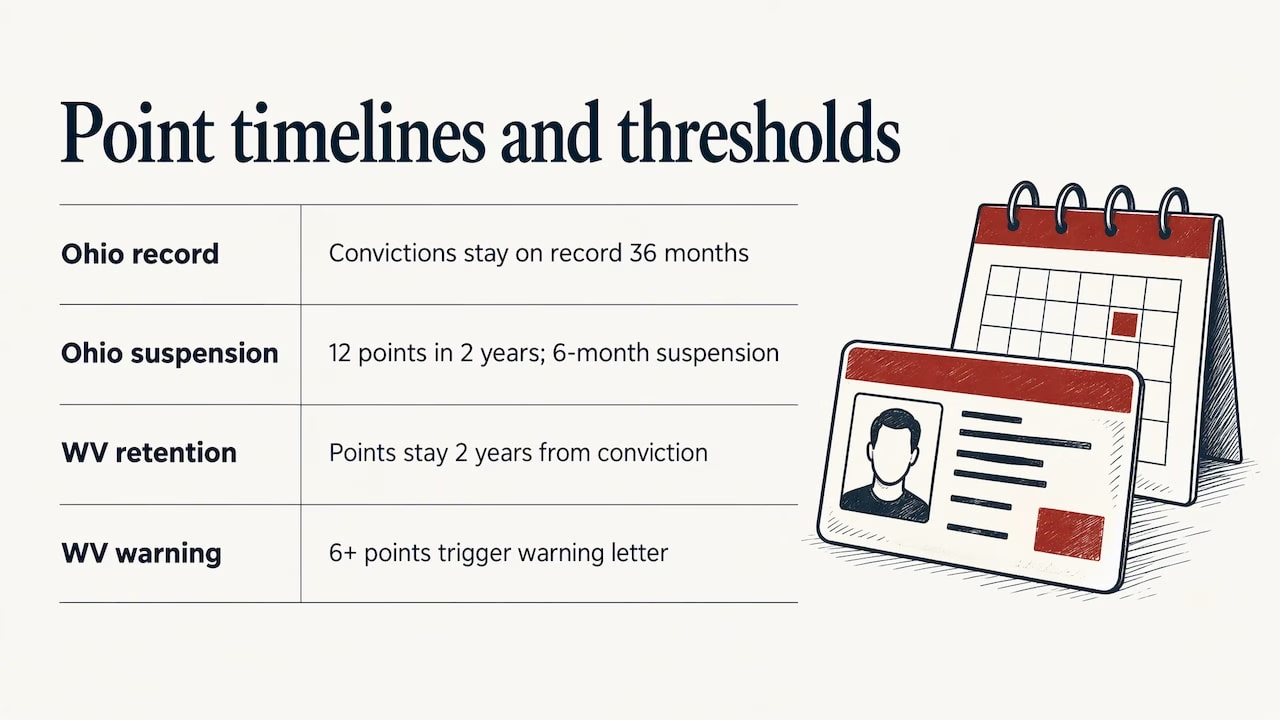
Points do not last forever, but they last long enough to matter. Ohio�s BMV says convictions stay on the driving record for 36 months, and that 12 points within two years brings a six-month suspension. West Virginia keeps points for two years from conviction, and 6 or more points trigger a warning letter. Thresholds differ by state, so check your own state�s agency for your number.
That is the strongest argument for stopping points at the start. A course taken before the conviction costs less and takes less effort than recovering from a suspension, which in Ohio means a remedial course, a new license exam, proof of financial responsibility and a $40 reinstatement fee.
Our Perspective
We build our courses in-house, with certified educators and safety specialists, and we keep them aligned with the statutory requirements of the states we serve. When a driver contacts us after a ticket, the question is almost never about the content. It is about timing and eligibility: will the course count, and will it be on file before the deadline?
That is why we publish our prices openly and stand behind our courses with a money-back guarantee and no hidden fees. You should know what you are paying before you elect anything with the court. Our courses work on a phone, a tablet or a computer, and our multilingual read-along feature lets drivers follow along in the language they are most comfortable with. You can stop and return at your own pace.
Our view is simple. A ticket does not have to become points on your record if you use the option your state gives you and complete a state-approved course in time. We designed our Florida and Michigan courses to make that step straightforward.
the author
Ready to Enroll in a Florida Course
If your ticket was issued in Florida and you have elected a driver improvement course with the clerk, our Florida Basic Driver Improvement (BDI) course is $30. It is state-approved, runs online and comes with our money-back guarantee. Other Florida courses are listed on the same page, including the Driver Education Traffic Safety Course (DETS) at $29.90 and the Wireless Devices Distracted Driver Course at $24.50.

If you were cited in Michigan, start with the Michigan page. If you manage drivers for a business, we also build a custom fleet safety course.
FAQ
Can you prevent points from being added after a traffic ticket?
Often, yes. In states such as Florida, Michigan, California and Arizona, an eligible driver can complete a state-approved course so the points are not assessed. You have to elect the option and finish on time. The rules on eligibility, how often you can use it and the deadline are set by your state and court.
Will 3 points affect my insurance in Florida?
If you complete a driver improvement course for an eligible non-criminal ticket, Florida�s licensing agency says insurers cannot raise your premium or refuse renewal solely because of that infraction. The exceptions include a second infraction within 18 months, a third within 36 months, or speeding more than 15 mph over the limit. Without the course, points can be recorded and insurers may see the violation.
Can I get points removed from my license in Ohio?
Ohio does not remove them through a course. A driver with 2 or more points can take a remedial driving class to earn a 2-point credit, once in any 3-year period and up to five times in a lifetime. The credit raises the number of points you can carry before the 12-point suspension applies.
How long do points stay on your record?
It depends on the state. Ohio keeps convictions on the record for 36 months, and West Virginia keeps points for two years from conviction. Your state�s licensing agency can tell you the exact period.
Can I take a course if I have a commercial driver�s license?
Generally no, not to dismiss or mask a ticket. Florida excludes CDL holders from the driver improvement option, and federal rules bar CDL holders from using traffic school this way. Talk to the court clerk named on your citation about your options.
Sources
- Driver Improvement Courses FAQ, Florida Department of Highway Safety and Motor Vehicles
- Basic Driver Improvement Course, Michigan Secretary of State
- Traffic School, Miami-Dade Clerk
- Traffic school, California Courts Self Help Guide
- Frequently Asked Questions, Arizona Courts
- Point and Insurance Reduction Program, NY DMV
- How To Take A Driver Training Course Instead Of Points, North Dakota Courts
- Deferred Traffic Prosecution, Utah Courts
- Types of Suspensions, Ohio Reinstatement Handbook
- Ohio BMV driving record guidance
- Point System, West Virginia DMV
- Using Driving School to Dismiss a Ticket and Reduce Fines, Nolo
Recommended
- 7 Ways to Reduce Points on Your Driving Record
- Understand License Points and Protect Your Record
- How to Avoid Points on License in Florida
- Point Dismissal Options: Ways to Clean Your Driving Record
This article is provided for general information and is not a professional advice.