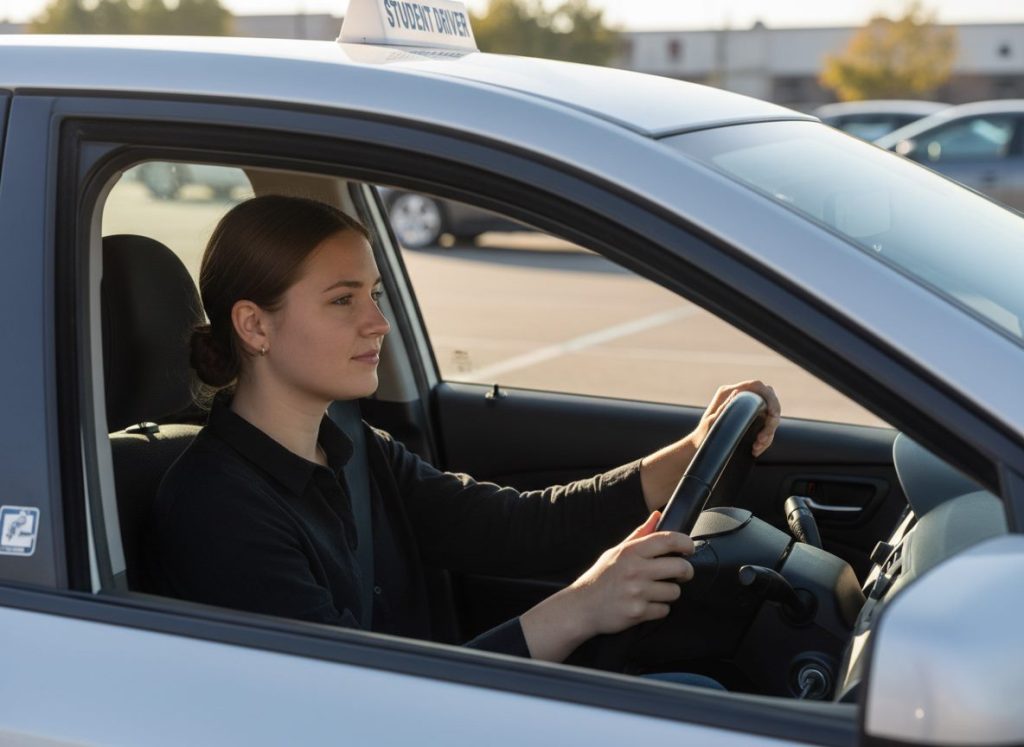
The Florida road test is the Class E Driving Skills Test. You take it with an examiner in a real vehicle, and you must pass it to earn a standard Florida driver license. The examiner watches how well you control the car and obey traffic laws.
This guide explains who takes the test, what the examiner scores, what your vehicle needs and what to do if you fail. Rules change, so confirm current details on the FLHSMV (Florida Department of Highway Safety and Motor Vehicles, often called the Florida DMV) website before you book.
Key Takeaways
- Florida calls its road test the Class E Driving Skills Test, and you must pass it to get a standard driver license.
- Teens under 18 must hold a learner’s license for 12 months (or until age 18) and log 50 hours of supervised driving, 10 of them at night.
- Your vehicle needs a valid registration, proof of insurance and a passed safety inspection, or the examiner will not give the test.
- The test covers set maneuvers such as the three-point turn, parking on a grade, backing up and keeping a safe following distance.
- If you fail, a retest fee applies, so practice the maneuvers and read the official handbook before your appointment.
- Out-of-state license holders moving to Florida may have the skills test waived, so check your situation with FLHSMV first.
Table of Contents
- What is the Florida road test?
- Who has to take the Florida road test?
- What do teens need before the road test?
- What does the examiner check during the Florida road test?
- What vehicle can you use for the road test?
- Where can you take the Florida road test?
- What happens if you fail the Florida road test?
- How can you prepare for the Florida road test?
- Does the road test change after you get your license?
- Our Perspective
- FAQ
- Sources
What is the Florida road test?
The Florida road test is the Class E Driving Skills Test. FLHSMV describes it as a series of maneuvers that show whether you can operate a motor vehicle safely. You must pass it to obtain a Class E driver license.
Florida law backs this up. Under s. 322.12, Florida Statutes, the Class E exam includes an actual demonstration of your ability to exercise ordinary and reasonable control of a vehicle.
Class E covers regular passenger cars and light trucks. Commercial licenses have a different, longer skills process. You can read more in our CDL (commercial driver license) test guide.
Who has to take the Florida road test?
Most first-time license applicants must take it. That includes teens moving from a learner’s license to a full license and adults getting their first Florida license. Some drivers with a valid license from another state may not need to.
According to the Official Florida Driver License Handbook, the knowledge and skills exams are waived if you present a valid license from a US state, a US territory or the US military. Section 322.12 also lets the department waive the tests when you surrender a valid license from another state or a Canadian province, for an equal or lesser license class.
If you hold an out-of-state or foreign license, remember that the rules above apply to Florida licensing. Confirm your exact situation with FLHSMV before you assume a waiver.
What do teens need before the road test?
Teens must hold a learner’s license for 12 months or until age 18, whichever comes first. They also need 50 hours of supervised driving, with 10 of those hours at night. A parent or another adult over 21 certifies the hours.
FLHSMV lists these requirements for teens, including a minimum age of 16 for the driver license. The same page notes that a teen should have no moving violation convictions for one year from the learner’s license issue date, unless adjudication was withheld.
A moving conviction can delay things. FLHSMV explains that the one-year holding period can extend for another year from the date of the conviction, or until age 18.
Steps before you book the road test
- Complete the required driver education course. Teens take DETS (Driver Education Traffic Safety); adults take TLSAE (Traffic Law and Substance Abuse Education).
- Pass the vision and hearing screening and the Class E Knowledge Exam to get your learner’s license.
- Drive with a licensed adult 21 or older in the seat to your right. Section 322.1615 requires this at all times.
- Log your 50 supervised hours, including 10 at night.
- Gather your identity, Social Security number and address documents.
Our guides to the Florida learner’s permit and permit test requirements cover the earlier steps in more detail.
What does the examiner check during the Florida road test?
The examiner scores a set list of maneuvers and watches your general control and obedience to traffic laws. You are not trying to drive perfectly. You are showing safe, predictable habits the whole way through.
The FLHSMV skills test page lists these maneuvers:
| Maneuver | What the examiner wants to see |
|---|---|
| Three-point turn | You turn the car around in a 20 to 40 foot space. |
| Approach of crossing | You get in the proper lane and look in each direction. |
| Yield right-of-way | You let pedestrians cross, stop for emergency vehicles and avoid blocking traffic. |
| Straight-in parking | You center the car in the space with no part in the traffic lane. |
| Parking on a grade | You park correctly uphill and downhill, with and without a curb. |
| Stop quickly | You make a quick, safe stop when the examiner tells you to. |
| Passing | You look ahead and behind before you pass. |
| Proper lane | You stay in the right lane unless on a one-way street, and change lanes only when safe. |
| Safe following distance | You keep a minimum following distance of four seconds, per the FLHSMV page. |
The handbook adds a few more items. You back up 50 feet at a slow speed while looking to the rear, without relying on the mirror or camera. You also signal your turn for the last 100 feet, and you keep both hands on the wheel without resting an elbow in the window.
Because the handbook and web page word the following distance slightly differently, check the current handbook before test day.
What vehicle can you use for the road test?
You must bring your own vehicle. It needs a valid registration, proof of insurance and a passing basic safety inspection by the examiner. If the car fails the inspection, the examiner will not give the test, and you may lose your appointment.
FLHSMV says the test will not be given if the examiner finds problems such as these:
- A defective horn, rear-view mirror, turn signals, steering wheel, brakes, tires, brake lights or taillights
- No windshield wiper on the driver’s side or no working headlights
- Cracked or broken glass that blocks your view
- An expired tag
- Doors that do not open from both inside and outside, or seats that are not fixed in place
- A low-speed vehicle, meaning a top speed of 20 to 25 miles per hour
Walk around the car a few days early. Test every light, signal and wiper. Check the tag date. Our Florida driving test checklist and the shorter 8-point checklist can help you do this.
Where can you take the Florida road test?
You have several options. You can take the Class E Driving Skills Test at a driver license service center, with an approved third-party administrator, or through a high school driver education class that offers it. Availability depends on your area.
The FLHSMV page names these options, including the Driver Education Licensing Assistance Program (DELAP). Many high school driver education classes take part. Ask your local school whether it does.
FLHSMV also notes that some offices work by appointment only, while others accept walk-ins. Check your office before you go. Our guide to how to schedule a DMV road test walks through booking.
One more detail matters if you test through a third party. Under s. 322.56, FLHSMV may randomly select you for a no-fee retest at a driver license or tax collector office. You get your license after you pass that retest.
What happens if you fail the Florida road test?
You can try again, but a fee may apply. Florida law sets a fee for each skills test after the first failed attempt. Use the time between tries to practice the maneuvers you missed, then rebook once you feel steady.
The Florida Statutes, s. 322.12 state that an applicant who fails the initial skills test pays a $20 fee for each subsequent test, as of the 2023 statutes. Fees can change, so confirm the current amount with FLHSMV or your tax collector office.
Third-party rules add limits. According to the FLHSMV administrator agreement, an applicant may take the skills exam only once in a 24-hour period. After a third failed attempt, the applicant must test at a driver license or tax collector office.
The agreement also treats it as an automatic failure if the examiner has to use an instructor brake. In other words, if the examiner has to step in, you fail that attempt.
How can you prepare for the Florida road test?
Practice the exact maneuvers, drive in varied conditions and study the official handbook. Repetition builds the calm, smooth habits examiners want to see. Start well before your appointment, and do not skip the night hours.
Here is a simple plan:
- Read the Official Florida Driver License Handbook.
- Practice three-point turns, straight-in parking and parking on a grade in an empty lot.
- Back up 50 feet while looking over your shoulder, not at the camera.
- Count four seconds behind the car ahead on real roads.
- Drive the same area as your test center, so the streets feel familiar.
BDI School offers online driver education courses, including DETS for first-time drivers under 18 and TLSAE for first-time drivers 18 and older, in English, Spanish and Portuguese.
For extra study help, see our guides to how to pass the driving test in Florida and the behind-the-wheel test. You can also try a free practice test to check your rules knowledge.
Does the road test change after you get your license?
Passing the road test does not end the rules. Teens still face curfews and point limits, and every driver should keep learning. A clean record also keeps your costs and license status in better shape.
For example, FLHSMV states that a teen who gets six points within 12 months is restricted to Business Purposes Only for 12 months or until age 18. Extra points extend that restriction by 90 days each.
If you later earn a ticket, learn your options early. Our speeding in Florida guide explains how points and insurance can be affected.
Our Perspective
We see many students treat the Florida road test as one scary event. It is not. It is a short, predictable list of skills, and the examiner tells you what to do. Most failed attempts come from small, avoidable problems such as an expired tag, a burned-out brake light or a rushed parking move.
Our advice is to prepare the car first and the driver second. Do a full walk-around, then practice each maneuver until it feels boring. Practice at the time of day your appointment is booked, so the light and traffic feel familiar.
We also encourage parents to treat the 50 supervised hours as real teaching time. Vary the roads, the weather and the time of day. A teen who has driven in rain, at night and on busy streets walks into the test with real confidence, not just test-day nerves.
� The BDI School team
If you or your teen still need the education course that comes before the Florida road test, you can review the DETS and TLSAE options online, in English, Spanish or Portuguese, at https://bdischool.com/courses/.
FAQ
How many questions are on the Florida road test?
The road test has no question list. It is a driving exam where the examiner scores set maneuvers and your overall control and obedience to traffic laws. The written part is the separate 50-question Class E Knowledge Exam, which you pass at 80 percent, according to FLHSMV.
Can I use a rental car for the Florida road test?
FLHSMV requires the vehicle to have a valid registration, proof of insurance and a passed safety inspection. A rental may or may not meet those conditions or the rental company’s own rules. Ask the test provider and the rental company before you book.
Can someone ride with me during the road test?
Usually not. Under the FLHSMV third-party agreement, only the applicant, the examiner and an interpreter, if needed, may be in the vehicle. A department representative performing official duties is the exception. Ask your test site about its own rules.
Do I need a road test if I move to Florida from another state?
Often you do not. The handbook says the skills exam is waived if you present a valid license from a US state, territory or the US military. FLHSMV says a new resident exchanging an out-of-state license passes only vision and hearing tests, so confirm your case with FLHSMV.
Sources
- Class E Knowledge Exam & Driving Skills Test – FLHSMV
- Licensing Requirements for Teens, Graduated Driver License Laws and Driving Curfews – FLHSMV
- Traffic Laws for Florida Teens – FLHSMV
- Florida Class E Driver License Handbook – FLHSMV
- General Information – FLHSMV
- Administrator Driving Skills Agreement – FLHSMV
- Teen Drivers – FLHSMV
- Section 322.12, 2025 Florida Statutes – The Florida Senate
- Section 322.12, Florida Statutes